
The Kansas City Chiefs lead the Las Vegas Raiders 76 wins to 56, with two ties, across 134 meetings since 1960, and they lead the rare playoff meetings 2-1. That reads like a Chiefs rivalry. For thirty years it was the opposite: the Raiders led the series as late as the 1980s, before the Chiefs went 18-3 against them in the 1990s and never handed it back. They next play on 4 October 2026.
It is one of the oldest rivalries in the sport, born in the first year of a rival league in 1960, and it is regularly named among the most bitter in the NFL. The rest of this page is how a series the Raiders once led by eleven games turned into one the Chiefs now lead by twenty.
Who leads, and by how much
Kansas City leads on every all-time count. Here is the full series, with the date it is current to.
Chiefs v Raiders, all-time series (through the 2025 season)
| Measure | Record |
|---|---|
| Total meetings | 134 |
| All-time series | Chiefs lead 76-56-2 |
| Regular season | Chiefs lead 74-55-2 |
| Postseason | Chiefs lead 2-1 |
| First meeting | 16 September 1960: Texans 34, Raiders 16 |
| Chiefs’ biggest win | 48-9 (2021) |
| Raiders’ biggest win | 41-6 (1968 playoff) |
| Chiefs’ longest winning run | 9 games (2003-2007) |
| Raiders’ longest winning run | 7 games (1975-1978) |
| Current run | Raiders, 1 game (2025-present) |
Source: Pro Football Reference, cross-checked against The Football Database game log and the series history. The two have tied twice, both in the 1970s. The Raiders’ largest win, 41-6, came in a 1968 playoff game.
A quick gloss on two of those rows. The regular season is the ordinary schedule every team plays. The postseason, or playoffs, is the knockout tournament at the end of it. These two have met only three times in the playoffs in 65 years, and Kansas City has won two, including the game that sent it to the first modern Super Bowl it would win. Hold on to the “current run” line, though: the most recent word in this series belongs to the Raiders, and how that happened is a story in itself.
How it started: 1960, and a brand-new league
They first played on 16 September 1960, and the Chiefs won 34-16. Except they were not the Chiefs yet. The club began life that year as the Dallas Texans, one of the eight founding members of the American Football League, the upstart competitor to the NFL. Their owner, Lamar Hunt, had started the whole league after being refused an NFL team. The Texans moved to Kansas City and became the Chiefs in 1963. The Raiders were founded the same year, 1960, as the AFL’s eighth team, added late to replace another city that pulled out.
So the rivalry is as old as professional football’s second league. The two have shared a division from that very first season, first the AFL West and, after the AFL and NFL merged in 1970, the AFC West (one of the league’s eight four-team divisions, the groups that decide the standings). Sixty-five years of two guaranteed meetings a year is a lot of history, and this pairing has more of it than almost any other.
Why these two can’t stand each other
Age is only part of it. Three other things turned a divisional fixture into a genuine feud.
The first is that they were the AFL’s two best teams early on, and they kept meeting with everything at stake. In 1968 both finished 12-2 and had to play an extra game just to decide the division, which the Raiders won 41-6. A year later the Chiefs got their revenge in the AFL Championship Game, 17-7, then beat the heavily favoured Minnesota Vikings in Super Bowl IV, the last game the AFL ever played. Two clubs settling the league between themselves, year after year, is how a rivalry gets its edge.
The second is a grievance that has nothing to do with football. In 1968 Kansas City’s baseball team, the Athletics, up and moved to Oakland. A US sports club can do that: there is no promotion or relegation, and a franchise (a club) can relocate to a new city, taking its name or picking a new one. Kansas City felt robbed, got a replacement baseball team, and had a fresh reason to resent Oakland. The football rivalry inherited all of it.
The third is simply reputation. The Raiders spent decades cultivating an outlaw image, and the games against Kansas City were among the most violent of their era. The rivalry is regularly listed among the most bitter in the league, and there is even a university-press book devoted to it. I am not going to call it the “greatest” or the “fiercest”, because those are impossible to prove and everyone claims them. What is true is that it is one of the oldest, one of the most one-sidedly reversed, and the source of one of the most famous rule changes in the sport. That last one deserves its own section.
One more oddity worth naming. These two are not neighbours any more. The Raiders left Oakland for Los Angeles in 1982, went back to Oakland in 1995, then moved to Las Vegas in 2020. The rivalry survived all of it, because it was never really about the map. It was about the division, the history, and the bad blood.
The eras: the rivalry that flipped
Here is the thing the 76-56 record hides completely. Break the series down by decade and it is not one rivalry at all. It is two, running in opposite directions.
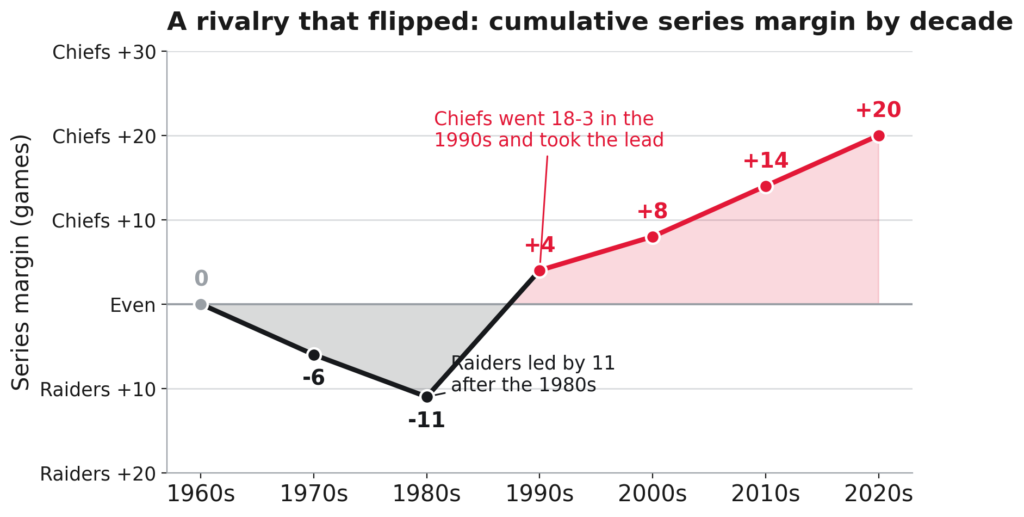
Chart Source: Cumulative series margin (Chiefs wins minus Raiders wins) at the end of each decade, all meetings included. Source: Pro Football Reference and The Football Database, current to the 2025 season.
The Raiders led this series for its first thirty years. They were ahead by eleven games at the end of the 1980s. Then the Chiefs went 18-3 against them in the 1990s, took the lead, and have stretched it every decade since, out to plus twenty.
That single decade, the 1990s, is the hinge of the whole thing. The Chiefs of that era, built around a ferocious defence and a run of playoff seasons, simply owned the Raiders, winning eighteen of twenty-one meetings. Everything before it belonged to Oakland; almost everything after it has belonged to Kansas City. The by-decade view shows the same story from the other side.
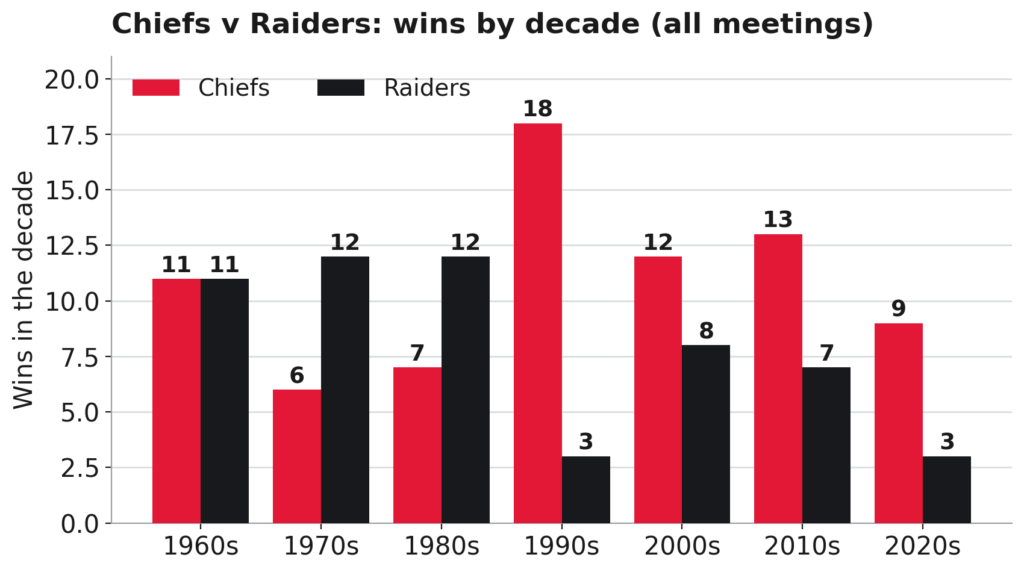
Chart source: Regular-season and playoff meetings, counted in the decade each was played; the two 1970s ties are not shown as wins. Source: Pro Football Reference and The Football Database, current to the 2025 season.
The Raiders won the 1970s and 1980s comfortably. From the 1990s on, every decade has gone to the Chiefs, most of them heavily.
Chiefs v Raiders, wins by decade (all meetings, including the three playoff games)
| Decade | Chiefs wins | Raiders wins | Chiefs’ running lead |
|---|---|---|---|
| 1960s | 11 | 11 | 0 |
| 1970s | 6 | 12 | -6 |
| 1980s | 7 | 12 | -11 |
| 1990s | 18 | 3 | +4 |
| 2000s | 12 | 8 | +8 |
| 2010s | 13 | 7 | +14 |
| 2020s | 9 | 3 | +20 |
“Running lead” is the Chiefs’ cumulative wins minus the Raiders’ after each decade. A minus sign means the Raiders were ahead. The two ties, both in the 1970s, are left out of the win columns, which is why the decade rows track wins only. Source: Pro Football Reference / The Football Database, current to the 2025 season.
The 1970 brawl that changed a rule
Every old rivalry has one afternoon that stands for all the others. This one happened on 1 November 1970, in Kansas City, and it changed the rulebook.
The Chiefs led 17-14 late in the fourth quarter. Quarterback Len Dawson ran for a first down that would have let Kansas City run out the clock and win. As he lay on the ground, well after the whistle, Raiders defensive end Ben Davidson dived into him helmet-first. Chiefs receiver Otis Taylor flew in to defend his quarterback, both benches emptied, and by the time order was restored Davidson and Taylor had both been ejected. Under the rules of the day, their offsetting penalties wiped out Dawson’s first down. Kansas City had to punt. The Raiders drove back, and George Blanda kicked a 48-yard field goal with eight seconds left to tie it 17-17.
That tie was expensive. It handed the Raiders the AFC West on an 8-4-2 record, while the Chiefs finished 7-5-2 and missed the playoffs. The following season the NFL changed the rule, so that a foul like Davidson’s would be enforced at the end of the play and the offended team would keep its first down. It is one of the clearest cases in the sport of a single rivalry game rewriting the laws of the game.
The rivalry has a lighter legend too. After a lopsided Chiefs win in 1975, Kansas City’s live horse mascot circled the field after every touchdown, and Raiders coach John Madden delivered the line the rivalry has never forgotten: “We couldn’t beat the Chiefs, but we damn near killed their horse.”
When they meet, and what’s at stake
Because they share the AFC West, the two are guaranteed to play twice every season, home and away, forever. That is fixed by the way the league builds its schedule, not left to a draw. If you need more information on how the season is created this NFL Season guide, is a good starting point, as is this conferences and divisions guide (something that helped me at the beginning!)
The prize is usually the division, and for long stretches it has been more than that. These are two of the most successful clubs in AFC history: the Raiders with three Super Bowl titles from their Oakland and Los Angeles years, the Chiefs with a run of recent championships that has made them the team to beat. When they meet with the division on the line, which is often, sixty-five years of grievance comes with it.
How the two compare now
The all-time record is history. Here is how the two actually compared last season, in the numbers that describe a team best. I explain what each of these means, and why point differential is more honest than a win-loss record, on the NFL Team Stats page.
| 2025 regular season | Kansas City Chiefs | Las Vegas Raiders |
|---|---|---|
| Record | 6-11 | 3-14 |
| Points scored | 362 | 241 |
| Points allowed | 328 | 432 |
| Point differential | +34 | -191 |
Point differential is points scored minus points allowed. Source: ESPN for record and points. 2025 regular season.
This is the “record can lie” lesson running in reverse. The Chiefs went 6-11 and missed the playoffs for the first time since 2014, which looks like a collapse. Their point differential says something else: they outscored their opponents by 34 points across the season, with the sixth-best defence in the league. A team that good does not normally win six games. What sank them was luck in close ones and the loss of their quarterback. Kansas City finished 1-9 in one-score games, and Patrick Mahomes went down with a season-ending knee injury, which is a large part of why the scoring dropped. Point differential, the measure that carries best into a new season, says the Chiefs were far better than 6-11. The advanced stats go a layer further.
The Raiders were the opposite: bad on every measure. They finished 3-14, were outscored by 191 points across the season, the worst mark in the league, and earned the first pick in the draft. Where the Chiefs’ record understates them, the Raiders’ record flatters no one.
What it means for the next meeting
Two things worth holding onto.
The gap between these teams last season was real, and it was not close. The Chiefs were a good team with a wrecked record; the Raiders were a poor team with a matching one. On point differential, the measure that travels into a new season, the two were 225 points apart. If you want to know who is likely better over a full year, that is your answer.
And yet the Raiders won the game that mattered most to this page. In the season finale, with Mahomes long since injured and Kansas City down to its fourth-string quarterback, the Raiders won 14-12 on a 60-yard field goal on the final play. That is the whole truth about a rivalry game: season quality tells you who is probably better over seventeen games, not who wins one afternoon in this fixture. Use the numbers to set expectations, never to call the result.
The last five meetings
The recent picture is Chiefs, then one Raiders answer, which fits the modern rivalry.
Chiefs v Raiders, last five meetings
| Date | Result |
|---|---|
| 4 January 2026 | Raiders 14, Chiefs 12 |
| 19 October 2025 | Chiefs 31, Raiders 0 |
| 29 November 2024 | Chiefs 19, Raiders 17 |
| 27 October 2024 | Chiefs 27, Raiders 20 |
| 25 December 2023 | Raiders 20, Chiefs 14 |
Source: Pro Football Reference and The Football Database. Current to the 2025 season.
The two 2025 meetings tell the season in miniature. In October, a healthy Mahomes led a 31-0 shutout at Arrowhead. By January, with Mahomes and his backup both out for the year, Kansas City could not score a touchdown, and the Raiders won a game of eight field goals and one safety on that last-play 60-yarder. It was the Raiders’ first win over the Chiefs in Las Vegas, and it snapped a ten-game losing streak. Whoever you back in this rivalry, the other one tends to answer.
The next meetings
The two guaranteed games in the 2026 season are already set.
| Date | Fixture | Venue |
|---|---|---|
| Sunday 4 October 2026 | Chiefs at Raiders | Allegiant Stadium, Las Vegas |
| Week 18 (early January 2027) | Raiders at Chiefs | GEHA Field at Arrowhead Stadium, Kansas City |
The two close the regular season against each other in Kansas City, exactly as they did in 2025, when the Raiders spoiled the Chiefs’ finale. Whether Mahomes is back to full strength by then is the question that will shape both games, and probably the division with them.
Common questions
Who leads the Chiefs-Raiders series?
The Kansas City Chiefs lead the all-time series 76 wins to 56, with two ties, across 134 meetings through the 2025 season, and they lead the playoff meetings 2-1. The Raiders led the series as late as the 1980s; the Chiefs went 18-3 against them in the 1990s and have led ever since.
When do the Chiefs and Raiders next play?
The Chiefs and Raiders next meet on 4 October 2026 at Allegiant Stadium in Las Vegas, then again in Week 18 in early January 2027 at Arrowhead Stadium in Kansas City. As AFC West rivals, they are guaranteed to play twice every season, home and away.