
The New England Patriots lead the New York Jets 77 wins to 56, with one tie, across 134 meetings since 1960, and they lead the three playoff meetings 2-1. That gap is much newer than it looks. The Jets led this series for its first forty years, and after fifty seasons the two were dead level at 50 wins each. Everything separating them was built after January 2000. They next play on 18 October 2026.
The rest of this page is how a rivalry that spent half a century going nowhere was settled, and why so much of the settling happened in offices and press conferences rather than on the field.
Who leads, and by how much
New England leads on every all-time count. Here is the full series, with the date it is current to.
Patriots v Jets, all-time series (through the 2025 season)
| Measure | Record |
|---|---|
| Total meetings | 134 |
| All-time series | Patriots lead 77-56-1 |
| Regular season | Patriots lead 75-55-1 |
| Postseason | Patriots lead 2-1 |
| First meeting | 17 September 1960: Patriots 28, Titans 24 |
| Patriots’ biggest win | 56-3 (1979) |
| Jets’ biggest win | 45-7 (1993) |
| Patriots’ longest winning run | 15 games (2016-2023) |
| Jets’ longest winning run | 9 games (1966-1970) |
| Current run | Patriots, 3 games (2024-present) |
Source: Pro Football Reference, cross-checked against The Football Database game log and the series history. The two have tied once, on 2 October 1966. Neither club was called what it is called now when they first met.
Two quick notes from me first. The regular season is the ordinary schedule every club plays. The postseason, or playoffs, is the knockout tournament at the end of it, and these two have only reached it against each other three times in sixty-five years.
Hold on to that fifteen-game winning run, though, because it is the single most revealing row in the table. No other pairing on this site has anything like it, and it happened almost entirely inside one twenty-year stretch.
How it started – 1960’s, and two clubs in a rival league
They first played on 17 September 1960, at the Polo Grounds in New York, and the Patriots won 28-24. Neither was using its current name. New England were the Boston Patriots; New York were the Titans of New York, and would not become the Jets until 1963. Both were founding members of the American Football League, the upstart competitor that launched that year to challenge the NFL.
The finish was a mess, and a good sign. When a Titans punter fumbled the snap, the ball bounced loose, and Patriots defensive back Chuck Shonta picked it up and ran it in for the winning score.
New York protested that a Patriots player had illegally kicked the ball during the scramble. The protest went nowhere and the result stood. Sixty-five years later they are still arguing about things.
The two have shared a division from that first season, first in the AFL and, after the AFL and NFL merged in 1970, in the AFC East (one of the league’s eight four-team divisions, the groups that decide the standings). That means two guaranteed meetings a year, every year, for sixty-five years and counting.
Why these two dislike each other so much
Location, location and you guessed it location! Boston and New York have been arguing about sport since long before either club existed, and the football rivalry inherited a grudge the baseball clubs had been building for decades. Fans at these games chant about the Red Sox and the Yankees.
That is a borrowed rivalry, and it is real.
Then add into the mix the incestuous revolving door between the two organisations. Rivals do not usually swap staff. These two have swapped almost everything. Bill Parcells coached both. Bill Belichick coached both. Pete Carroll coached both. Eric Mangini worked for one and then coached the other. Curtis Martin, Darrelle Revis and Danny Woodhead all played for both. Between 1993 and 2008 alone, more than fifty players appeared for each club.
Most rivalries are built on games. A good deal of this one was built on bad break ups, and on the arguments that followed people out of the door.
The eras: forty even years, then a break
Here is what the 77-56 record hides. Split the series by decade and the first forty years are close to a stalemate, and then something happens.
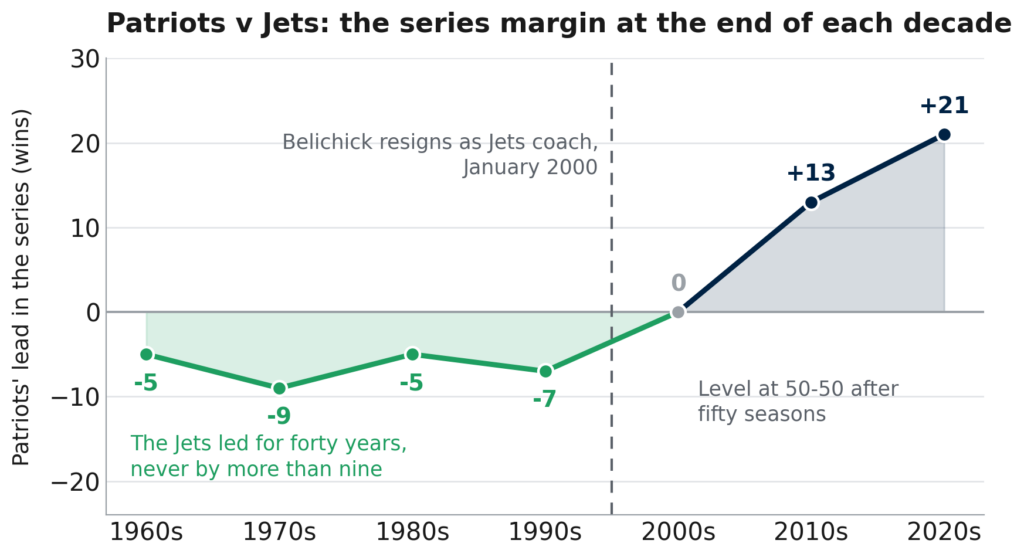
Chart Source: Cumulative series margin (Patriots wins minus Jets wins) at the end of each decade, all meetings included. The dashed line marks January 2000. Source: Pro Football Reference and The Football Database, current to the 2025 season.
The Jets led this series at the end of the 1960s, the 1970s, the 1980s and the 1990s, and never by more than nine games. After fifty seasons it was level: 50 wins each, one tie. Since then the Patriots have won 27 of 33.
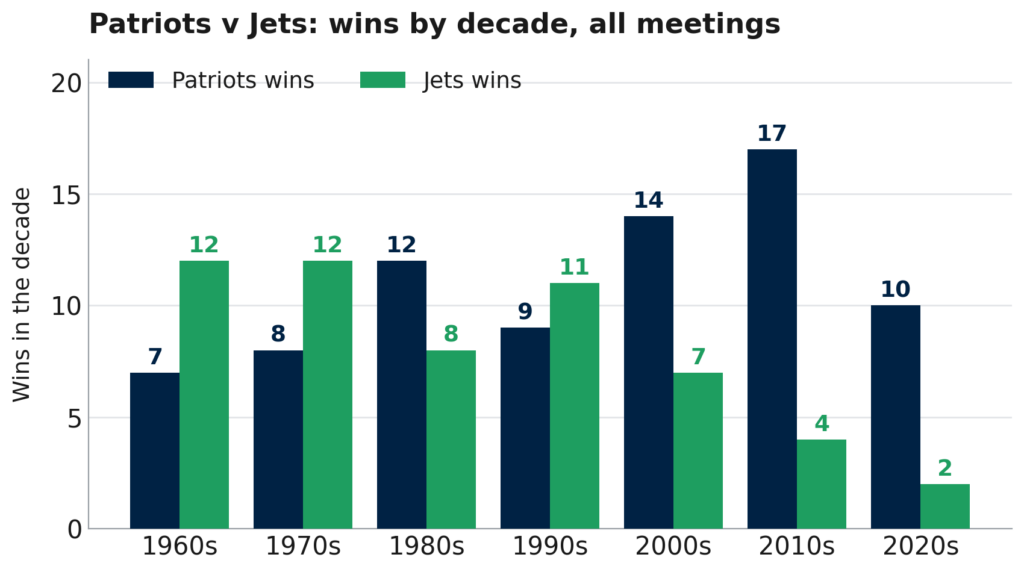
Chart source: Regular-season and playoff meetings, counted in the decade each was played; the single 1966 tie is not shown as a win for either club. Source: Pro Football Reference and The Football Database, current to the 2025 season.
Four of the first four decades were split roughly evenly, with the Jets edging three of them. The last three have all gone to New England, and the 2010s were not close at all.
Patriots v Jets, wins by decade (all meetings, including the three playoff games
| Decade | Patriots wins | Jets wins | Patriots’ running lead |
|---|---|---|---|
| 1960s | 7 | 12 | -5 |
| 1970s | 8 | 12 | -9 |
| 1980s | 12 | 8 | -5 |
| 1990s | 9 | 11 | -7 |
| 2000s | 14 | 7 | 0 |
| 2010s | 17 | 4 | +13 |
| 2020s | 10 | 2 | +21 |
“Running lead” is the Patriots’ cumulative wins minus the Jets’ after each decade. A minus sign means the Jets were ahead. The 1966 tie sits in neither win column, which is why the rows track wins only. Source: Pro Football Reference / The Football Database, current to the 2025 season.
Count the last three rows and you get the whole story in one figure. Since the start of the 2000 season, the Patriots have won 41 of these games and the Jets have won 13. Before that, across forty seasons, the Jets were ahead. Something changed in the winter of 1999, and it was not a football game.
The day the rivalry was decided
Three things happened between the two clubs in three years, and they run in sequence…
Bill Parcell Leaves for the Jets
In 1997, Patriots head coach Bill Parcells left for the Jets in circumstances the Patriots’ owner, Robert Kraft, considered outright poaching. He called the arrangement the two clubs cooked up “a transparent farce”. The league’s commissioner had to step in and set compensation, and New England were handed a run of draft picks (each club gets a fixed set of turns to sign the best incoming college players, and picks are tradeable currency): third and fourth-rounders in 1997, a second-rounder in 1998 and a first-rounder in 1999.
Jets sign Curtis Martin
In 1998, the Jets signed the Patriots’ best young running back, Curtis Martin, using a contract structured so that matching it would have been ruinous for New England. It was the first “poison pill” of the modern free agency era, and the practice was eventually outlawed in 2011.
Bill Belichick resigns
Then came 4 January 2000. Parcells had retired, and under his contract the job passed automatically to his assistant head coach, Bill Belichick. The Jets called a press conference to introduce their new man. Shortly before walking out, Belichick scribbled a handwritten note and handed it to club officials. It read: “I resign as HC of the NYJ.” He then talked for the best part of an hour, explaining that he could not commit to a club whose ownership was unresolved after the death of its owner, Leon Hess.
He went to New England. It took a lawsuit and another compensation deal to get him there, and it cost the Patriots their first-round pick in the 2000 draft, which went to the Jets.
Now put the dates next to the record. When Belichick wrote that note, the Jets led the series 43-36-1. Since then it has been Patriots 41, Jets 13.
I want to be careful here, because a date lining up with a trend is not the same as a date causing it. One man does not win forty-one football games. There is a fourth thing that happened…
Tom Brady
In April of that same year, with a sixth-round pick, 199th overall, the Patriots took a quarterback from Michigan named Tom Brady, and he alone went 29-7 against the Jets. The Jets, in the first round of that same draft, took a quarterback too: Chad Pennington, 18th overall. Both clubs thought they had found their man that spring. Only one of them had.
What is fair to say is this. The entire margin in a sixty-five-year rivalry was built in the twenty-six seasons after that press conference, and the man who built it had been the Jets’ head coach the day before. Across his time in charge at New England, from 2000 to 2023, Belichick’s record against the club he walked out on was 38-12.
Spygate, and the tape that went both ways
The two met in the first week of the 2007 season, at the Jets’ stadium, and New England won 38-14. Afterwards the Jets complained to the league that Patriots staff had been filming their defensive signals from a position on the field where filming was not allowed. Signals are how a coaching staff tells its players what to do, so knowing them in advance is a genuine advantage.
The league agreed. On 13 September 2007 it fined Belichick 500,000 dollars, fined the club 250,000, and took away New England’s first-round pick in the following year’s draft. It remains one of the heaviest penalties ever handed to a coach.
The part usually left out is that the tape ran in both directions. Later that same season, Jets staff were reported to have been found filming from a level of the Patriots’ stadium and asked to leave. The Jets said they had been given permission. Belichick said no permission was given. Nobody was punished for that one, and the two versions have never been reconciled.
I am not going to tell you who was worse. This rivalry is messy, the fine, the lost pick, and the fact that both clubs were accusing each other of pointing cameras at things.
The Thanksgiving game, and the Jets’ one great answer
Every rivalry has an afternoon that becomes shorthand. This one has a Thursday.
On 22 November 2012, the two met on Thanksgiving (the US national holiday in late November, one of the few days the NFL plays a full slate of televised games) for the first time. Late in the second quarter, Jets quarterback Mark Sanchez took the ball, found nowhere to run, and collided face-first with the backside of his own offensive lineman. The ball came loose. New England’s Steve Gregory picked it up and ran 32 yards for a touchdown. It has been known as the butt fumble ever since, and it is probably the most replayed play in the history of this fixture.
It was not an isolated moment of chaos. New England scored three touchdowns in 52 seconds, tied the NFL record of 35 points in a single quarter, and won 49-19.
The Jets are owed their answer, and they have a good one. Two seasons earlier, in December 2010, New England had beaten them 45-3 on a Monday night. Six weeks after that, the two were drawn together in the playoffs at New England, and the Jets won 28-21 and knocked the Patriots out. It stands as the only postseason defeat Belichick’s Patriots ever suffered against the Jets, and for a club with one league title to its name, from January 1969, it is one of the great days.
When they meet, and what’s at stake
Because they share the AFC East, the two are guaranteed to play twice every season, home and away, forever. That is fixed by the way the league builds its schedule, not left to a draw. ( How the NFL season works, and here is conference and division guide.)
The prize is usually the division, and the imbalance in what each club has done with it is stark. New England have six Super Bowl titles, all of them won in the twenty-six seasons since that resignation. The Jets have one championship, from the 1968 season, won in the third Super Bowl ever played and before either club had joined the NFL. You can see how the titles are spread across the league on the Super Bowl winners page.
Head-to-Head stats from last season
The all-time record is history. Here is how the two actually compared last season, in the numbers that describe a team best. I explain what each of these means, and why point differential is more honest than a win-loss record, on the NFL Team Stats page.
| 2025 regular season | New England Patriots | New York Jets |
|---|---|---|
| Record | 14-3 | 3-14 |
| Points scored | 490 | 300 |
| Points allowed | 320 | 503 |
| Point differential | +170 | -203 |
Point differential is points scored minus points allowed. Source: The Football Database, 2025 regular season.
This one is a bit different and that is because it is the opposite of the lesson most of these tables teach. On the other rivalry pages I have used this table to show a record that lies: a team whose win-loss column flatters it, or badly undersells it. Here, nothing lies.
The Patriots went 14-3 and outscored their opponents by 170 points. The Jets went 3-14 and were outscored by 203. Every measure agrees with every other measure.
Point differential earns its keep by disagreeing with the record often enough to be worth checking, and when it does not disagree, you can take the record at face value.
The 373 points between these two is the widest gap in any comparison on this site. New England went unbeaten away from home, reached Super Bowl LX and lost it to Seattle. New York lost all six games against their own division. For the deeper measures, the advanced stats go a layer further.
What it means for the next head-to-head
Two things worth holding onto.
The gap last season was as real as a gap gets, and both the record and the underlying numbers said the same thing about it. If you want to know who was better over a full year, there is no ambiguity to resolve.
But a season is not a fixture. The Jets’ most recent win in this series, in September 2024, was a 24-3 win over a Patriots side they beat comfortably, and the January 2011 playoff game is the reason no New England supporter takes one of these lightly. Use the numbers to set expectations for a season. Never use them to call an afternoon.
The last five head-to-heads
The recent run belongs to New England, and the turn was sharp.
Patriots v Jets, last five results
| Date | Result |
|---|---|
| 28 December 2025 | Patriots 42, Jets 10 |
| 13 November 2025 | Patriots 27, Jets 14 |
| 27 October 2024 | Patriots 25, Jets 22 |
| 19 September 2024 | Jets 24, Patriots 3 |
| 7 January 2024 | Jets 17, Patriots 3 |
Source: Pro Football Reference and The Football Database. Current to the 2025 season.
Read that list from the bottom and you can watch a team change. The Jets won two in a row across the 2023 and 2024 seasons, both of them comfortably, against a Patriots side that had just parted with Belichick. New England have won the three since, the last two by a combined 45 points.
The next meetings
The two guaranteed games in the 2026 season are already set, both of them on a Sunday afternoon.
| Date | Fixture | Venue |
|---|---|---|
| Sunday 18 October 2026 | Jets at Patriots | Gillette Stadium, Foxborough |
| Sunday 27 December 2026 | Patriots at Jets | MetLife Stadium, East Rutherford |
The October meeting is the first divisional game of the Jets’ season, which makes it an early marker of whether anything has changed. The December one falls in the last fortnight of the regular season, which in this division usually means it matters.
Common questions
Who leads the Patriots-Jets series?
The New England Patriots lead the all-time series 77 wins to 56, with one tie, across 134 meetings through the 2025 season, and they lead the playoff meetings 2-1. The lead is recent: the Jets led for the first forty years, and the series stood level at 50 wins each after fifty seasons.
When do the Patriots and Jets next play?
The Patriots and Jets next meet on 18 October 2026 at Gillette Stadium in Foxborough, then again on 27 December 2026 at MetLife Stadium in East Rutherford. As AFC East rivals, they are guaranteed to play twice every season, home and away.