
The Green Bay Packers lead the Chicago Bears 109 wins to 98, with six ties, across 213 meetings since 1921. That makes it the most-played rivalry in the NFL, and one of its oldest. The Bears were ahead for most of the century. Green Bay overtook them in 2017 and hasn’t looked back. The two clubs next play on 11 October 2026.
That is the whole rivalry in five sentences. The rest of this page is why each of those sentences is true, and why a fixture between two small-market clubs from the American Midwest became the longest argument in the sport.
Who leads, and by how much
Green Bay leads, narrowly on the all-time count and heavily in living memory. Here is the full series, with the date it is current to.
Bears v Packers, all-time series (to 10 January 2026)
| Measure | Record |
|---|---|
| Total meetings | 213 (the most in NFL history) |
| All-time series | Packers lead 109-98-6 |
| Regular season | Packers lead 108-96-6 |
| Postseason | Bears lead 2-1 |
| First meeting | 27 November 1921: Chicago Staleys 20, Packers 0 |
| Bears’ biggest win | 61-7 (1980) |
| Packers’ biggest win | 49-0 (1962) |
| Bears’ longest winning run | 8 games (1985-1988) |
| Packers’ longest winning run | 11 games (2019-2024) |
| Current run | Bears, 2 games (2025-present) |
Source: Pro Football Reference, cross-checked against the Chicago Tribune rivalry archive. A “tie” is a drawn game; the NFL allowed them freely for decades and still does when overtime settles nothing.
Quick note on these from me. The regular season is the ordinary schedule every team plays. The postseason, or playoffs, is the knockout tournament at the end of it, where a handful of the best teams compete for the title.
The two sides have only met three times in the playoffs in a hundred years, and the Bears have won two of those three, including the most recent. So Green Bay owns the long ledger; Chicago owns the rare high-stakes days.
The 109 Green Bay wins are the most any team has ever recorded against another in NFL history, ahead of the New York Giants’ 108 over Washington. The rivalry holds two records at once, then: the most meetings of any in the league, and the most wins by one side in any of them. The Packers only took that second record in the last few years. For most of the century it was the Bears sitting on the bigger pile of wins.
How it started: 1921, and a 20-0 shutout
They first played on 27 November 1921, and the Bears won 20-0. Except they weren’t the Bears yet. They were the Chicago Staleys, named after the food-starch company in Decatur, Illinois that had bankrolled them before the team moved to Chicago. They became the Bears the following year.
The Packers have a nearly identical origin. They were funded in 1919 by the Indian Packing Company of Green Bay, a meatpacking firm, which is where the odd name comes from. Both clubs, in other words, started life as works teams, the American cousins of the factory sides that founded a lot of English football. They are the two oldest teams in continuous operation in the NFL, and they have played each other almost every season since that first meeting. Only 1922 and 1982 went by without at least one game between them.
That shared age is the root of everything else. When two clubs have been playing since before radio, the record alone runs to 213 games, and the grudges have had a century to set.
Why the rivalry runs so deep
Three things stack up, and it’s the stacking that matters.
Location, location and location
Green Bay and Chicago sit roughly 200 miles apart, close enough that this has always been a genuine regional fight rather than two strangers meeting once a year.
NFL Schedule
The second is the calendar, and it’s the part most people outside the sport don’t know: because the two clubs share a division (a group of four nearby teams who are bound together in the standings), the NFL schedule guarantees they play twice every single season, home and away. I’ll come back to that below, because it’s the single most useful thing to understand about why these games keep mattering.
The men behind the franchises
The third is that the founders themselves couldn’t stand losing to each other. George Halas founded the Bears, coached them on and off for forty years, and owned the club until his death in 1983. Curly Lambeau did the same in Green Bay, and the stadium the Packers still play in carries his name. Later it was Halas against Vince Lombardi, the coach the Super Bowl trophy is named after. The men in charge were rivals as much as the teams were, and that tone never really left.
The eras: a lead built, held, then lost
For most of the rivalry’s life, this was a Chicago story. Look at the running total below. It shows one side’s lead over the other, game by game, gathered up into decades. Above the line, the Bears are ahead; below it, the Packers.
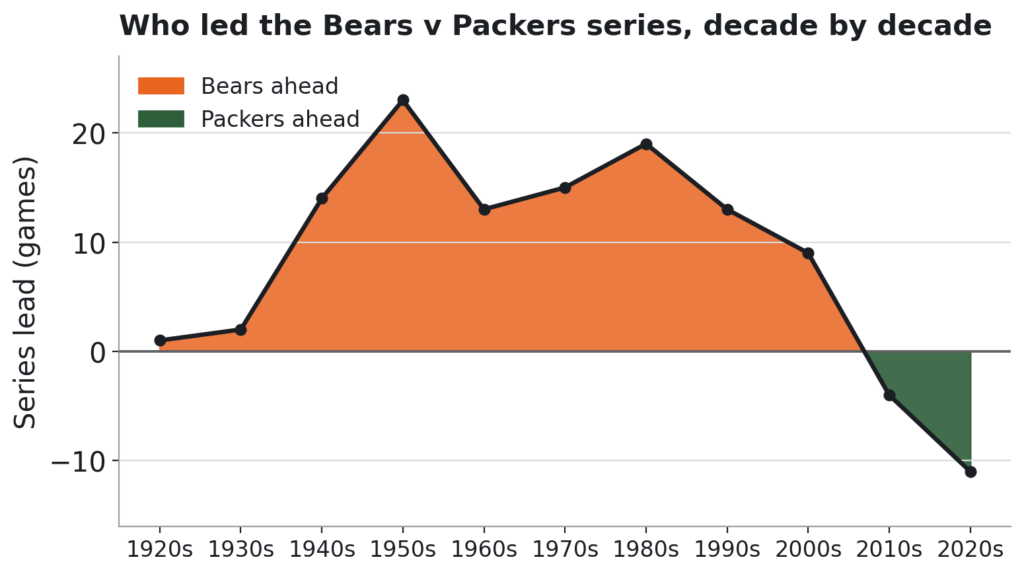
Cumulative wins, one side minus the other, at the end of each decade; orange = Bears ahead, green = Packers ahead. Includes the three playoff meetings. Source: Pro Football Reference and StatMuse, current to 10 January 2026.
Orange marks the decades the Bears led the all-time series and green the decades Green Bay led. Chicago was 23 games clear by the end of the 1950s, then Green Bay wiped the whole lead out and moved in front for good in 2017.
The Bears surged ahead in the 1940s and 1950s, and by the end of the fifties they led the all-time series by 23 games. That is an enormous margin, and it held up for a long time. As late as the 1980s, the decade of the famous 1985 Bears, Chicago still led the head-to-head by 19.
Then Green Bay took the rivalry apart. The arrival of two great quarterbacks, Brett Favre from 1992 and Aaron Rodgers after him, turned three decades of near-total dominance. The Packers overtook the Bears in the all-time series during the 2017 season, erasing a lead Chicago had held at the end of every decade from the 1920s to the 2000s. The gap since has only widened.
The per-decade view shows the same turn from a different angle.
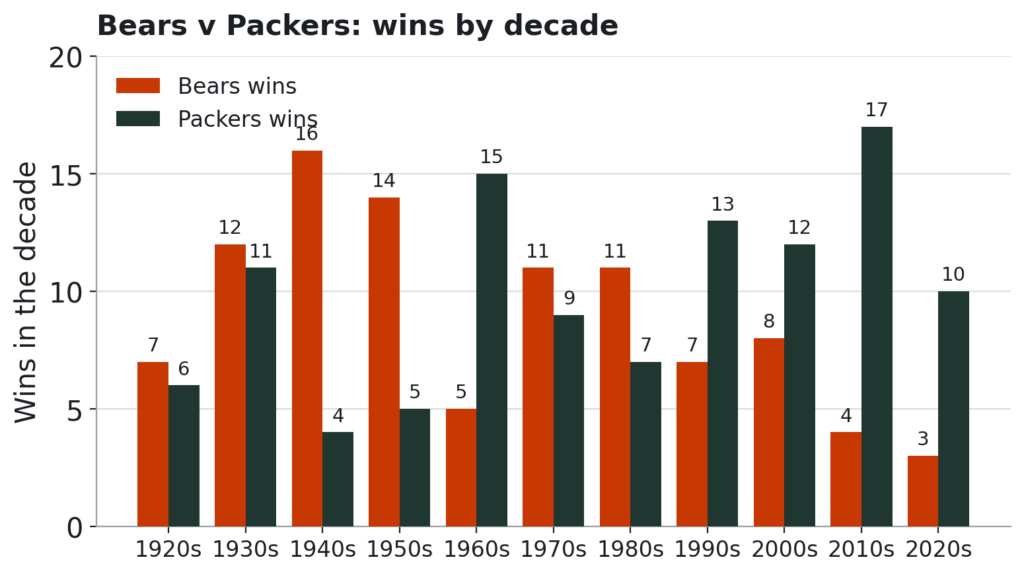
Chart source: Regular-season and playoff meetings, counted in the decade each was played; six ties (1920s-1950s) not shown. Source: Pro Football Reference and StatMuse, current to 10 January 2026.
The Bears took the 1940s and 1950s comfortably; Green Bay has won the majority in every decade since 1990, most heavily in the 2010s at 17 wins to 4.
Bears v Packers, wins by decade (all meetings, including the three playoff games)
| Decade | Bears wins | Packers wins | Ties | Bears’ running lead |
|---|---|---|---|---|
| 1920s | 7 | 6 | 3 | +1 |
| 1930s | 12 | 11 | 1 | +2 |
| 1940s | 16 | 4 | 1 | +14 |
| 1950s | 14 | 5 | 1 | +23 |
| 1960s | 5 | 15 | 0 | +13 |
| 1970s | 11 | 9 | 0 | +15 |
| 1980s | 11 | 7 | 0 | +19 |
| 1990s | 7 | 13 | 0 | +13 |
| 2000s | 8 | 12 | 0 | +9 |
| 2010s | 4 | 17 | 0 | -4 |
| 2020s | 3 | 10 | 0 | -11 |
“Running lead” is the Bears’ cumulative wins minus the Packers’ after each decade. A minus sign means Green Bay is ahead. Source: Pro Football Reference / StatMuse, current to 10 January 2026.
There is a small turn at the very end worth noting, because it is the reason this fixture feels alive again. The Bears have won the last two meetings: an overtime comeback in December 2025, and then the playoff game in January 2026. Two in a row is a modest thing against a decade of losing 17 of 21. But it is the first time in a long time that a Bears fan has gone into one of these games expecting to win.
The dirtiest hit in the rivalry
Every long rivalry has one afternoon it can’t shake. This one has 23 November 1986, at Soldier Field in Chicago.
Before kickoff, Green Bay defensive lineman Charles Martin walked out with a white towel tucked into his trousers. Written on it were the numbers of five Bears players. It was, by every account since, a hit list. The Bears were the defending champions; the Packers were on their way to a losing season, and the bad blood between the two head coaches, Chicago’s Mike Ditka and Green Bay’s Forrest Gregg, had been running hot for years.
Late in the game, Bears quarterback Jim McMahon threw an interception. A full two seconds after the ball had gone, with the play effectively over, Martin grabbed him from behind and drove him shoulder-first into the artificial turf. McMahon tore his rotator cuff and was finished for the season. The referee, Jerry Markbreit, ejected Martin.
The commissioner, Pete Rozelle, suspended him for two games, making Martin the first modern player suspended for multiple games for something he did on the field. It is still shown, four decades on, as one of the ugliest hits the league has ever produced.
This was one of the reasons the rivalry felt close enough, and personal enough, that a team heading nowhere would rather hurt the champions than merely lose to them.
Head- to -heads and what’s at stake
Here is the twice-a-year point I promised, and it is the thing to hold onto if you’re new to the sport.
In most of the football the rest of the world watches, who you play and how often is decided by a draw or by where you finish.
In the NFL it is largely fixed in advance. The 32 teams are sorted into eight divisions of four, grouped by region, and the schedule guarantees that you play the other three clubs in your division twice every season, once at your stadium and once at theirs.
The Bears and Packers are both in the division called the NFC North. So six of each team’s seventeen regular-season games, more than a third of the year, are against the same three neighbours, every single year, forever. (Here’s how the full schedule is built)
That is why a rivalry like this never cools off for long. There is always a next one, and it is never more than months away. English football’s biggest derbies manage two league meetings a year and call it a rivalry for the ages; the NFL bakes that same guarantee into every divisional pairing. On top of the two guaranteed games, the two can be drawn together again in the playoffs, which is exactly what happened in January 2026, giving them three meetings in a single season.
The stakes are usually the division itself. Finish top of the NFC North and you’re into the playoffs; the Bears and Packers have spent a hundred years taking that prize off each other.
Head-to-head stats last season
The all-time record is history. Here is how the two actually compared last season, in the numbers that describe a team best. I explain what each of these means, and why point differential is more honest than a win-loss record, on the NFL Team Stats page.
| 2025 regular season | Chicago Bears | Green Bay Packers |
| Record | 11-6 | 9-7-1 |
| Points scored | 441 | 391 |
| Points allowed | 415 | 360 |
| Point differential | +26 | +31 |
| Turnover differential | +22 | +1 |
Point differential is points scored minus points allowed. Source: ESPN for record and points, The Football Database for turnover differential. 2025 regular season.
The Bears won more games and scored more points, but the two were closer than 11-6 against 9-7-1 makes it look: Green Bay finished with the better point differential, +31 to +26. And Chicago’s record leaned heavily on one thing. The Bears led the NFL in turnover differential at +22, taking the ball away 33 times all season. That number comes with a health warning, and the Team Stats page spells it out: turnover margin is largely luck and tends not to carry from one year to the next, which is often why a team that rode it to a strong record falls back the following season. Read the two columns together and this was a tighter year than the standings suggest. If you want the deeper measures, the advanced stats go a layer further.
What it means for the next meeting
The two are closer than the records say.
Chicago finished 11-6 to Green Bay’s 9-7-1, but the Packers had the better point differential, and a big slice of the Bears’ edge came from a league-leading turnover margin that usually fades. Point differential is the measure that carries best into the following season, and on it the two were close.
Be wary of using any of it to call a single game.
Season numbers describe seventeen games each; one rivalry meeting is far noisier, and this fixture especially. After losing eleven in a row to Green Bay, the Bears have won three of the last four, including the playoff game. Form here does not sit still.
Home helps, a little.
Across the NFL the home side wins a bit more than half the time, an edge that has narrowed over the years rather than grown. In this rivalry, Green Bay has been hard to beat at Lambeau, especially in the December cold, which matters because the first 2026 meeting, on 11 October, is there. The Christmas rematch is at Soldier Field, where the Bears have won their last two against the Packers.
The last five head-to-heads
The recent turn is easiest to see game by game. The Bears have won three of the last four, after losing almost everything for a decade.
Bears v Packers, last five meetings
| Date | Result |
|---|---|
| 10 January 2026 (NFC Wild Card) | Bears 31, Packers 27 |
| 21 December 2025 | Bears 22, Packers 16 (overtime) |
| 7 December 2025 | Packers 28, Bears 21 |
| 5 January 2025 | Bears 24, Packers 22 |
| 17 November 2024 | Packers 20, Bears 19 |
Source: Pro Football Reference and the clubs’ official game records. Current to 10 January 2026.
They played three times in the 2025 season alone: Green Bay took the first, Chicago the second, and then the Bears won the playoff meeting to end the Packers’ year. That is the twice-a-year guarantee, plus a bonus January meeting the draw threw up.
The next head-to-heads
The two guaranteed games in the 2026 season are already set.
| Date | Fixture | Venue |
|---|---|---|
| Sunday 11 October 2026 | Bears at Packers | Lambeau Field, Green Bay |
| Friday 25 December 2026 | Packers at Bears | Soldier Field, Chicago |
The Christmas Day game is a genuine first: in more than a hundred years and 213 meetings, the two have never played each other at Soldier Field on Christmas Day. Green Bay will start the season as the form team on paper. The Bears will arrive on the back of those two straight wins, including the one that ended Green Bay’s season. For once, there’s a real argument about who’s favourite.
Common questions
Who leads the Bears-Packers series?
The Green Bay Packers lead the all-time series 109 wins to 98, with six ties, through the teams’ meeting on 10 January 2026. The Bears led the series for most of its history; Green Bay overtook them in 2017 and now leads.
When do the Bears and Packers next play?
The Bears and Packers next meet on 11 October 2026 at Lambeau Field in Green Bay, then again on Christmas Day, 25 December 2026, at Soldier Field in Chicago. Divisional rivals are guaranteed to play twice every season, home and away.