
The Pittsburgh Steelers lead the Baltimore Ravens 38 wins to 27 across 65 meetings since 1996, and lead the rarer playoff meetings 3-2. The lead is real, but the games are not one-sided at all: across all 65 meetings, just 33 points separate the two clubs, and most of them are settled by a single score. They next play on 20 December 2026.
It is the youngest of the NFL’s famous rivalries, born only in 1996, and one of its most respected. The rest of this page is how two teams built on defence and bad intentions turned three decades of near-identical scorelines into a genuine feud.
Who leads, and by how much
Pittsburgh leads on every count, but only just, and every figure below hides how tight the actual games are.
Steelers v Ravens, all-time series (through the 2025 season)
Source: Pro Football Reference, cross-checked against The Football Database game log and the series history. Across all 65 meetings the Steelers have scored 1,311 points to the Ravens’ 1,278, a margin of 33 points in thirty years. The two have never tied.
Hold on to that last line. A team that has won eleven more games than its rival, over sixty-five meetings, has outscored it by an average of half a point per game. That is the whole character of this rivalry: one side edges ahead in the standings while almost every individual afternoon goes down to the wire. Of the 32 meetings since 2008, 26 were decided by one score, which the Steelers say is the most of any rivalry in the league.
How it started: a new team in 1996
The Ravens did not exist before 1996. They were created when the Cleveland Browns’ owner moved his club to Baltimore, and the new team took the field that autumn as the Ravens. The Steelers, by contrast, were one of the league’s oldest and proudest franchises, with four Super Bowl titles already in the cabinet.
They met for the first time on 8 September 1996, in Pittsburgh, and the Steelers won 31-17. Then, three months later, the new team went to work: Baltimore won the Baltimore rematch by the exact same score, 31-17. That first season set the tone. The established power would keep its nose in front over the decades, but the newcomer would never be an easy night, and would spend the next thirty years making sure of it.
Why these two hit so hard
The rivalry runs on one thing above all: defence. For most of their shared history, both clubs have built their identity around punishing, physical defensive teams, and the games have been fought in the trenches rather than shot out in the air. That is why the scorelines are so low and so close, and why the rivalry has a reputation for brutality that the other famous feuds don’t quite share.
Two other things stack on top. The first is the schedule: both clubs share the AFC North, one of the league’s eight four-team divisions (the groups that decide the standings), so they are guaranteed to play twice every season, home and away. The second is proximity in the table rather than on the map. Pittsburgh and Baltimore are about 250 miles apart, but what really binds them is that for thirty years they have been fighting for the same division title, usually right at the top of it.
The Ravens have a saying about it, repeated to every new arrival in their locker room: you’re not a Raven until you’ve beaten the Steelers. Few lines capture a rivalry better.
The eras: three swings in thirty years
For a young rivalry it has already turned over three times. The Steelers ran it early, the Ravens seized the middle, and Pittsburgh has taken it back most recently. The decade view shows all three swings.
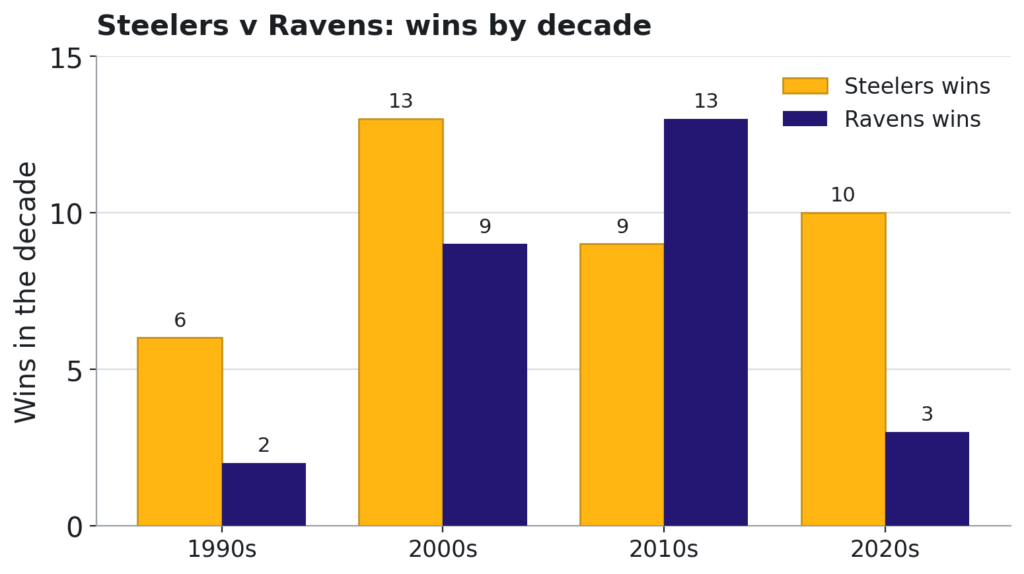
Chart Source: Regular-season and playoff meetings, counted in the decade each was played. The 1990s covers 1996 to 1999 only. Source: Pro Football Reference and The Football Database, current to the 2025 season.
The Steelers dominated the early years and held the edge through the 2000s; the Ravens owned the 2010s, winning 13 of 22; then Pittsburgh reasserted itself in the 2020s, taking 10 of the first 13.
Steelers v Ravens, wins by decade (all meetings, including the five playoff games)
| Decade | Steeler wins | Raven wins | Steelers’ running lead |
|---|---|---|---|
| 1990s | 6 | 2 | +4 |
| 2000s | 13 | 9 | +8 |
| 2010s | 9 | 13 | +4 |
| 2020s | 10 | 3 | +11 |
“Running lead” is the Steelers’ cumulative wins minus the Ravens’ after each decade. The Steelers have led the series at the end of every decade, but the Ravens’ 2010s pulled it close. Source: Pro Football Reference / The Football Database, current to the 2025 season.
The constant through most of it was the two head coaches. Mike Tomlin took over in Pittsburgh in 2007 and John Harbaugh in Baltimore in 2008, and from then until the end of the 2025 season they faced each other 40 times: 36 regular-season games and four in the playoffs. Two men, eighteen shared seasons, forty meetings. Then, in the space of eight days in January 2026, both were gone, and the game that set it off was one of theirs.
The physicality, and one infamous sideline
You cannot describe these games without describing the hits. This is a rivalry of concussive collisions, ejections and fines, played by two of the hardest defensive teams of their generation, and the physicality is the appeal rather than a footnote to it.
Its single most infamous moment, though, came from the sideline. On Thanksgiving night, 28 November 2013, in Baltimore, the Ravens were returning a kickoff when Steelers head coach Mike Tomlin drifted onto the edge of the field, watching the giant screen, and slowed Baltimore returner Jacoby Jones as he came up the sideline on what looked like a touchdown. The NFL fined Tomlin 100,000 dollars, and a debate that has never fully settled began: did he do it on purpose? Tomlin said he lost track of where he was standing. Jones, and much of Baltimore, were never convinced. The Ravens won the game 22-20, which was, of course, by one score.
The 40th meeting, and the end of both eras
The most consequential game in the history of this rivalry was played on 4 January 2026, and it was decided by two points.
It was the final Sunday of the regular season, in Pittsburgh, with the AFC North title and the playoff place that came with it on the line for both clubs. The fourth quarter had four lead changes in its last nine minutes. Baltimore got into range at the death and lined up a 44-yard field goal (a kick through the posts, worth three points) to win it. It missed. Pittsburgh won 26-24, took the division, and Baltimore’s season was over at 8-9, their first year out of the playoffs since 2021.
Two days later, on 6 January, the Ravens parted with John Harbaugh after eighteen seasons. He was the winningest coach in the club’s history and the longest-serving in Baltimore sports.
A week after that, on 13 January, Mike Tomlin stepped down in Pittsburgh after nineteen seasons, the day following a 30-6 wild card defeat to Houston. In nineteen years he had never had a losing season.
Be careful how you join those dots, because the two exits are not the same story. Harbaugh’s followed directly from this fixture: lose that kick, miss the playoffs, and the decision was made within 48 hours. Tomlin’s came after a different game, against a different opponent, and by his own account had been building for a while. What is true, and remarkable, is the sequence. The two longest-serving head coaches in the NFL both left within eight days of each other, and the first domino was a two-point Steelers-Ravens game settled by a missed kick on the final play.
Which is the whole argument of this page, in one afternoon. A rivalry separated by 33 points in thirty years produced a game decided by three, and it cost a man his job after eighteen years. The margins here are tiny. What rides on them is not.
When they meet, and what’s at stake
Because they share the AFC North, the two are guaranteed to play twice a year, home and away, every season. That is fixed by the way the league builds its schedule rather than left to a draw. (Here’s how that works, and here’s how the divisions fit together.)
The prize is usually the division, and often more. Win your division and you are into the playoffs; finish behind your rival and, as Baltimore found in January, you can go home on a missed kick. How qualification and seeding actually work is worth ten minutes if you have never had it explained.
These are also the only two AFC North clubs ever to win a Super Bowl: six for the Steelers, two for the Ravens, and two apiece since the rivalry began in 1996. You can see how that sits against the rest of the league on the Super Bowl winners page.
If you want the other great divisional feuds, I have written up Bears v Packers, Cowboys v Eagles, Chiefs v Raiders and Patriots v Jets, and the NFL teams hub has all 32 clubs with what each has won.
How the two compare now
The all-time record is history. Here is how the two actually compared last season, in the numbers that describe a team best. I explain what each of these means, and why point differential is more honest than a win-loss record, on the NFL Team Stats page.
| 2025 regular season | Pittsburgh Steelers | Baltimore Ravens |
|---|---|---|
| Record | 10-7 | 8-9 |
| Points scored | 397 | 424 |
| Points allowed | 387 | 398 |
| Point differential | +10 | +26 |
| Turnover differential | +12 | -3 |
Point differential is points scored minus points allowed. Source: ESPN for record and points, The Football Database for turnover differential. 2025 regular season.
This one is a lesson in disguise. The Steelers won the division and swept the Ravens, and the record says they were the better team, 10-7 to 8-9. The underlying numbers say the opposite: Baltimore outscored its opponents by 26 points across the season to Pittsburgh’s 10, the better mark by a distance. What flipped the season was turnovers. The Steelers took the ball away nine more times than they gave it up; the Ravens finished on the wrong side of that ledger and lost a stack of close games. As the Team Stats page explains, point differential describes a team more honestly than its record, and turnover margin is largely luck that tends not to repeat. For the deeper measures, the advanced stats go a layer further.
What it means for the next meeting
Three things worth holding onto.
Last season was closer than the sweep suggests. The Steelers won both games and the division, but the Ravens had much the better point differential, and Pittsburgh’s edge rested on a turnover margin that usually evens out. On the number that carries best into a new season, Baltimore graded higher, which is a reason to expect them to bounce back rather than fall away.
None of that calls a single game, though, and in this rivalry least of all. Season quality tells you who is likely better over a year; one Steelers-Ravens meeting is about as close to a coin toss as the sport offers, with most of them decided by a field goal. The record gap is built on inches, not blowouts.
And both clubs are being coached by someone new. Pittsburgh and Baltimore go into 2026 with their first new head coaches since 2007 and 2008 respectively, which is the largest change either side of this fixture has seen in nearly twenty years. Nobody, including me, knows what that does to a rivalry this old. It is the thing worth watching.
The last five meetings
The recent run is pure rivalry: back and forth, and rarely by much.
Steelers v Ravens, last five meetings
| Date | Result |
|---|---|
| 4 January 2026 | Steelers 26, Ravens 24 |
| 7 December 2025 | Steelers 27, Ravens 22 |
| 11 January 2025 (AFC Wild Card) | Ravens 28, Steelers 14 |
| 21 December 2024 | Ravens 34, Steelers 17 |
| 17 November 2024 | Steelers 18, Ravens 16 |
Source: Pro Football Reference and The Football Database. Current to the 2025 season.
The Steelers have won the last two, both in the 2025 season, to take the division back off Baltimore. Before that the Ravens had won three of four, including a comfortable playoff night. That is the pattern: whoever you back, the other one answers within months.
The next meetings
The two guaranteed games in the 2026 season are already set.
The two close the regular season against each other in Baltimore, exactly as they did in 2025, when the meeting decided the division and, as it turned out, a good deal more. It will also be the first season of these games in nearly two decades with neither Tomlin nor Harbaugh on a sideline, a reminder of how much of this rivalry was shaped by the men in charge as well as the men on the field.
Common questions
Who leads the Steelers-Ravens series?
The Pittsburgh Steelers lead the all-time series 38 wins to 27, across 65 meetings through the 2025 season, and lead the playoff meetings 3-2. The lead is narrow in scoring terms: just 33 points separate the two across all 65 games.
When do the Steelers and Ravens next play?
The Steelers and Ravens next meet on 20 December 2026 at Acrisure Stadium in Pittsburgh, then again in Week 18 in early January 2027 at M&T Bank Stadium in Baltimore. As AFC North rivals, they are guaranteed to play twice every season, home and away.