
There are 32 NFL teams, split into two conferences of 16, and each conference is split into four divisions of four. The Green Bay Packers have won the most championships, 13, though not the most Super Bowls. If you are trying to choose a team, there is no wrong answer and no test to pass: most American fans never chose either. Below is every club, what they have won, and the things worth weighing.
What a franchise is, and why clubs move cities
An NFL club is a franchise, which means a privately owned business that holds a permanent place in the league. That word does a lot of work, and it is the single biggest difference between following the NFL and following football in Europe.
There is no promotion and no relegation. Finish bottom and you stay in the league, keep your place, and get the first pick of the incoming college players as a reward. Finish top and you are back next year with everyone else. Nobody is ever going down, so no season is ever about survival.
The other half of it surprises people more. A club can move city. If an owner wants a bigger market or a new stadium, they can relocate the whole operation, subject to a vote by the other owners, and the team’s name often changes with it. This is not ancient history: the Rams, the Raiders and the Chargers have all moved this century.
The clearest example is also the strangest. In 1996 the Cleveland Browns’ owner moved the club to Baltimore, where it became the Ravens. But the deal that followed left the Browns’ name, colours and entire history in Cleveland, and a new Browns team started playing there in 1999. So the four championships in the table below sit with Cleveland, not Baltimore, even though it was Cleveland’s players and staff who made the move. A club, it turns out, is not quite the same thing as the people in it.
If you want the full structure, how the conferences and divisions fit together is the page for it.
All 32 clubs, ranked by championships
Here is every club, ordered by total championships won. I explain the counting directly beneath the table, because it is the part that trips people up.
Every NFL club by total championships (through Super Bowl LX, February 2026)
| Club | Division | Total titles | of which Super Bowls | Last title |
|---|---|---|---|---|
| Green Bay Packers | NFC North | 13 | 4 | 2010 |
| Chicago Bears | NFC North | 9 | 1 | 1985 |
| New York Giants | NFC East | 8 | 4 | 2011 |
| New England Patriots | AFC East | 6 | 6 | 2018 |
| Pittsburgh Steelers | AFC North | 6 | 6 | 2008 |
| Philadelphia Eagles | NFC East | 5 | 2 | 2024 |
| Washington Commanders | NFC East | 5 | 3 | 1991 |
| Dallas Cowboys | NFC East | 5 | 5 | 1995 |
| San Francisco 49ers | NFC West | 5 | 5 | 1994 |
| Cleveland Browns | AFC North | 4 | 0 | 1964 |
| Detroit Lions | NFC North | 4 | 0 | 1957 |
| Indianapolis Colts | AFC South | 4 | 2 | 2006 |
| Los Angeles Rams | NFC West | 4 | 2 | 2021 |
| Kansas City Chiefs | AFC West | 4 | 4 | 2023 |
| Denver Broncos | AFC West | 3 | 3 | 2015 |
| Las Vegas Raiders | AFC West | 3 | 3 | 1983 |
| Arizona Cardinals | NFC West | 2 | 0 | 1947 |
| Baltimore Ravens | AFC North | 2 | 2 | 2012 |
| Miami Dolphins | AFC East | 2 | 2 | 1973 |
| Seattle Seahawks | NFC West | 2 | 2 | 2025 |
| Tampa Bay Buccaneers | NFC South | 2 | 2 | 2020 |
| New Orleans Saints | NFC South | 1 | 1 | 2009 |
| New York Jets | AFC East | 1 | 1 | 1968 |
| Atlanta Falcons | NFC South | 0 | 0 | None yet |
| Buffalo Bills | AFC East | 0 | 0 | None yet |
| Carolina Panthers | NFC South | 0 | 0 | None yet |
| Cincinnati Bengals | AFC North | 0 | 0 | None yet |
| Houston Texans | AFC South | 0 | 0 | None yet |
| Jacksonville Jaguars | AFC South | 0 | 0 | None yet |
| Los Angeles Chargers | AFC West | 0 | 0 | None yet |
| Minnesota Vikings | NFC North | 0 | 0 | None yet |
| Tennessee Titans | AFC South | 0 | 0 | None yet |
“Last title” is the season, not the calendar year the game was played: Seattle’s 2025 title was won in February 2026. Counting NFL championships won up to 1965 plus every Super Bowl from the 1966 season onward, which is the standard way of avoiding double counting. Source: Pro Football Hall of Fame, plus Super Bowl LX. Nine clubs have never won a title on this count, and four of them will tell you otherwise, which I come to below.
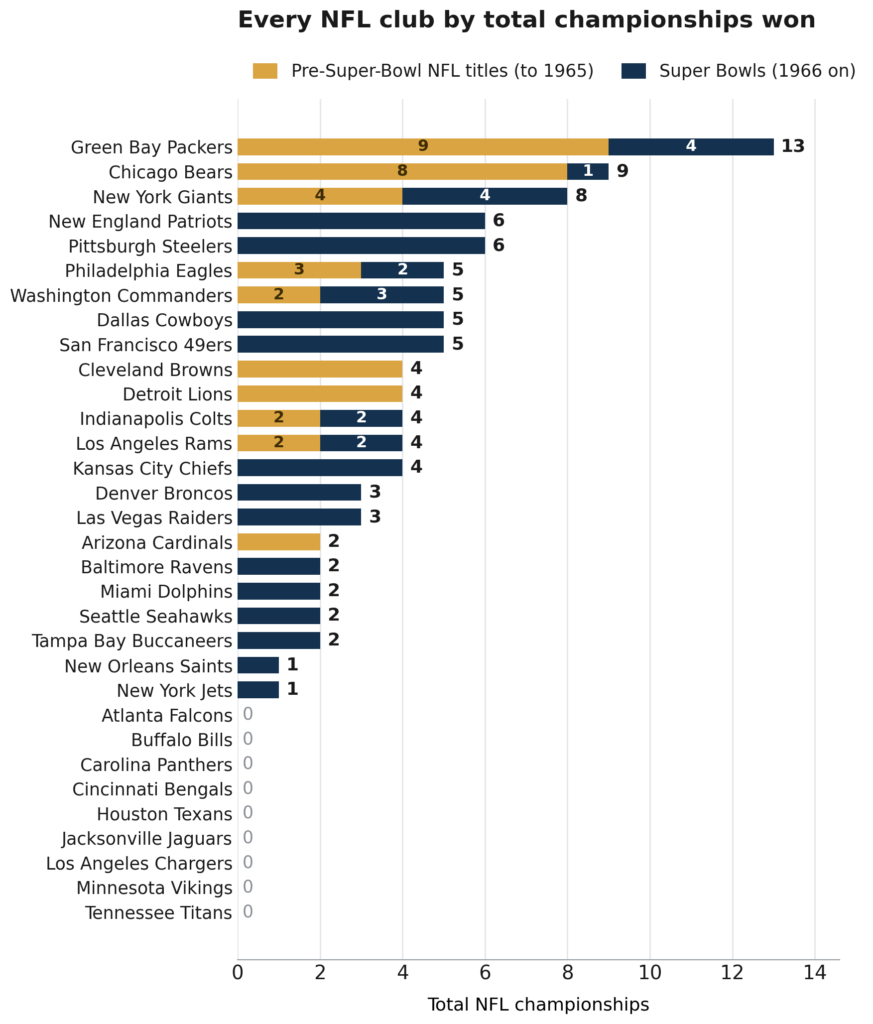
Chart Source: Total championships by club, split into titles won before the Super Bowl era and Super Bowls won since. Source: Pro Football Hall of Fame, plus Super Bowl LX, February 2026.
Only nine clubs have won more than three championships, and the gold portion of each bar shows how much of a club’s history sits before the Super Bowl existed. For Green Bay, Chicago and the Giants, most of it does.
Titles are not the same as Super Bowls
This is the bit that causes arguments, so here it is plainly. The Super Bowl did not exist until after the 1966 season. The NFL had been running since 1920 and crowning a champion every year, and those championships did not stop counting when the trophy changed.
Green Bay are the clearest case. They have four Super Bowls, which puts them behind five other clubs. They have 13 championships, which puts them first by a distance, because nine of them were won before the Super Bowl was invented. Chicago are the same story: nine championships, one Super Bowl. Ranking clubs purely by Super Bowls quietly deletes half the league’s history, and it is why the table above is sorted the way it is.
Both answers are correct, they are just answers to different questions. If you want the Super Bowl-only ranking, where Pittsburgh and New England lead on six each, every Super Bowl winner is listed here.
The clubs whose zero is not really a zero
Nine clubs show nothing in the table. Four of them have a fair objection.
From 1960 to 1969 there were two rival leagues, the NFL and the American Football League, each crowning its own champion, and they merged in 1970. Counting both sets of titles alongside the early Super Bowls would double count the same seasons, so the standard approach, and the one this table uses, is to count NFL championships up to 1965 and then Super Bowls from 1966. That is tidy, and it does leave four clubs looking emptier than they are:
- Buffalo Bills: AFL champions in 1964 and 1965.
- Tennessee Titans, who were the Houston Oilers then: AFL champions in 1960 and 1961.
- Los Angeles Chargers, then in San Diego: AFL champions in 1963.
- Minnesota Vikings: NFL champions in 1969, the last season before the merger. They lost Super Bowl IV to Kansas City a few weeks later, which is why the title does not appear here.
So if a Bills supporter tells you their club has won two championships, they are not making it up. They are using a different and entirely defensible count. I have flagged it rather than quietly picking a side, because the honest answer is that this one genuinely depends on where you draw the line.
Which team should you follow?
Most fans never chose. If you grew up in the United States, your team is almost certainly your family’s team, or the city you grew up in, or whoever happened to be on television when you were seven. It was decided for you, and that is completely normal.
For everyone else, and for Americans without an inherited team, here is what people actually weigh. None of these is more valid than another, and there is no correct answer at the end of it.
Geography. The nearest team, or a city you have a connection to. It is the most common reason in the world and it needs no defending.
What time the games kick off where you live. Nobody writes about this and in Europe it matters enormously. A club that features often in prime-time American slots means a run of midnight and 1am finishes. The early Sunday window is far more watchable from the UK or mainland Europe. The Super Bowl time conversions give you a feel for how the clock maths works.
Whether you want to win now or watch something get built. Picking a contender and picking a project are two different hobbies. Both are completely valid, and the second one is more interesting more of the time.
The rivalries you would inherit. You do not get to opt out of these. Pick a club and you pick its enemies, twice a season, forever. The five below are a decent place to see what that actually feels like.
International games. Some clubs play in London, Madrid, Munich, Dublin or Paris more often than others. That is a realistic chance of seeing them in person without crossing an ocean.
Whether your broadcaster shows them. Not every game is available everywhere, and it is worth ten minutes of checking before you commit.
How they play. Some clubs are built around throwing, some around defence, and if you already know what you enjoy watching, it is a reasonable tiebreaker. The stats explainers are where I unpack what those styles look like in the numbers.
One last thing. You cannot really switch later. Or you can, and people will notice.
Why rivalries matter more here
Divisional rivals play each other twice every season, home and away, guaranteed. Six of a club’s seventeen games are against the same three opponents, every single year, and that is fixed by the way the league builds its schedule rather than left to a draw.
That is more often than most European football rivals meet, and it is the thing I would most want a newcomer to understand about why these fixtures carry what they carry. There is always a next one, and it is already in the diary.
I have written up five in full. Each one covers who leads, how it started, the incident everybody still argues about, and how the two clubs compare right now.
- Bears v Packers, the most-played fixture in the sport.
- Cowboys v Eagles, where almost the entire all-time lead was built in one decade.
- Steelers v Ravens, the youngest of them, and the closest.
- Chiefs v Raiders, a series that completely reversed.
- Patriots v Jets, which was level for fifty seasons and then was not.
Those five cover five of the league’s eight divisions. The three missing ones, the AFC South, NFC South and NFC West, are all made up of younger clubs with less shared history, and none of them has a feud with the depth of the five above. That is a decision rather than an oversight, and if one of them develops into something, I will write it up.
Common questions
Which NFL team should I support?
There is no wrong answer, and most American fans never chose: they inherited a team from family or from the city they grew up in. If you are picking from scratch, the things people actually weigh are geography, what time the games kick off where you live, whether you want a contender or a rebuild, and the rivalries you would be signing up for.
Why do NFL teams move cities?
NFL clubs are privately owned franchises, and there is no promotion or relegation, so a club’s place in the league is permanent regardless of results. That means an owner who wants a bigger market or a new stadium can relocate the whole club, subject to a vote by the other owners, and the name often changes with it. The Rams, Raiders and Chargers have all moved this century.
Which NFL team has won the most championships?
The Green Bay Packers, with 13, counting NFL championships won before the Super Bowl began plus every Super Bowl since. That is a different question from who has won the most Super Bowls, which is Pittsburgh and New England on six each. Nine of Green Bay’s titles came before the first Super Bowl was played after the 1966 season.