
If Week 1 was a fireworks display, Week 2 was the defences bringing the rain.
A week after the Bears scored 59 points against Carolina, they managed just 3 against the Vikings. Same offence, same coordinator, 56 fewer points. They were not the only team to flip from firing on all cylinders to firing blanks.
Across the league, offences that looked unstoppable seven days ago ran into turnovers, missed kicks, a fair bit of rain and defensive coordinators who had spent a week doing their homework.
The Bears’ 56-point drop from one week to the next was the fourth-largest such swing in NFL history, and the biggest since 1973 (per ESPN Research, via Benjamin Solak). So before anything else, here is the full slate.
The NFL Week 2 Results
| Thursday 17 September | |
| BUFDetroit Lions at Buffalo Bills | 41-31 |
| Sunday 20 September | |
| PHIPhiladelphia Eagles at Tennessee Titans | 24-20 |
| NEPittsburgh Steelers at New England Patriots | 20-3 |
| MINMinnesota Vikings at Chicago Bears | 9-3 |
| CARCarolina Panthers at Atlanta Falcons | 34-3 |
| GBGreen Bay Packers at New York Jets | 20-17 |
| NONew Orleans Saints at Baltimore Ravens | 24-17 |
| CINCincinnati Bengals at Houston Texans | 20-6 |
| CLECleveland Browns at Tampa Bay Buccaneers | 23-19 |
| DENJacksonville Jaguars at Denver Broncos | 20-13 |
| LVLas Vegas Raiders at Los Angeles Chargers | 26-14 |
| SEASeattle Seahawks at Arizona Cardinals | 31-7 |
| SFMiami Dolphins at San Francisco 49ers | 35-13 |
| DALWashington Commanders at Dallas Cowboys | 37-20 |
| Sunday night | |
| KCIndianapolis Colts at Kansas City Chiefs | 33-30 |
| Monday night | |
| LARNew York Giants at Los Angeles Rams | 28-6 |
Following the Raiders? They beat the Chargers 26-14 to move to 2-0. I break their game down properly in the Raiders Week 2 review.
The Bears went from 59 to 3, and the defence is the reason
The Minnesota Vikings did not just beat the Chicago Bears 9-3. They took the highest-scoring offence of Week 1 and switched it off. Minnesota’s defensive coordinator, Brian Flores, sent extra pass rushers at Caleb Williams on roughly three of every four dropbacks, a tactic called the blitz, which trades defenders in coverage for more bodies chasing the quarterback. Williams never settled, checked the ball down all afternoon, and later left with a hamstring injury. His backup could not turn it around, and a last-second Minnesota sack ended it.
The same story played out in Atlanta. A week after conceding 59 points, Carolina’s defence held the Falcons to 3, forcing turnovers and taking a game over outright. Two of the most embarrassed defences from Week 1 came straight back and won games on their own.
If you want to measure a performance like that properly, the stat to know is EPA, expected points added. It grades every play by how much it moved a team’s expected points up or down, which strips the scoreboard out and rewards good football over lucky football. It is exactly what Sam Hoppen charts, game by game, and his Vikings-Bears breakdown shows how one-sided the day really was.
Just posted waterfall game recap charts over on my Substack for all the Week 2 games so far! Added a little commentary on what caught my eye as well. Another great week of football!
— Sam Hoppen (@SamHoppen) September 21, 2026
🔗⤵️ pic.twitter.com/QQm9gdKbTv
Read Sam Hoppen
If you want to see how a game was actually won and lost, past the final score, this is the work to follow. Every week, for every single game, Sam Hoppen charts the win probability and the expected points added on both sides of the ball. It is some of the clearest football data going, and it is free. Do yourself a favour and subscribe to Hoppen to Conclusions. Both charts in this piece are his.
A brilliant offence and a well-drilled defensive plan met on the same field, and this week the plan won. That is the whole game in one sentence, and it is why a single enormous week never settles anything.
For the numbers that measure a defence properly, defense stats, decoded breaks them down.
The upset of the week turned on one gutsy decision
The New Orleans Saints walked into Baltimore as heavy underdogs, trailed 14-6 at the break, and walked out 24-17 winners. The game turned on nerve. With the ball near the goal line and the result in the balance, head coach Kellen Moore turned down the safe field goal and went for it on fourth down instead, the last of the four attempts a team gets to move the ball ten yards. Quarterback Tyler Shough sneaked it in himself for the score that won it.
Going for it there used to look reckless. It is now, more and more, just arithmetic. Close to the goal line, the points a team can expect from going for the touchdown outweigh the near-certain three from a kick, as long as it backs the offence to convert. Moore backed his in each of the first two weeks, and this time it paid off. Sam Hoppen’s charts show the swing in full.
The safe call and the smart call are not always the same one, and the space between them is where coaches earn their money. If you want the mechanics of downs and why a team “goes for it”, how the NFL works lays it out.
The Chargers are 0-2, and the way they got there is uncanny
The Los Angeles Chargers have now lost both their games by the exact same score, 26-14, first to Arizona and then to the Raiders. ESPN Insights flagged just how odd the start is: they are only the fourth team in NFL history to open 0-2 against opponents who each won three or fewer games the season before.
The Chargers are winless and their games have been eerily similar 😳
— ESPN Insights (@ESPNInsights) September 21, 2026
🏈 Week 1: Lost 26-14 to Arizona (3-14 last season)
🏈 Week 2: Lost 26-14 to Las Vegas (3-14 last season)
They're the 4th team in NFL history to start 0-2 despite facing opponents who won 3 or fewer games… pic.twitter.com/IMIXkqG8bN
One caution before anyone buries them: that is four teams across roughly ninety seasons, which is another way of saying it is barely a pattern, and it is two games of football. The underlying numbers are not kind either.
As Sam Hoppen’s data shows, the Chargers sit near the very bottom of the league for offensive efficiency through two weeks, and they are running the ball for a league-worst return per carry.
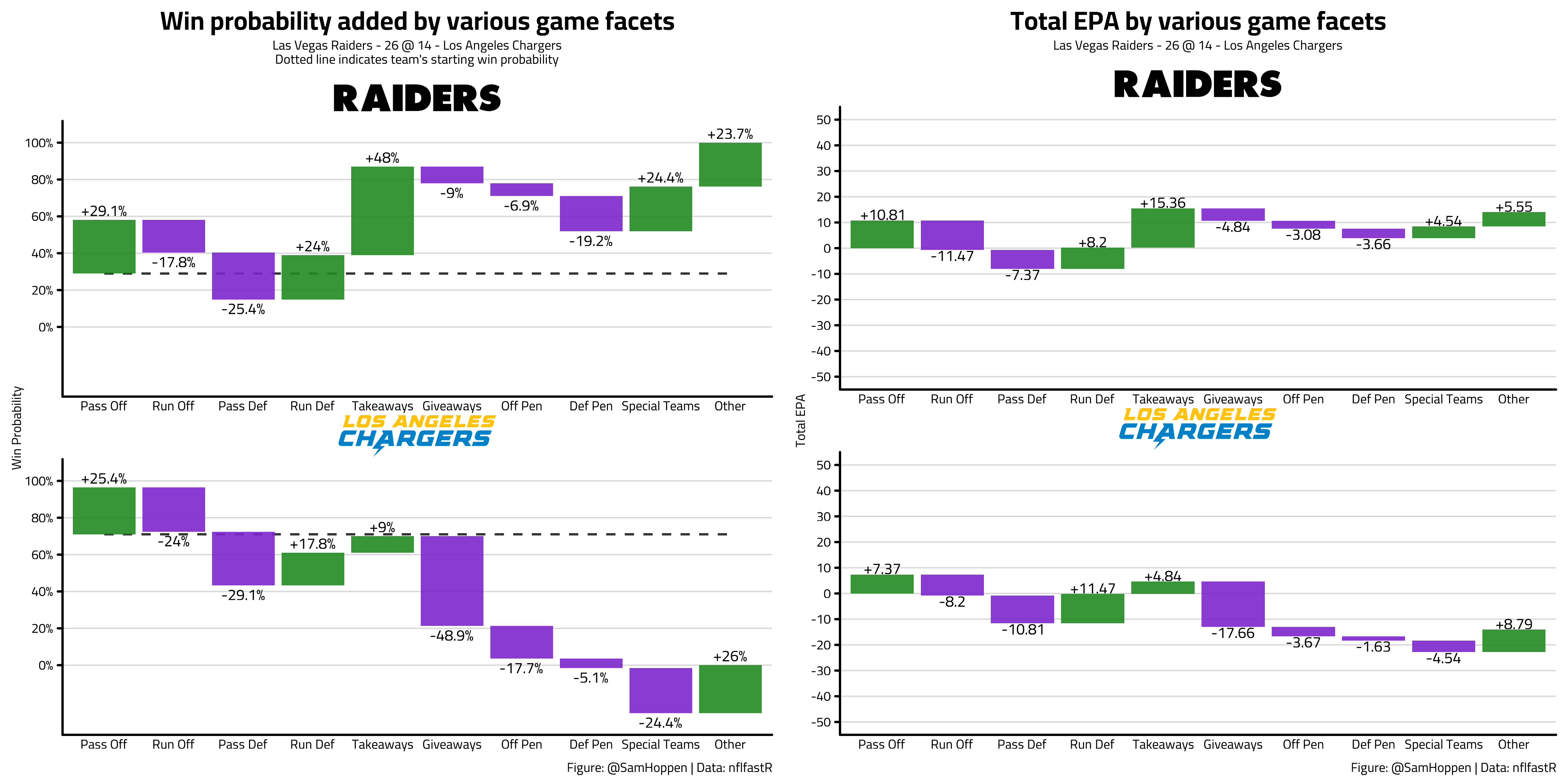
Chart by Sam Hoppen, Hoppen to Conclusions.
The team that handed them Sunday’s defeat, of course, was the Raiders, who I cover on their own in the Raiders Week 2 review.
Two identical defeats make a tidy story. Whether they add up to a bad season is a question only the next month can answer.
What did NFL Week 2 show us?
The Bears’ 59 points and the Giants’ statement win over Dallas were both gone by Sunday night, replaced by a 3 and a 28-6 hiding on Monday. That does not mean Week 1 lied and Week 2 is the truth. It means two data points are not a trend, and the league spends September reminding everyone of exactly that. I will keep decoding it a week at a time.
Wonder which way the pendulum swings next, if it swings at all. Roll on Week 3!
Leave a Reply