Author: alison b

  • Raiders Week 2 Review: the pressure numbers behind a 2-0 start

    Raiders Week 2 Review: the pressure numbers behind a 2-0 start

    Two and oh, Raider Nation. I am sat here with the biggest grin on my face, on a sunny Tuesday afternoon. I am a fan first and a level-headed writer a distant second, where the Raiders are concerned.

    Las Vegas Raiders are 2-0 for the first time in longer than I care to admit.

    The best part is not even the record. It is how they did it. Las Vegas went to Los Angeles, beat the Chargers 26-14 on their own field, and did it with a pass rush that, by at least one measure, is now the most disruptive defence in the entire league (NFL.com). Last season the Raiders lost in that same building 31-14. This one was never really that close.

    If you missed it, last week they opened with a 27-13 win over Miami, and the story was the same one: the defence set the tone and Kirk Cousins did the rest. Here is what mattered this time.

    How the game went

    Nobody scored in the first quarter, which suited the Raiders fine, because the longer the game stayed tight the more their defence took over.

    Las Vegas led 10-7 at the half, 17-14 after three, and then shut the Chargers out in the fourth while adding nine points of their own to win going away.

    QuarterRaidersChargers
    Q100
    Q2107
    Q377
    Q490
    Final2614

    Source: NFL.com game centre, Raiders at Chargers Week 2.

    Here is how the points actually went up.

    QuarterScoring playScore (LV-LAC)
    Q2 11:51Raiders: Cousins 40-yard touchdown pass to Tucker7-0
    Q2 5:26Chargers: Hampton 1-yard touchdown run7-7
    Q2 0:04Raiders: Gay 59-yard field goal10-7
    Q3 9:49Chargers: Herbert 10-yard touchdown pass to Gadsden10-14
    Q3 3:53Raiders: Cousins 13-yard touchdown pass to White17-14
    Q4 2:59Raiders: Cousins 11-yard touchdown pass to White24-14
    Q4 1:41Raiders: safety, Chargers holding in the end zone26-14

    That last line is worth a look, because it is the rarest way to score in football.

    A safety is two points awarded to the defence, and this one came when the Chargers were flagged for a holding foul committed inside their own end zone.

    Commit a penalty like that behind your own goal line and the other team is simply handed two points and the ball.

    It was a fittingly tidy way to cap a game the Raiders controlled, and if you want the full list of ways points go on the board, how scoring works has it.

    The whole afternoon ran through the Raiders’ pass rush. Justin Herbert, who is a strong quarterback, spent the day being chased, hit and hurried, and the Chargers kept putting the ball on the floor under the pressure.

    When a defence dictates a game like that, the offence does not need to be spectacular, it just needs to not get in the way, and the Raiders managed exactly that. If you want the full picture of the jobs a defence is actually doing on a play like this, I keep it here: the defence, decoded.

    Pressure rate: the stat that made me sit up

    What is pressure rate? It is the share of an opponent’s dropbacks on which the defence disrupts the quarterback, and disruption means a sack, a hit, or a hurry, not only the sacks that show up on the scoreboard.

    According to Next Gen Stats, the Raiders are generating a quarterback pressure rate of 50.0% through two weeks, the highest in the NFL (NFL Researcher). SumerSports, a different stats model, has them a shade lower but still second in the league at 51.5%, which it grades in the 98th percentile of any defence since 2022 (Shawn Syed).

    Roughly half of everything Herbert tried on Sunday, the Raiders got a hand in. The two numbers differ slightly because the two services define a “pressure” a little differently, which is a useful reminder that a single stat is only ever as good as its definition. Either way, the message is the same: this is the loudest part of the team right now. If you want to know which defensive numbers are worth watching and what each one is really telling you, defence stats, decoded lays them out.

    Fumbles, the bit that confused me

    While we are on the subject of the pass rush, one stat about it went round Raiders social on Sunday night and needs a second look, because it is a lovely example of how a football number can mislead you.

    The first version doing the rounds was that the Raiders had forced six fumbles, which would have put them one off an NFL single-game record of seven. That would have been a story in itself, but it was not quite true.

    The person who posted it corrected himself within the hour: the Chargers fumbled the ball six times, but the Raiders were credited with forcing four of those (Alex Monfreda).

    That gap is the whole lesson. A fumble is simply the ball coming loose, and it goes against whoever was holding it.

    A forced fumble is different: it is credited to the specific defender who knocked it out, and it is the one that measures the hit.

    And then a fumble recovery is a third thing again, who actually ends up with the ball once it is on the floor, which can be either team.

    Six loose balls is not the same as six forced fumbles, which is not the same as six takeaways.

    The Raiders had a genuinely destructive day either way, but the honest number is four forced, not six, and the record was never really in danger. I unpick this kind of thing in defence stats, decoded and the plain-English rules glossary.

    The takes

    It was not all defence. Kirk Cousins had another tidy afternoon, going 19 of 29 for 253 yards and three touchdowns, which StatMuse noted made him one of the most productive active quarterbacks in three-touchdown games (StatMuse).

    Pro Football Focus’s grades told a clearer story of how, Cousins beat Herbert in nearly every column that mattered, three touchdowns to one, one interception to two, and a passer rating of 113.0 against Herbert’s 59.5 (PFF). When the quarterback everyone rates gets outplayed by the quarterback nobody talks about, that is the take of the day.

    What glorious day it was. The Raiders’ own account sums up the mood better than I can.

    Where the Raiders sit now

    Two wins in, the Raiders sit level at the top of the AFC West, and for once the view is worth enjoying. Isn’t it nice to be able to see down below!

    AFC WestRecord
    Kansas City Chiefs2-0
    Las Vegas Raiders2-0
    Denver Broncos1-1
    Los Angeles Chargers0-2

    Kansas City kept pace, so the division still runs through the champions until somebody knocks them off it, which is the oldest story in Raiders football.

    But the underlying maths has genuinely shifted. The Athletic’s playoff model now gives Las Vegas a 22% chance of reaching the postseason, up from 8% before the season, and a 7% shot at the division, up from 3% (Sam Warren, via The Athletic’s Raiders playoff simulator — subscription needed or get a free 7-day trial to view).

    Read that for what it is, one model’s summary of where a 2-0 start leaves them, not a promise.

    If you want to understand how a fast start actually turns into a playoff place, the NFL playoffs and seeding explains what 2-0 is really worth, and the AFC and NFC covers why the division race matters most.

    How did the rest of the league do

    The Raiders were one of sixteen games again, and there was plenty going on elsewhere in Week 2. Although this for me was THE highlight! Check out the full Week 2 roundup across the league in my write up.

    Before I get too carried away

    I know how this works. Two good weeks in September is a reason to smile, not a reason to book anything for January, and the pressure rate will come back to earth the moment the Raiders meet an offence that can get the ball out quickly.

    But 2-0 is 2-0, the defence looks like it could ruin people’s Sundays all year, and I am going to enjoy every minute until proven otherwise. If you want to relive it, the club put together a proper highlight reel that is well worth your time (Raiders.com highlights). See you next Tuesday, Raider Nation. I’ll just leave this here…

  • NFL Week 2: the defences answered back

    NFL Week 2: the defences answered back

    If Week 1 was a fireworks display, Week 2 was the defences bringing the rain.

    A week after the Bears scored 59 points against Carolina, they managed just 3 against the Vikings. Same offence, same coordinator, 56 fewer points. They were not the only team to flip from firing on all cylinders to firing blanks.

    Across the league, offences that looked unstoppable seven days ago ran into turnovers, missed kicks, a fair bit of rain and defensive coordinators who had spent a week doing their homework.

    The Bears’ 56-point drop from one week to the next was the fourth-largest such swing in NFL history, and the biggest since 1973 (per ESPN Research, via Benjamin Solak). So before anything else, here is the full slate.

    The NFL Week 2 Results

    Week 2 results
    2026 season · full slate · kickoff times US Eastern
    Thursday 17 September
    BUFDetroit Lions at Buffalo Bills 41-31
    Sunday 20 September
    PHIPhiladelphia Eagles at Tennessee Titans 24-20
    NEPittsburgh Steelers at New England Patriots 20-3
    MINMinnesota Vikings at Chicago Bears 9-3
    CARCarolina Panthers at Atlanta Falcons 34-3
    GBGreen Bay Packers at New York Jets 20-17
    NONew Orleans Saints at Baltimore Ravens 24-17
    CINCincinnati Bengals at Houston Texans 20-6
    CLECleveland Browns at Tampa Bay Buccaneers 23-19
    DENJacksonville Jaguars at Denver Broncos 20-13
    LVLas Vegas Raiders at Los Angeles Chargers 26-14
    SEASeattle Seahawks at Arizona Cardinals 31-7
    SFMiami Dolphins at San Francisco 49ers 35-13
    DALWashington Commanders at Dallas Cowboys 37-20
    Sunday night
    KCIndianapolis Colts at Kansas City Chiefs 33-30
    Monday night
    LARNew York Giants at Los Angeles Rams 28-6

    Following the Raiders? They beat the Chargers 26-14 to move to 2-0. I break their game down properly in the Raiders Week 2 review.

    The Bears went from 59 to 3, and the defence is the reason

    The Minnesota Vikings did not just beat the Chicago Bears 9-3. They took the highest-scoring offence of Week 1 and switched it off. Minnesota’s defensive coordinator, Brian Flores, sent extra pass rushers at Caleb Williams on roughly three of every four dropbacks, a tactic called the blitz, which trades defenders in coverage for more bodies chasing the quarterback. Williams never settled, checked the ball down all afternoon, and later left with a hamstring injury. His backup could not turn it around, and a last-second Minnesota sack ended it.

    The same story played out in Atlanta. A week after conceding 59 points, Carolina’s defence held the Falcons to 3, forcing turnovers and taking a game over outright. Two of the most embarrassed defences from Week 1 came straight back and won games on their own.

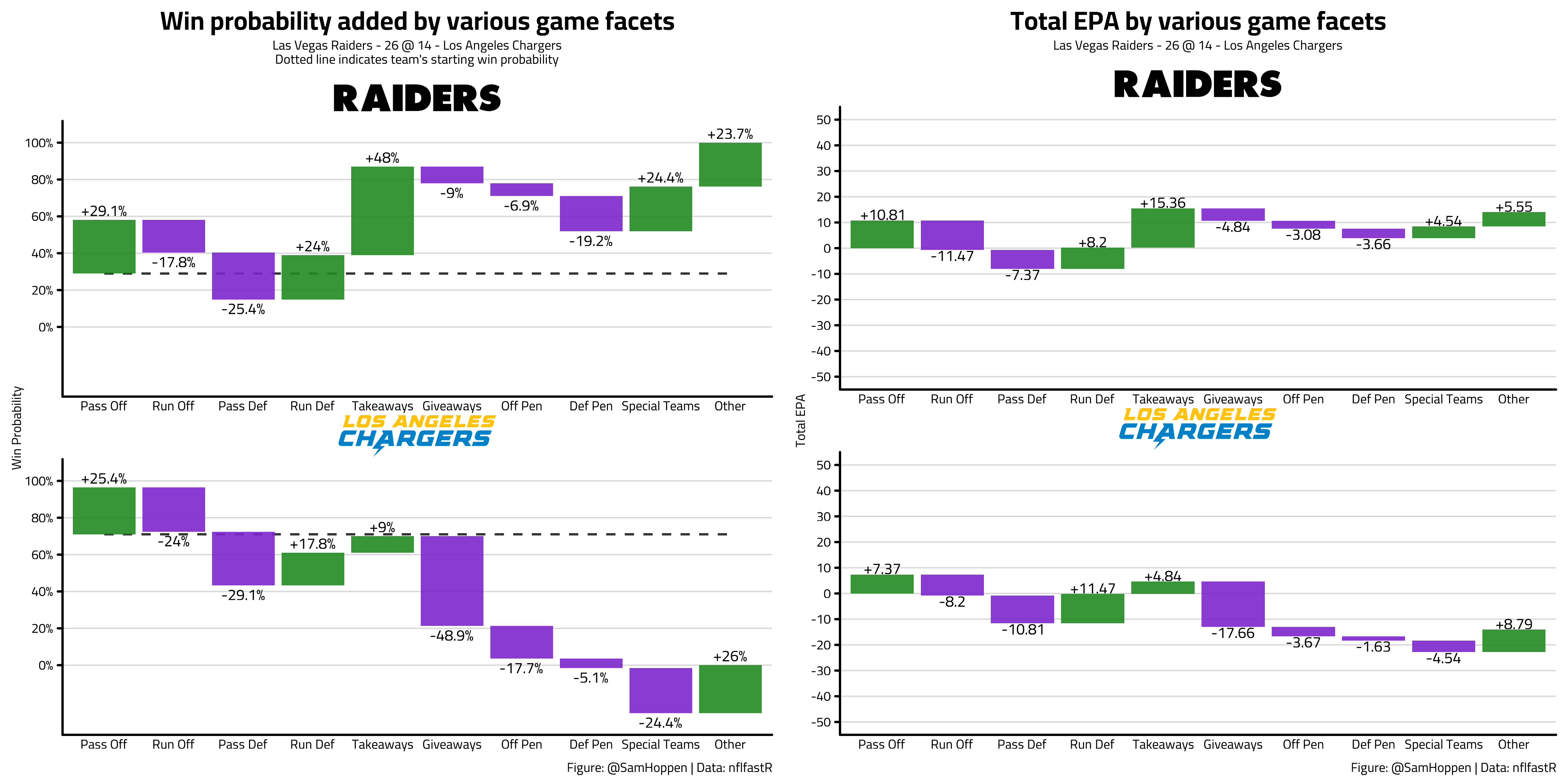
    If you want to measure a performance like that properly, the stat to know is EPA, expected points added. It grades every play by how much it moved a team’s expected points up or down, which strips the scoreboard out and rewards good football over lucky football. It is exactly what Sam Hoppen charts, game by game, and his Vikings-Bears breakdown shows how one-sided the day really was.

    Read Sam Hoppen

    If you want to see how a game was actually won and lost, past the final score, this is the work to follow. Every week, for every single game, Sam Hoppen charts the win probability and the expected points added on both sides of the ball. It is some of the clearest football data going, and it is free. Do yourself a favour and subscribe to Hoppen to Conclusions. Both charts in this piece are his.

    A brilliant offence and a well-drilled defensive plan met on the same field, and this week the plan won. That is the whole game in one sentence, and it is why a single enormous week never settles anything.

    For the numbers that measure a defence properly, defense stats, decoded breaks them down.

    The upset of the week turned on one gutsy decision

    The New Orleans Saints walked into Baltimore as heavy underdogs, trailed 14-6 at the break, and walked out 24-17 winners. The game turned on nerve. With the ball near the goal line and the result in the balance, head coach Kellen Moore turned down the safe field goal and went for it on fourth down instead, the last of the four attempts a team gets to move the ball ten yards. Quarterback Tyler Shough sneaked it in himself for the score that won it.

    Going for it there used to look reckless. It is now, more and more, just arithmetic. Close to the goal line, the points a team can expect from going for the touchdown outweigh the near-certain three from a kick, as long as it backs the offence to convert. Moore backed his in each of the first two weeks, and this time it paid off. Sam Hoppen’s charts show the swing in full.

    The safe call and the smart call are not always the same one, and the space between them is where coaches earn their money. If you want the mechanics of downs and why a team “goes for it”, how the NFL works lays it out.

    The Chargers are 0-2, and the way they got there is uncanny

    The Los Angeles Chargers have now lost both their games by the exact same score, 26-14, first to Arizona and then to the Raiders. ESPN Insights flagged just how odd the start is: they are only the fourth team in NFL history to open 0-2 against opponents who each won three or fewer games the season before.

    One caution before anyone buries them: that is four teams across roughly ninety seasons, which is another way of saying it is barely a pattern, and it is two games of football. The underlying numbers are not kind either.

    As Sam Hoppen’s data shows, the Chargers sit near the very bottom of the league for offensive efficiency through two weeks, and they are running the ball for a league-worst return per carry.

    Chart by Sam Hoppen, Hoppen to Conclusions.

    The team that handed them Sunday’s defeat, of course, was the Raiders, who I cover on their own in the Raiders Week 2 review.

    Two identical defeats make a tidy story. Whether they add up to a bad season is a question only the next month can answer.

    What did NFL Week 2 show us?

    The Bears’ 59 points and the Giants’ statement win over Dallas were both gone by Sunday night, replaced by a 3 and a 28-6 hiding on Monday. That does not mean Week 1 lied and Week 2 is the truth. It means two data points are not a trend, and the league spends September reminding everyone of exactly that. I will keep decoding it a week at a time.

    Wonder which way the pendulum swings next, if it swings at all. Roll on Week 3!

  • Do NFL stats lie? The Bears rushing number, decoded

    Do NFL stats lie? The Bears rushing number, decoded

    Three. That is how many games the Chicago Bears have run for 250-plus yards in since the start of the 2025 season. The rest of the NFL, all 31 other teams put together, has four. One team is sitting on nearly half the league’s total by itself, and that lopsidedness is the whole reason the stat stops your thumb mid-scroll.

    I did precisely that when this post crossed my feed on X over the weekend.

    simple question: do the stats lie?

    Well, not this one. The number is real. It’s also carefully framed, and the framing is the part worth seeing, because the same move sits behind half the stats anyone will ever throw at you about a team.

    What the number is actually counting

    Rushing means running the ball forward, not throwing it. A rushing yard is a yard a team gains on the ground, and 250 of them in a single game is a lot.

    The modern NFL is a passing league. Most teams are built to throw first and run mainly to kill the clock late in a game they are already winning. A 250-yard day on the ground means a team either has a genuinely dominant offensive line and running back, or spent the afternoon steamrolling a helpless opponent, or both. Plenty of teams go a whole season without one.

    So the Bears having three while everyone else combined manages four is a genuine outlier. That part isn’t a trick.

    Why the stats framing lands so hard

    The line doing the heavy lifting is “the rest of the NFL only has four combined.”

    Said flat, “the Bears have had three big rushing games since last season” is a shrug. Reframed as three against four-across-everyone-else, the identical fact becomes a scarcity story. Your brain does the maths, sees one team holding nearly half a league-wide total, and reads dominance. It’s the same move a good headline makes, and it works.

    The two dials every stat like this is set on

    Here is the part nobody points out. A stat like this has two dials, and whoever writes it chooses where both are set.

    The first is the window: “since the start of last season.” Not this season, not the last five years, not since 2020. A specific start date, picked.

    The second is the threshold: 250 rushing yards. Not 200, not 300. A specific line, picked.

    Nudge either one and the picture moves. Drop the line to 200 yards and other teams walk back into the count. Widen the window and the gap can shrink. This isn’t the tweet lying, it’s just how a stat like this is made: choose the window and the line that make your team look most singular, then let the number speak for itself.

    Knowing the dials are there is the difference between being impressed and being informed.

    The stat itself is still true, though

    Don’t take my over-analysis as cynicism. The dials being adjustable doesn’t make the Bears’ running game fake.

    They finished the 2025 season third in the league for rushing yards per game, with two backs, D’Andre Swift and Kyle Monangai, both clearing 750 yards on the ground. Under head coach Ben Johnson, this is a team with a real identity: win by running the ball straight down people’s throats, in a league built around the pass. The stat is dressed up, but the thing underneath it is real.

    So, do NFL stats lie?

    No, as long as you understand that a good stat like this is doing two things at once: telling you something true, and choosing the frame that makes it land hardest. Both can be true together.

    The Bears really are running the ball better than anyone right now, and the person who wrote that stat really did pick the window and the line that said so most loudly.

    Seeing both at the same time is the whole skill, and it’s the same one behind reading a tidy power ranking without swallowing it whole.

  • One position owns the top of the NFL draft

    One position owns the top of the NFL draft

    Eight of the last ten players taken first in the NFL draft were quarterbacks. The other two were edge rushers, and both were treated as mild surprises.

    What “first overall” NFL Draft pick means

    The draft is how NFL teams sign new players out of college, and the team that finished the previous season with the worst record picks first. That very first name called is the “first overall” pick, the most prized slot in the whole event, and you can read how a team ends up with it here.

    Almost every year, that pick is spent on a quarterback: the player who takes the ball at the start of nearly every play and runs the offense.

    So the most valuable pick in the sport nearly always buys the same job.

    Why that is stranger than it sounds

    A team with the first pick can choose any player, at any of the twenty-odd positions on the field. It keeps choosing the same one.

    Through 2026, 38 quarterbacks have gone first overall, more than any other position by a wide margin. A running back has not been picked first since 1995.

    Out of a whole roster of roles, one has become the default answer.

    What a quarterback is actually worth

    The quarterback touches the ball on almost every offensive play and makes the first decision on most of them. Get that position right and the rest of the team looks better; get it wrong and little else helps. It is also the position with the numbers everyone argues about, which is how a quarterback gets measured.

    That is why a team will spend the single best pick it owns, and often trade up to reach it, on the chance of finding one.

    The top pick, put plainly, is a bet on a franchise quarterback.

    A comparison if you have come from football

    There is no draft in football, so the closest parallel is the transfer market. Picture a summer window where the biggest fee in the world went to the same position almost every year, decade after decade.

    That is what the top of the NFL draft looks like. The role that costs the most is settled before the bidding starts.

    The surprise at the top is not who goes first, but what they play.

    The Draft exceptions that make the point

    Only two of the last ten first picks broke the pattern: Myles Garrett in 2017 and Travon Walker in 2022, both edge rushers, the defenders whose main job is to chase down the quarterback.

    When a team passes on a quarterback with the first pick, it is notable enough to lead the coverage.

    The rule is firm enough that breaking it becomes the story.

    Last ten No. 1 picks — table preview

    The last ten No. 1 overall picks

    Eight quarterbacks, two edge rushers. The exceptions are shaded.

    Year First overall pick Pos Team
    2026Fernando MendozaQBLas Vegas Raiders
    2025Cam WardQBTennessee Titans
    2024Caleb WilliamsQBChicago Bears
    2023Bryce YoungQBCarolina Panthers
    2022Travon Walkernot a QBEDGEJacksonville Jaguars
    2021Trevor LawrenceQBJacksonville Jaguars
    2020Joe BurrowQBCincinnati Bengals
    2019Kyler MurrayQBArizona Cardinals
    2018Baker MayfieldQBCleveland Browns
    2017Myles Garrettnot a QBEDGECleveland Browns

    Positions: QB quarterback, EDGE edge rusher. Source: NFL first overall pick records via Pro Football Reference; all-time position counts via NBC Sports. Last updated: 20 September 2026.

    So when a team wins the race to the bottom and lands the first pick, half the guesswork about who they will take is already done for you. It is almost always the quarterback. The rare year it is not usually means that team either had its quarterback already, or looked at the ones on offer and decided none was worth the sport’s most expensive bet.

  • The Tuck Rule game and the eleven years it took to kill the rule

    The Tuck Rule game and the eleven years it took to kill the rule

    Tom Brady lost the ball, the Raiders recovered it, and the Patriots’ season should have ended there. Referee Walt Coleman went to the replay screen and came back with an incomplete pass, because of a rule so obscure most people watching had never heard of it. The Patriots won in overtime, went on to their first Super Bowl, and eleven years later the NFL scrapped the rule entirely by a vote of 29-1.

    This is the third of three plays so contentious the league rewrote its book. The Raiders are in all of them: beaten by the Immaculate Reception in 1972, winners by the Holy Roller in 1978, and on the wrong end here.

    What happened in the snow at Foxboro

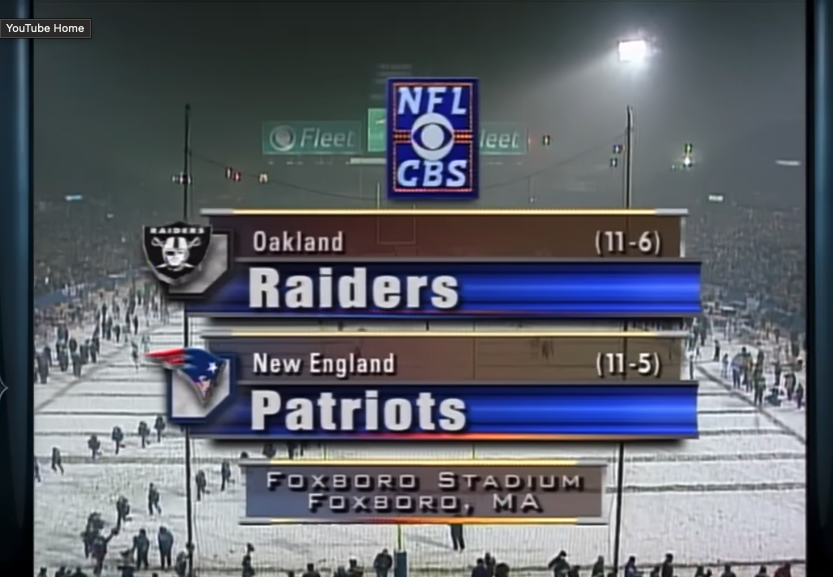
    Raiders vs Patriots screen grab of a still from the NFL YouTube video on the Tuck Rule.

    Image still is from the NFLs YouTube Channels, Raiders vs. Patriots: ‘Tuck Rule’ Game | NFL 2001 Divisional Round Highlight

    It was 19 January 2002, an AFC divisional playoff game at Foxboro Stadium, played through heavy snow. The Raiders led the New England Patriots 13-10 in the fourth quarter.

    With under two minutes left, Raiders cornerback Charles Woodson blitzed from Brady’s right and hit him as he brought the ball down. The ball came loose. Raiders linebacker Greg Biekert recovered it, which, with the Raiders ahead and the clock running down, would have effectively ended the game.

    Coleman reviewed the play and overturned the call. Not a fumble, an incomplete pass. New England kept the ball.

    Adam Vinatieri kicked a 45-yard field goal through the snow with 27 seconds left to tie it, then a 23-yarder in overtime to win it 16-13. Two games later the Patriots won Super Bowl XXXVI.

    What the tuck rule actually said

    The rule was Rule 3, Section 22, Article 2, Note 2, and it had been in the book since 1999. In plain terms: once a quarterback starts moving his arm forward to throw, it counts as a forward pass even if he loses the ball while pulling it back into his body. Only once the ball is fully tucked against him does dropping it become a fumble.

    That is the whole thing. It sounds like a technicality because it is one. A quarterback who has visibly given up on throwing, and is bringing the ball back to his chest, is still legally “passing” until the tuck is complete.

    So Brady dropping the ball mid-tuck was, by the letter of the rule, an incomplete pass rather than a fumble.

    Why the call was defensible and infuriating at once

    Coleman applied the rule as written. That is the uncomfortable part for anyone wanting a villain: the ruling followed the text.

    The Raiders never accepted it. Woodson has maintained for years that it was a fumble and the call was wrong. Bruce Allen, then running the Raiders’ front office, put the objection more precisely: he said the rule itself did not bother him, but that as the rule was written, it was a fumble.

    Coleman later said the reversal was right and it was his on-field explanation that had been muddled. The NFL backed the call, and its competition committee reviewed the rule after that season and left it alone.

    What made it burn was not a rogue referee. It was a rule almost nobody agreed with, enforced correctly at the worst possible moment.

    The eleven-year wait

    The rule survived far longer than the outrage suggests. It kept surfacing, roughly a dozen times a season by the league’s own account, including a Chiefs-Ravens playoff game in January 2011 where a Matt Cassel fumble was reversed to an incomplete pass on review. Mike Pereira, the NFL’s former head of officiating, publicly withdrew his support after that one.

    Then on 20 March 2013, at the annual meeting in Phoenix, the owners voted 29-1 to strike it out. Pittsburgh cast the only vote to keep it. New England abstained, as did Washington, whose general manager was that same Bruce Allen, by then citing a tribute to the late Raiders owner Al Davis.

    Patriots owner Robert Kraft, asked about it afterwards, said he loved the tuck rule and always would, and that Al Davis was probably smiling. Today, a quarterback who loses the ball while tucking it has fumbled, full stop.

    What the three plays add up to

    Put the series side by side and a pattern shows. In 1972 the rule was too strict, and the NFL repealed the double-touch restriction six years later. In 1978 the rule was too loose, and the league closed the fumble loophole within months. In 2002 the rule was simply bad, and it took until 2013 to go.

    The rulebook is not handed down finished. It gets rewritten by the plays that break it, usually years after everyone has agreed it should be.

    Watch a quarterback lose the ball mid-motion this season. It is a fumble, no debate, no replay booth searching for an arm angle. That clean answer cost the Raiders a playoff game and took the league eleven years to arrive at.

  • The Immaculate Reception and the rule that made it a coin flip

    The Immaculate Reception and the rule that made it a coin flip

    A deflected pass, scooped inches off the turf and run in for the winning touchdown, is the most famous play in NFL history. What almost nobody remembers is that under the rules of the day it was arguably illegal, and referee Fred Swearingen had to work out which of two players the ball had touched before he could decide whether to allow it. Get that wrong and the Steelers lose.

    This is the second of three plays so contentious the NFL changed its book because of them, and the Raiders are on the wrong end of this one. Six years later they would even the score against the Chargers with the Holy Roller, a play the losing side named in direct revenge for this one.

    What happened at Three Rivers Stadium

    Raiders vs Steelers screen grab of a still from the NFL YouTube video on the 'Immaculate Reception'

    Image still is from the NFLs YouTube Channels, ‘The Immaculate Reception’ Raiders vs. Steelers 1972 AFC Divisional Round

    It was 23 December 1972, an AFC divisional playoff game between the Pittsburgh Steelers and the visiting Oakland Raiders. The Steelers had led 6-0 on two Roy Gerela field goals. With 1:17 left, Raiders quarterback Ken Stabler ran 30 yards for a touchdown, and George Blanda’s extra point put Oakland ahead 7-6. If that name is familiar, it should be: Stabler is the same quarterback who would beat the Chargers with the Holy Roller six years later.

    That left Pittsburgh with fourth down and ten yards to go from their own 40-yard line, 22 seconds on the clock, and no timeouts. Fourth down is the last of the four attempts a team gets to advance the ball ten yards, so this was the final play of their season if it failed.

    Quarterback Terry Bradshaw scrambled away from the rush and threw downfield toward running back John “Frenchy” Fuqua. Raiders safety Jack Tatum arrived at the same instant, the collision sent the ball flying backwards, and rookie running back Franco Harris caught it just before it hit the ground and for a 60-yard touchdown. Pittsburgh won 13-7.

    The rule that made it a coin flip

    Here is the part that gets lost behind the highlight. Under the 1972 rules, two offensive players could not legally touch the same pass one after the other. If the ball came off Fuqua and went straight to Harris, both Steelers, the catch was illegal and the pass incomplete.

    A defender touching it changed everything. If the ball hit Tatum, or hit both men in any order, the play was legal and the touchdown stood.

    So the entire game hung on a contact nobody could see clearly at full speed: did the ball graze Tatum, or only Fuqua?

    How the referee decided

    Swearingen could not call it alone. He consulted umpire Pat Harder and field judge Adrian Burk, who both reported seeing the ball hit Tatum as well as Fuqua. He then went to a sideline telephone to speak to Art McNally, the NFL’s supervisor of officials, before emerging and signalling touchdown.

    There was no instant replay in 1972, so nobody could go to a screen and settle it. The crew’s own eyes were the entire evidence base, and his position on the field gave him no view of the collision at all.

    Raiders coach John Madden ran onto the field to argue. Fans still argue. The honest answer is that the play was too fast and the footage too limited for certainty, which is precisely why it remains contested.

    Why the NFL scrapped the rule

    The double-touch rule survived this game, but not for long. The NFL repealed it for the 1978 season, and today there is no restriction on deflections at all. A pass can bounce off any number of players, attacking or defending, and a catch is a catch.

    The Immaculate Reception was not the only reason. The same rule had caused a disputed touchdown in Super Bowl V, and the league took years to act on both.

    Run the play under today’s rules and there is no controversy to have. Whoever the ball touched, Harris made a legal catch and the touchdown counts.

    The year both these plays point at

    Here is what makes this pair worth reading together. The double-touch rule was repealed for the 1978 season. The Holy Roller happened in September 1978, and its rule change followed that same winter.

    So 1978 is the hinge: the league scrapped the rule that nearly voided this touchdown, then within months wrote a new one to void the Raiders’ trick against the Chargers. Two plays, one short stretch of rewriting, and Ken Stabler on the field for both.

    Watch it: the NBC broadcast footage is on YouTube, and there is a slow-motion version if you want to judge the deflection for yourself. Fair warning: fifty-odd years of people staring at it has not produced agreement.

    That leaves one more play in this series, and one more Raiders rule change. The third is the one still shouted about in bars, and the only one where the league took eleven years to admit the rule was the problem.

  • The Super Bowl party has its own game, and it isn’t the football

    The Super Bowl party has its own game, and it isn’t the football

    Twenty-eight million. That is roughly how many Americans, going into the 2023 Super Bowl, planned to bet casually with friends in a pool or a squares contest rather than at a sportsbook.

    Most of the betting around the Super Bowl is not what you would picture. It is not a room of serious gamblers studying the odds. It is a party game, often for a dollar or two, and plenty of the people playing it could not name a single player on the field. If you are watching from outside the US, the whole thing looks a little strange, and from the UK it is a smaller, later affair anyway, which I have covered in how to watch the Super Bowl.

    What the grid on the fridge actually is

    The party’s engine is Super Bowl squares. It is a ten-by-ten grid, so a hundred squares, and people write their name in as many as they fancy, usually for a small buy-in.

    Only once the grid is full does anyone get a number. Each row and each column is randomly assigned a digit from 0 to 9. You win if the last digit of each team’s score lands on your square at the end of a quarter.

    There is no skill in it and no football knowledge required, which is the entire point. A grandmother who has never seen a game has exactly the same chance as the friend who watches every week.

    The bets that have nothing to do with football

    The other party staple is the prop bet, short for proposition bet, a wager on something other than who wins.

    The famous ones have nothing to do with the sport. People bet on the coin toss, on how long the national anthem lasts, on the colour of the Gatorade (the sports drink) tipped over the winning coach, and on which song opens the halftime show.

    That is the cultural trick. A prop turns a moment nobody cares about into a reason to shout at the television, so a casual watcher has something riding on the night from the first whistle.

    Why this became the main event

    Since the US began legalising sports betting in 2018, the betting has moved from the edges of the broadcast to the middle of it. I spent years doing SEO in sports betting, so I watched that shift from the inside: the pools and the novelty props exist to hand a casual viewer a stake in a game they have no team in.

    The scale now is genuinely large. Americans were expected to wager a record $1.76 billion legally on the 2026 game, and that figure counts only regulated bets, not the dollar-a-square pools running in a hundred thousand kitchens.

    A note on the betting itself

    Squares and a friendly pool are a party game. Actual sportsbook betting is a different thing: legal and regulated across much of the US since 2018, and long-established but differently regulated in the UK.

    Wherever you are, it is meant to be entertainment, not a way to make money, and over time the odds are built to favour the house, not you. I don’t run betting links on these pages. If that ever changes, they will be clearly marked as paid, because I would rather you trusted the guide than the ad.

    So if you get invited to one

    The grid on the fridge is not a test you can fail. It is a raffle.

    Put your name in a square, pick a prop that makes you laugh, and you will have a stake in the game before kickoff, sat right next to the people who have watched football their whole lives. For one night, that is the great leveller, and it is a surprisingly good way in. If you want to know what you are actually watching once the game starts, the Super Bowl explained is the place to begin.

  • How the ‘Holy Roller’ rewrote the NFL rulebook

    How the ‘Holy Roller’ rewrote the NFL rulebook

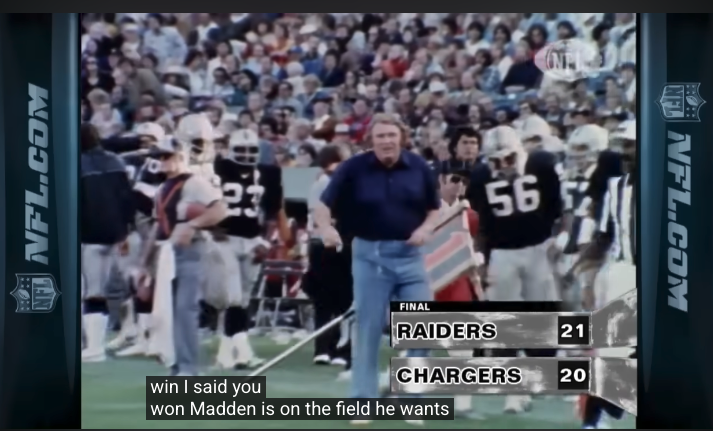
    Ken Stabler dropped the ball on purpose. Two Raiders team-mates, Pete Banaszak and Dave Casper, knocked it forward toward the goal line, and Casper fell on it in the end zone. Errol Mann’s extra point won the game 21-20.

    Raiders vs Chargers screen grab of a still from the NFL YouTube video on the 'Holy Roller'.

    Image still is from the NFLs YouTube Channels, Top Controversial Plays: ‘The Holy Roller’

    Then the NFL was so unimpressed it rewrote the rulebook that spring so nobody could ever do it again. That is the Holy Roller, a 1978 Raiders win the Chargers still call the Immaculate Deception, a bitter pun on the Immaculate Reception, the play that had knocked the Raiders out six years earlier. Same league, same era, opposite luck.

    I’m telling you about it now because this Sunday the Las Vegas Raiders (my team, so I’ll keep myself honest about how they won this one) travel to the Los Angeles Chargers in Week 2, their first divisional game of the season. It is the same fixture as the Holy Roller, both clubs relocated since: in 1978 it was the Oakland Raiders at the San Diego Chargers. The Raiders go in 1-0 after a Week 1 win over Miami. Every tight finish this rivalry throws up now runs on the rule this one play created.

    What happened in the final ten seconds

    Ten seconds were left, the Raiders trailed 20-14, and they had the ball on the Chargers’ 14-yard line. Quarterback Ken Stabler, a left-hander known as “The Snake,” rolled to his right as the Chargers’ rush broke through, an awkward way for a left-handed passer to move, and with nothing on he threw the ball forward onto the turf. A fumble: a ball dropped rather than passed, which either team can grab.

    What followed was not luck. Running back Pete Banaszak reached the ball, could not keep his feet, and shoved it forward again. Tight end (an attacking player who blocks and catches passes) Dave Casper got there next, batted and kicked it into the end zone, and fell on it for the touchdown as time expired. Errol Mann kicked the extra point, and the Raiders won 21-20.

    Three Raiders touched the ball on its way to the goal line, and every touch moved it closer. That is the whole controversy in one sentence.

    Watch it happen: the full enhanced video of the play is on YouTube, as is the radio call by the Raiders’ Bill King, which became one of the most famous in the sport.

    The rule that was already in the book

    Here is the part almost nobody mentions. The rules already had a line for this. A fumble sent forward on purpose was not meant to count as a fumble at all: ruled deliberate, it becomes a forward pass, not a loose ball.

    That one distinction decides the game. A forward pass that hits the ground untouched is simply incomplete: the ball comes back, the down ends, and at zero on the clock the Chargers win 20-14. Ruled a fumble, the ball stays live and Casper’s recovery counts. So the officials were not staring at a hole in the rules. They were staring at a rule that turned on a single word: intent.

    The rulebook had already imagined this exact trick. It just could not prove it in real time.

    Why the referee let it stand

    Referee Jerry Markbreit ruled it a legal play, and the league backed him. The reasoning was that the crew could not be sure the forward taps were deliberate, and without that certainty they could not upgrade the fumbles to illegal forward passes. In a live scramble, that is a defensible call.

    The trouble is what the players said afterwards. Stabler was blunt about his own fumble: “I fumbled it on purpose.” His team-mates insisted their touches were real attempts to recover, and the doubt never lifted.

    The call held not because the play was clean, but because intent is almost impossible to judge in the half-second you get to judge it.

    The rule the Holy Roller created

    The NFL does not usually rewrite its book over one game. It did over this one. After the 1978 season the league added a rule, now Rule 8, Section 7 of the rulebook, restricting who can advance a fumble.

    As it stands today:

    On fourth down, or after the two-minute warning in either half, only the player who fumbled may recover and advance the ball for his team.

    If a team-mate recovers it in those situations, the ball is dead. It goes back to the spot of the fumble if it travelled forward. The two-minute warning, for anyone new to it, is the automatic clock stoppage two minutes before the end of each half.

    Run the Holy Roller under that rule and it dies on contact. Banaszak touches the ball, and because he is not the man who fumbled, the play is dead and the ball goes back to where Stabler lost it. No forward crawl, no Casper touchdown, no win. The loophole was not clarified. It was shut.

    Why it matters when the Raiders visit the Chargers on Sunday

    The reason this is the play to start with is that the fixture is live again, and the rivalry has a long memory. These two have met well over a hundred times, and rivalries like this one don’t fade.

    Watch the late-game fumbles this Sunday. Any loose ball in the final two minutes now gets whistled dead the instant a team-mate of the fumbler touches it, and the ball trots back upfield while newcomers wonder why the recovery did not count. That is not officials being fussy. That is a 1978 Raiders trick, written into law and still enforced 48 years later.

    You now know something most people watching the game do not: the fumble rule they are half-ignoring exists to stop the Raiders doing this to the Chargers a second time.

    This is the first of three plays so notorious the NFL changed its book because of them. The Raiders turn up in all three, which tells you something about the Raiders.

  • Raiders Week 1 Review: what the 27-13 win actually told us

    Raiders Week 1 Review: what the 27-13 win actually told us

    I have spent a lot of Septembers braced for the Raiders to invent a new way to lose. Not this one, this one was a fun one. Las Vegas opened 2026 with a 27-13 win over Miami, led from the first quarter to the last, and for once I got to enjoy every minute of it (NFL.com, ESPN).

    Not a classic game, and it didn’t need to be. A win is a win. Miami are the youngest team in the league and were always likely to be outmatched. But a comfortable home win, with a new quarterback settling in and the defence setting the tone, is exactly the start I wanted. I will take that any day!

    How the Raiders first game went down

    The Raiders never trailed. Scoring first, they led 17-6 at the half, stretched it to 27-6 through three quarters, then let Miami close the gap to the final margin once the game was already decided.

    QuarterDolphinsRaiders
    Q107
    Q2610
    Q3710
    Q400
    Final1327

    The Raiders sacked Miami quarterback Malik Willis five times, with Maxx Crosby credited for a share of them, and Willis spent most of the afternoon throwing before he wanted to (ESPN).

    A sack is simply tackling the quarterback behind the line before he can get rid of the ball, and it does two things at once: it loses the offence yards, and it rattles the person the whole thing depends on. Do it five times and you are not really letting the other team play. If you want the rest of the ways a defence takes a game over, I have the defence, decoded.

    The key number: 300

    Kirk Cousins, playing his first season in silver and black after arriving from Atlanta, completed his first ten passes and finished 21 of 30 for 160 yards and three touchdowns. Somewhere in there he threw the 300th touchdown pass of his career, only the fifteenth quarterback in NFL history to reach that mark, nudging one clear of John Elway (ESPN).

    A touchdown pass is what it sounds like, a throw the receiver catches in the end zone for six points, and 300 of them is a career, not a season. To put the scale on it: the league has been played since 1920 and fewer than fifteen men have ever got there. It is the kind of number that tells you what a steady quarterback is worth, which is most of what the Raiders were buying.

    He also threw two interceptions, so let us not get completely carried away, but the efficiency was the point. If you want to know why completion percentage and the numbers around it matter more than they look, QB stats, decoded lays it out.

    The key Raider Nation takes

    Jack Bech caught the first touchdown of his career, and the Raiders were quick to mark it.

    Then the milestone that had Raiders social buzzing all night: Maxx Crosby became only the third player in franchise history to reach 70 career sacks (ESPN). Seventy sacks from a defensive end is a decade of Sundays being the problem, and he is doing it in silver and black.

    I was not the only one who liked what I saw. Sports Illustrated’s Raiders desk ran three “overreactions” to the win, and their headline one is Ashton Jeanty, the second-year running back who looked like a genuine workhorse behind a rebuilt offensive line (Sports Illustrated).

    That is their read, framed as an overreaction on purpose, and I would only add that an offensive line going from a punchline to a strength is the quietest, most important thing that happened on Sunday.

    Where they sit now after NFL Week 1

    Raiders are 1-0 and, for a change, the AFC West is easy on the eyes. Kansas City did Kansas City things and beat Denver 31-10, but the Los Angeles Chargers, the team most people fancied to push the Chiefs, were upset at home by Arizona.

    AFC WestRecordWeek 1
    Las Vegas Raiders1-0beat Miami 27-13
    Kansas City Chiefs1-0beat Denver 31-10
    Denver Broncos0-1lost to Kansas City
    Los Angeles Chargers0-1lost to Arizona

    It is one week, and the division still runs through Kansas City until somebody proves otherwise, which is a story as old as the Chiefs and Raiders themselves. But there was a nice outside marker too: Pro Football Network’s Defense Impact metric for Week 1 put the Raiders fifth in the league, inside a top ten it shared on Monday (PFN). Read that for what it is, one analyst’s summary of a single afternoon that already happened, not a forecast. If you want to know how a record turns into a playoff place come January, the NFL playoffs and seeding explains where 1-0 actually gets you, and the AFC and NFC covers why the division matters most of all.

    The rest of the league

    The Raiders were one of sixteen games, and Week 1 had a 96-point shootout, an overtime rule earning its keep and two games decided by a two-point conversion. I wrote all of it up in the full Week 1 roundup across the league.

    Before I get carried away

    Week 1 lies, and it lies to Raiders fans as readily as anyone. A comfortable win over a rebuilding team is a good day, not a guarantee of the season ahead. The real test comes next Monday morning UK time, when Las Vegas travel to face the Chargers on the road in a division game that will tell us far more than this one did.

    For now, though, I am allowed to enjoy a 1-0 start. Well done Raiders. See you next week.

  • NFL Week 1 Review: what actually mattered

    NFL Week 1 Review: what actually mattered

    Ninety-six points. That is what the Chicago Bears and Carolina Panthers scored between them on Sunday afternoon, the most in any season-opening game in NFL history (ESPN). The Bears put up 59 of them, their highest total in a single game since 1980 (NFL.com).

    That was the standout moment of Week 1. But it wasn’t the only one that was worth understanding. A game in Detroit came down to the league’s new overtime rule. A team in Philadelphia was stopped one play short of tying a match it had clawed back into. And a couple of defences won games their offences never really controlled.

    This was a fun NFL Week 1 for me, so let’s get straight into it and start with the results!

    The NFL Week 1 results

    Every one of the 32 teams plays in Week 1, so there are no byes and nobody sitting out. Kickoff times are US Eastern, so for anyone reading in the UK, the Sunday-afternoon games land on Sunday evening our time, and Monday Night Football runs into the early hours of Tuesday.

    Matchup (away at home)Result
    New England Patriots at Seattle SeahawksSeahawks 13-10
    San Francisco 49ers at Los Angeles Rams49ers 27-7
    Chicago Bears at Carolina PanthersBears 59-37
    Baltimore Ravens at Indianapolis ColtsRavens 41-23
    Atlanta Falcons at Pittsburgh SteelersSteelers 20-13
    Cleveland Browns at Jacksonville JaguarsJaguars 34-10
    Tampa Bay Buccaneers at Cincinnati BengalsBengals 33-27
    New York Jets at Tennessee TitansJets 23-10
    New Orleans Saints at Detroit LionsLions 31-30 (OT)
    Buffalo Bills at Houston TexansBills 36-31
    Arizona Cardinals at Los Angeles ChargersCardinals 26-14
    Green Bay Packers at Minnesota VikingsVikings 39-22
    Miami Dolphins at Las Vegas RaidersRaiders 27-13
    Washington Commanders at Philadelphia EaglesEagles 24-22
    Dallas Cowboys at New York GiantsGiants 28-20
    Denver Broncos at Kansas City ChiefsChiefs 31-10

    Following the Raiders? They opened the season with a 27-13 win over Miami. I break their game down properly, and what it sets up for the weeks ahead, in the Raiders Week 1 review.

    The Bears scored 59, and the number that frames it

    Chicago gained 552 total yards and ran in six touchdowns, which is not a typo (NFL.com). Total yards is just every yard a team gains, running and passing added together, and 552 is an enormous day; a healthy offence might manage 350 to 400. Caleb Williams threw for 269 yards and two scores, ran in two more himself, and finished with a passer rating of 124.1.

    Passer rating is one number that tries to sum up how well a quarterback threw the ball, on a scale that tops out at 158.3. Anything above 100 is a strong afternoon, so 124.1 tells you Williams was close to faultless as a passer, before you even count his running. If you want the full picture of what that number rewards and what it quietly ignores, I have it here: QB stats, decoded.

    The combined-points record does not tell you Chicago is a contender or Carolina a disaster. It tells you both defences had a rotten afternoon on the same field at the same time. Enjoy it for what it is, and no more.

    How Detroit won in overtime, and why New Orleans was not robbed

    The Lions and Saints were level at 24-24 when regulation ended, so the game went to overtime, and overtime is where a rule change from last season earned its keep. Detroit got the ball first and scored a touchdown. Under the rule the NFL used until 2025, that would have ended the game on the spot, and New Orleans would have lost without their offence taking a single snap in the extra period.

    That is exactly what happened to the Buffalo Bills in a famous 2022 playoff defeat, and it is why the league changed the rule. Now, in the regular season, both teams are guaranteed a possession in overtime, the same as the playoffs (I have the full NFL season and overtime breakdown here). So New Orleans got the ball back and answered with a touchdown of their own, which pulled them within one, at 31-30.

    Then came the decision. They could kick a routine extra point to tie the game at 31-31 and play on, or go for a two-point conversion to win it there and then. They went for the win, the pass fell incomplete, and Detroit survived 31-30. Regular-season overtime lasts ten minutes, and if nobody is ahead when it ends, the game is recorded as a tie. New Orleans decided they would rather win or lose than settle.

    The defences that showed up like an offence

    A defence does not only stop the other team. The defense can take the ball away, and it can score. NFL Week 1 gave clean examples of both.

    In Pittsburgh, T.J. Watt put away a 20-13 win over Atlanta with a pick-six, an interception carried all the way back to the end zone for a touchdown (NBC Sports). A defender catches a pass meant for the other side and runs it in to score. It is the most deflating play in football if it happens to your team.

    In Cincinnati, the Bengals took the ball off Tampa Bay four times and turned one into points, Demetrius Knight Jr. scooping up a loose ball and carrying it 27 yards for a touchdown (NFL.com). A takeaway is any turnover a defence forces, an interception or a recovered fumble, and each one hands the ball straight back to your own offence. Four in a single game is daylight robbery.

    Individual plays are one thing; rating a whole unit’s afternoon is another, and this is where defensive stats come in. The plain ones count what you can see: sacks (tackling the quarterback before he can throw), takeaways, and the points and yards a defence gives up. The cleverer ones roll all of that into a single number so one defence can be ranked against another. Pro Football Network published one such measure after Week 1, their Defense Impact score, and it put Kansas City top, which fits the way the Chiefs smothered Denver on Monday night. Several of the defences from this review sit just behind them, with the Steelers, Bengals, Seahawks, Jaguars and the Raiders all inside the top ten.

    A number like that is worth reading for what it is: one analyst’s summary of what already happened, not a verdict on who is best or a hint at next week. If you want to know which defensive stats are worth watching, and what each one is really telling you, defense stats, decoded lays them out.

    Two-point conversion decided two games

    After a touchdown, a team almost always kicks a short extra point for one point. The alternative is to line up and run a single play from close to the goal line for two points instead. That is a two-point conversion, and it is rarer because it is riskier: come up short, and you get nothing.

    Week 1 served up both reasons a team goes for it. In Philadelphia, Washington scored a late touchdown to trail 24-22, which left them needing two points to draw level, since a kick would still have them a point behind. They went for two to force overtime, the Eagles broke it up, and Philadelphia won by that exact margin (Bleacher Report).

    In Detroit’s overtime, New Orleans met the other version of the same sum: a kick would only have tied it and dragged the game on, so they went for two to win outright. Both attempts came up empty. When a team waves away the easy extra point, the scoreboard nearly always explains why. If you want the rest of the ways points go up, how scoring works has it.

    The Monday night finish

    Kansas City closed the week out on Monday night with a comfortable 31-10 win over Denver, and it was built on defence and the run rather than anything flashy. The Chiefs held the Broncos to 176 total yards, sacked their quarterback four times, and broke a 60-yard touchdown run as part of a 220-yard rushing night. Not a classic match by any means, but a tidy way to end the round. If you are new to why every week finishes with a single prime-time game on a Monday, I have written up what Monday Night Football is and why it matters separately.

    One thing before you overreact

    NFL Week 1 is a single game out of seventeen, and it lies every year without fail. A team can look unstoppable in the opener and can then go on to miss the playoffs. At the same time another team looks finished and wins its division.

    The Bears scoring 59 is real, and it was the most fun anyone had all weekend, but it is not a cast iron guarantee. Enjoy the overreactions this week, mine included. Well done Raiders, and come back next week for the NFL Week 2 review!