The best-paid player on any NFL defense is not the man who runs it. It is the one whose only job is to get to the quarterback before the quarterback can do anything. Micah Parsons does exactly that for about $47 million a year, which makes him the highest-paid defender in the history of the sport, ahead of every cornerback and every linebacker who has ever played.
So the market has already answered the question. Ask an NFL team who matters most on defense and it votes with its cheque book, and the cheque goes to the man who rushes the passer. Watch an actual game, though, and the film hands you two other honest answers. Both of them are right, which is the interesting part.
The money has already picked a winner
The clearest answer to “who matters most” is the one nobody argues about, because it is written into contracts. Here is the top of the market at three defensive positions.
Position
Top-paid player
Roughly per year
The deal
Edge rusher
Micah Parsons
$47m
4 years, $188m with Green Bay, 2025
Cornerback
Sauce Gardner
$30m
4 years, $120.4m with the Jets, 2025
Off-ball linebacker
Fred Warner
$21m
3 years, $63m with San Francisco, 2025
Contract values via ESPN and NFL.com reporting, 2025 deals. Figures are average annual value and move whenever a new deal resets a market.
An edge rusher (the defender lined up on the end of the line whose job is to beat his blocker and reach the passer) sits about $17m a year clear of the best-paid cornerback, and more than double the best-paid off-ball linebacker (the defender in the middle who reads the play and makes tackles rather than rushing). Parsons’ deal made him the highest-paid non-quarterback in NFL history when he signed it. When teams spend like that, they are saying the rarest and most valuable defender is the one who can wreck a passing play on his own.
The market’s verdict is not close. On money, the pass rusher wins.
Watch a game and you get two other answers
Two other players have a real claim, and you only see it if you watch a snap instead of a spreadsheet.
The first is the linebacker with the green dot. On every defense, exactly one player has a small green sticker on the back of his helmet, and he is the only one with a radio to the coaches. He takes the call, then sets the other ten before the ball is snapped. If he lines the defense up wrong, all eleven are wrong, on that play and the next one. People call him the quarterback of the defense for good reason, and Fred Warner, the best-paid one, is the archetype.
The second is the shutdown corner. A cornerback like Gardner can follow the other team’s best receiver all game and take him out of it, which changes every throw the quarterback even considers. You tend not to notice, because the proof is that nothing happens on his side of the field.
You can watch all of this right now. Houston had the best yards-allowed defense in the league last season and has spent the 2026 preseason swarming people even with its starters resting. That is not one man. It is a pass rush, a secondary and a signal-caller working together, which is the whole point.
Why the money and the film disagree
Money does not price importance. It prices scarcity, in a league built on the pass.
Nearly every NFL offense lives or dies by throwing the ball, and the fastest way to ruin a throw is to hit the quarterback before he lets go of it. Players who can beat a blocker one-on-one and do that, snap after snap, barely exist. Rare plus game-warping equals expensive. A brilliant play-calling linebacker is valuable too, but his worth shows up as the whole unit being in the right place, which is harder to isolate and easier to replace, so the market pays it less.
The gap is not the market saying a linebacker matters half as much as a pass rusher. It is the market saying you can find a good linebacker more easily than you can find a wrecking ball off the edge. That is a different claim, and it is the one a salary actually makes. It is the same lesson as the one on the defensive stats page: no single number, and no single figure on a contract, ranks a defender on its own.
So who is the most important defender?
There is no single one, and the reason is worth having.
If you want to know who can win a game by himself, watch the edge rusher on passing downs. If you want to know who can quietly lose one, watch the player with the green dot. If you want to know why a star receiver vanished from the box score, find the corner nobody threw at. All three are the most important player on defense, depending on what you were really asking when you asked.
The gap in the table is the real tell. A team will pay a man to hunt the quarterback more than double what it pays the one who runs its whole defense. Whether that makes him the most important player or just the hardest to replace is the one question the money was never built to answer.
Common questions
Who is the highest-paid defensive player in the NFL?
Micah Parsons, an edge rusher for the Green Bay Packers, on a four-year deal worth $188 million, about $47 million a year. That made him the highest-paid non-quarterback in NFL history when he signed it in 2025.
Who is the most important player on an NFL defense?
There is no single answer, and that is the honest one. By the money it is the edge rusher, the pass rusher paid more than any other defender. By what happens on the field it is often the play-calling linebacker who sets the defense before each snap, or the cornerback who removes the other team’s best receiver. Which one you name depends on what you are asking.
The Chicago Bears, Detroit Lions, Green Bay Packers and Minnesota Vikings have all revealed new “Rivalries” uniforms for 2026, and each team will wear its version exactly once this season: at home, against a division rival.
If you saw the photos doing the rounds and wondered, just like I did, whether this is a genuine NFL thing or a one-off bit of marketing, it’s the genuine thing. It’s a real, multi-year programme run by the NFL and Nike, and this is only its second year. The nearest comparison for a non-US sports fan I can give is Manchester United’s 2026/27 third kit, an off-white Salford Lads Club tribute that trades on heritage and local pride the same way.
The NFC North “Rivalries” uniform debuts
Each club will debut its new look in a single home fixture against one of its NFC North rivals, and the four dates are already set.
Below is the full run for the division this season:
Team
Week
Home game against
Green Bay Packers
5
Chicago Bears
Detroit Lions
8
Minnesota Vikings
Minnesota Vikings
15
Detroit Lions
Chicago Bears
16
Green Bay Packers
The Packers will go first, in Week 5 against the Bears. The Bears close the set in Week 16, also against Green Bay, so that one pairing bookends the whole thing.
Nike x NFL Rivalries: yes, it’s a real collab
The Nike x NFL Rivalries programme launched in 2025 with eight teams from two divisions: the AFC East (Bills, Dolphins, Patriots, Jets) and the NFC West (Cardinals, Rams, 49ers, Seahawks). Each wore a one-off design during a home game against a rival, exactly as the NFC North teams will do this season.
These became Fanatics’ best-selling merchandise release to date: on launch day, Rivalries gear made up about 80% of all sales across Fanatics’ online network, including NFLShop.com. That is a large part of why the programme is back and growing rather than quietly dropped. It’s a four-year rollout, so by 2028 all divisions will have completed the programme:
Season
Divisions joining
2025
AFC East, NFC West
2026
AFC South, NFC North
2027
NFC East, AFC West
2028
AFC North, NFC South
Why the uniform only ever comes out against a division rival
In the NFL, the teams in your division are the only opponents you are guaranteed to play twice every season, once at home and once away. The league is split into eight divisions of four teams. Your three division rivals account for six of your seventeen games, home and away against each. (I’ve drawn the full map on the conferences and divisions page, and I explain how the seventeen games are built on the NFL season, explained.)
So when the league wants each team to debut a uniform against a rival, in a home game, it doesn’t have to hope the right fixture exists. It’s already on the calendar, twice.
The Bears and Packers game is the oldest one in the book
Two of the four teams, the Bears and Packers, have been playing each other since the 1920s, which makes theirs the oldest and most-played rivalry in the league. I’ve written the full story of it on the Bears–Packers rivalry page, so you can get the history here.
It’s a nice detail that the Bears chose “Monsters of the Midway”, their own decades-old nickname, as the theme of their new kit. The NFL didn’t invent these rivalries to sell uniforms. It just handed the oldest ones a fresh set of clothes.
The NFL collab is more than a commercial opportunity
Strip away the launch videos and the merchandise, and the Rivalries programme is really a nod to how the NFL is built: around divisions, and around the two games a year that turn near-neighbours into rivals.
You don’t have to buy a jersey to get the good part. You just need to know that when the Bears face Green Bay in Week 16 in something new, the reason that game exists at all is the same reason it has been played for a hundred years.
When I was writing my most recent post about the blindside and how this impacts the quarterback, the article was focused on the quarterback being right-handed. It got me wondering about left-handed quarterbacks, how many are there, do plays change, and more importantly does it make any difference?
As we get closer to the 2026 season start, the two most talked-about left-handed quarterbacks in the NFL play for the same team. Atlanta signed Tua Tagovailoa in March to compete with Michael Penix Jr., and in doing so became only the third team in league history to carry two left-handers at once. The others were the 1991 Cincinnati Bengals and the 1997 Jacksonville Jaguars.
That is how rare a lefty is. Two on one roster is a talking point.
Just how rare is a left-handed QB
About one in ten people are left-handers. In the NFL it is closer to none.
In 2020, the year Tua Tagovailoa came into the league, not one of the 107 quarterbacks signed to NFL rosters threw with his left hand. Across the league’s whole history only around 30 have ever played the position. ESPN puts the count at 33 since 1950. The last one to start a game before Tua was Kellen Moore, back in 2016. That is a decade ago!
Why the NFL has so few left-handed QBs
The scarcity is not an accident. The game is built around right-handers, and left-handers reach the top of it rarely.
The former quarterback David Carr described coming into an offense as a lefty as “like handing them a pair of right-handed scissors.” When plays are drawn up for a right-handed thrower, a left-hander arrives to find the whole design mirrored.
It shows up in the draft too. When Atlanta took Michael Penix Jr. eighth overall in 2024, he broke a long drought. The last left-hander drafted in the top ten before him was Matt Leinart, in 2006.
Do left-handed QBs actually have an edge?
This is the myth worth checking, because you will hear it often. The theory is that a left-hander is harder to face.
There is a grain of truth in it. A left-hander’s ball spins the opposite way to the one defenders and receivers see all week, and some say that makes the deep ball harder to judge and harder to catch.
But it is not really an advantage. That same reversed spin troubles the left-hander’s own receivers just as much, and there is no scientific case I could find that left-handers perform better as a group. The difference is real. The edge is mostly folklore.
The one difference that is concrete: the blindside flips
There is a single, clean way a left-hander changes a team, and it is the one we met last time.
A right-handed quarterback cannot see the left side as he throws, so the left tackle guards it. Flip the thrower and you flip the danger. A left-hander’s back is turned to the right, so his blindside is on the right, and the right tackle takes on the job the left tackle usually owns.
Ken Stabler joined him in Canton in 2016. Young was the league’s Most Valuable Player twice, won the Super Bowl and its MVP award, and took a record six passing titles. By the time he retired he had the highest career passer rating in NFL history.
Passer rating is the standard score for a quarterback’s passing, and I unpack how it works here.
One per era: the lefties worth knowing
The NFL has had a defining left-hander in most eras, even when it never had many at once.
Ken Stabler, “The Snake”, the Raiders’ great of the 1970s.
Boomer Esiason, the Bengals’ MVP of the 1980s.
Steve Young, the Hall of Famer, through the 1990s.
Michael Vick, the most electric runner the position had seen, in the 2000s.
Mark Brunell, Tim Tebow and Kellen Moore among the rest.
And now Tua Tagovailoa and Michael Penix Jr., both in Atlanta.
Roughly one memorable left-hander a generation, rarely two.
The left-hander who was born right-handed
Here is the odd part about the most famous left-hander in the game today. Tua Tagovailoa is naturally right-handed. He writes, eats and golfs with his right hand.
He throws left-handed because his left-handed father put the ball in his left hand as a toddler, so his dad would not be the family’s only left-hander. It stuck.
Why they stay rare
Left-handers will stay rare for as long as the game is drawn for the other hand.
What Atlanta has done is put two of them in one room and dare the league to work them out. Neither Tua nor Penix is Steve Young, at least not yet. But for a position that usually allows the league one memorable left-hander at a time, having two worth arguing about is its own small piece of history.
Do left-handed quarterbacks have an advantage?
No scientific case I could find says left-handers perform better. A left-hander’s ball spins the opposite way, which some receivers and defenders find harder to read, but that also troubles his own receivers, and NFL playbooks and blind-side protection are built for right-handers. The clearest real effect of a lefty is that the right tackle, not the left, protects his blindside.
I was catching up on some of the NFL preseason action on Sunday night and came across the Bengals vs Lions game from Thursday. Although the Bengals won their first preseason game 16 – 14, the talk post match was on how left tackle Orlando Brown Jr. had not protected their Quarterback Joe Burrow.
As many of you are like me still learning the game, the reason there have been some questions asked and the Head Coach Zac Taylor has had to come out and support his left tackle Orlando Brown is not so obvious.
Preseason rarely produces headlines about one blocker. This position does, because of the exact spot on the field it exists to protect: the quarterback’s blindside.
What is the blindside?
The blindside is the side a quarterback can’t see as he sets up to throw. Most quarterbacks are right-handed, so when they drop back and turn to look downfield, their back faces the left. A defender arriving from that side comes in unseen, and that is when quarterbacks get hurt.
Quick note to avoid a mix-up: a “blindside block” is a separate thing, a move the NFL made illegal in 2019, where a blocker moving back toward his own end of the field hits an opponent with force. Protecting the blindside, which is the left tackle’s job here, is a normal and legal block.
Why this is the left tackle’s job
The left tackle is the lineman on the far left of the offensive line, and guarding that unseen side is his main reason for being on the field. One warning on the word “tackle”, because it trips up anyone coming from the other type of football: here it does two jobs, a position and the act of bringing a ball-carrier down, and this is not done with the feet.
On a passing play the left tackle isn’t tackling anyone. He is blocking, by standing between the quarterback and the fastest, meanest defender the other team has to send round the edge.
A right-handed quarterback will naturally drop back with his back turned to the left. He can see trouble coming from his right. From his left he cannot, and he cannot easily spin away from it either.
If that edge rusher (the defender attacking from the outside) beats the left tackle, the quarterback often has no idea he is there until he is on the floor.
That is a sack, the game’s word for dragging the quarterback down behind the line before he can throw, and it costs the offense yards and, on a bad day, its most important player.
The wall the linemen build around the quarterback has a name too: the pocket. Hold the pocket and the quarterback gets a couple of seconds to work. Let it collapse and everything else on the play falls apart.
Where does the name Blindside come from
If “the blindside” rings a bell, it is probably the 2009 Sandra Bullock film, or the Michael Lewis book behind it. Both are named after this exact position. Lewis’s point was that as the NFL fell for passing from the 1980s onward, keeping the quarterback upright became worth a fortune, and the man protecting his blindside quietly turned into one of the highest-paid players on the roster. A blocker who never touches the ball, paid like a star, because of a side of the field the quarterback cannot see.
What happened to Orlando Brown and the Bengals
Here is the live version. In Cincinnati’s 2026 preseason opener, quarterback Joe Burrow took more hits than his coaches wanted, and left tackle Orlando Brown Jr. was the man beaten on both plays where Burrow got hit. Head coach Zac Taylor watched the tape and backed his player in public, calling Brown “motivated to give us the best version of himself” and pointing to his job protecting Burrow’s blindside.
The detail that gives it an edge: earlier in the summer, Brown had called Cincinnati’s pass protection the best unit in the league. One warm-up game does not undo that, and Taylor plainly is not worried. But it is a tidy illustration of why this position lives under a spotlight the other four linemen mostly escape. When the quarterback gets hit, the eyes go to the blindside first.
Why one block can lose a game
This is the part newcomers struggle to believe. The five offensive linemen never carry the ball, never catch it, never score. They are the least glamorous players out there and, together, among the most important. A defense’s whole plan on a passing down is to break that wall before the quarterback can throw. Break it on the left, against the blindside, and you might not just stop the play. You might end a quarterback’s season.
That is why a left tackle beaten twice registers as news in August, and why teams pay so heavily to make sure it does not happen in October. If you want the full cast of who does what up front, I have laid out every position on the field, and what a quarterback is actually trying to do behind that wall.
One wrinkle: left-handed quarterbacks
The sharp question a beginner asks straight away: what about left-handed quarterbacks? Flip everything. A left-hander drops back with his back to the right, so his blindside is on the right, and it is the right tackle who carries that weight. Left-handers are rare enough that “protect the blindside” and “protect the left tackle’s side” usually mean the same thing, but not always. I am going to pull that thread properly soon, in its own piece.
Is the blindside always on the left?
No. The blindside is the side away from the quarterback’s throwing hand. For a right-handed quarterback that is the left, protected by the left tackle; for a left-handed quarterback it is the right, protected by the right tackle. Most quarterbacks are right-handed, so the left tackle usually gets the job.
Passer rating and QBR are not the same stat. They measure different things, they sit on different scales, and people interchange them constantly while not knowing there is a difference. Once you see why the two numbers disagree, every quarterback argument you will read or listen to will hit differently.
I stumbled across this issue by accident. I have been watching the Raiders pre-season games and the promising early performances of our exciting new rookie quarterback and first overall pick, Fernando Mendoza, and it got me thinking about doing a series on quarterbacks.
So, let’s get stuck into this first post on passer rating vs QBR.
Where the confusion between Passer Rating and QBR started
The confusion is not really the reader’s fault. It is a brand naming accident.
For decades, passer rating was casually called “quarterback rating.” Then ESPN launched its own stat and called it Total QBR, on 5 August 2011. The abbreviation landed right on top of the nickname people already used for the older number.
So now someone says “QBR” and means passer rating, or reads “quarterback rating” and thinks of ESPN’s stat. Two different measures, one blurred label.
While I was researching my quarterback post, I stumbled into an r/nfl thread where people had been arguing about the two stats while mixing them up mid-argument, eight years ago. That tangle is what this post is here to sort out.
The key thing to remember is that most of the confusion is a naming problem, not a maths problem, and clearing up the label is half the battle.
You can get a full overview of both stats on the QB stats page. Here I only want enough of each to see why they pull apart.
Passer rating (RTG), the transparent stat
Passer rating is the old, official one, and it only looks at throwing. It looks at four stats:
completion percentage
yards per attempt
touchdowns per attempt
interceptions per attempt
These four go through a fixed formula that turns them into a single number between 0 and a strangely specific 158.3, which is a perfect game.
Its best quality is that it is transparent. The formula is public, it is the same for every quarterback in every era, and anyone can check the maths.
Its scale takes a little getting used to. A strong day clears 100, a rough one dips below 70, and 158.3 is flawless. The passer rating was created in 1973 by an NFL committee led by Don Smith of the Pro Football Hall of Fame, working with Seymour Siwoff of the Elias Sports Bureau.
Passer rating is, in essence, a clean, honest score for how a quarterback threw the ball, and nothing else.
However, the formula almost nobody understands
Here is the twist that makes passer rating so odd. Public does not mean simple.
The equation is a tangle of ratios and caps that even professionals struggle to explain. Peyton Manning, one of the finest passers the game has seen, leaned right into the joke, taking the calculation to a university maths class and still coming up short.
“I have no idea what you just said, but I’m thrilled that my rating’s higher than yours.” — Kirk Cousins
Passer rating hides nothing and still manages to baffle almost everyone, which is half the reason a stat like QBR ever got invented.
QBR, ESPN’s ambitious stat
QBR, or as it should be called, Total QBR, is ESPN’s attempt to score the whole quarterback, not just the passer.
It still counts the throwing, but it adds the running, folds in sacks, and adjusts for the situation. The situation being the down, the distance, the score, even the strength of the defence faced.
It is built on expected points added, a measure of how much each play shifts a team’s chances of scoring.
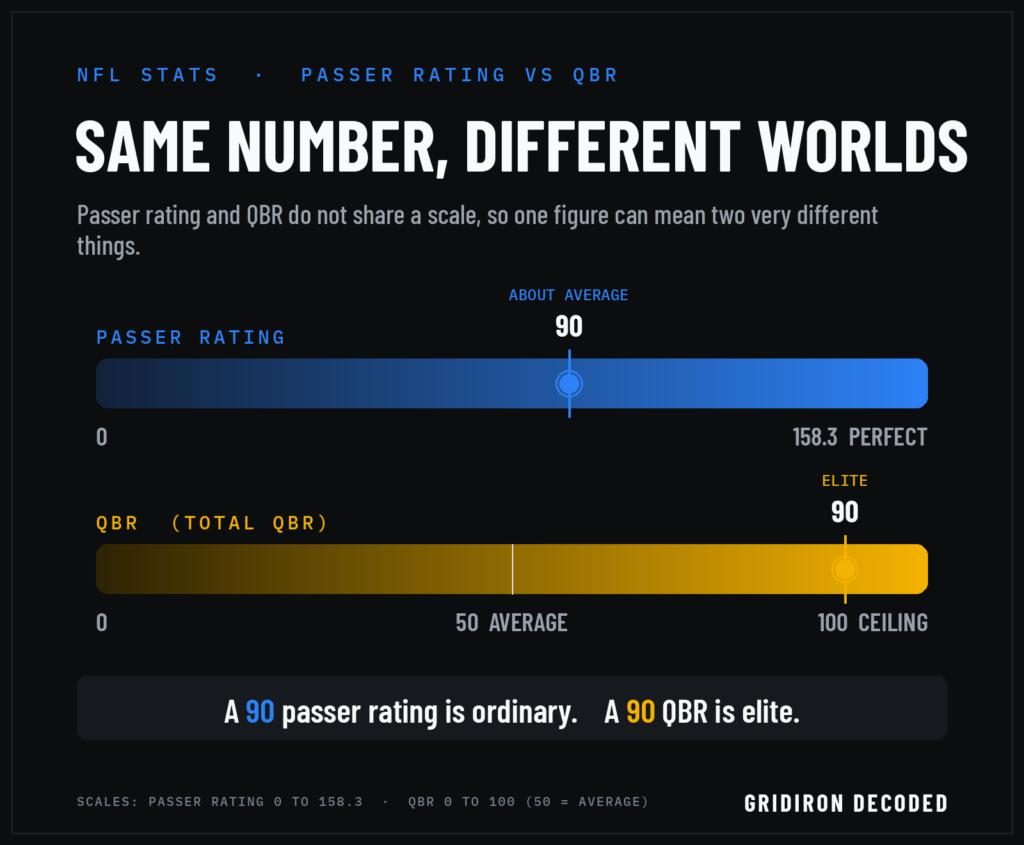
It runs on a 0 to 100 scale, which is much easier to understand, where 50 is roughly average and 100 is the ceiling.
Its headline strength is that it finally puts running quarterbacks on the same footing as pocket passers, because their legs actually count towards the score.
But QBR is trying to do something much bigger, and that is to answer a more complex question beyond his throws.
How much did this quarterback help his team win
Here is the same idea as a table, which is the fastest way to see the gap:
What it counts
Passer rating
QBR (Total QBR)
Passing (completions, yards, TDs, INTs)
Yes
Yes
The quarterback’s own rushing
No
Yes
Sacks taken
No
Yes
Game situation (down, distance, score)
No
Yes
Strength of opponent
No
Yes
Formula made public
Yes
No
Scale
0 to 158.3
0 to 100
Why do Passer rating and QBR disagree
These numbers are not even on the same scale, so a “90” means completely different things depending on which stat you are reading.
Because they are not measuring the same thing, they will often rate the same game very differently. That is not a glitch. That is the whole point.
Take a simple check-down pass, a short throw to a running back who then breaks three tackles and runs 75 yards for a touchdown. Passer rating credits the quarterback with a 75-yard touchdown pass. QBR tries to give him credit only for the safe short throw, and hands the rest to the runner.
Now flip it. QBR does not hand out bonus points for “clutch” moments. What it does instead is discount blowout garbage time, counting those plays as little as a quarter. So a quarterback who piles up numbers after the game is already decided gets less credit for them than his box score suggests, which can pull his QBR below a passer rating that counted every one of those yards the same.
Neither result is wrong. One number rewards the box score, the other rewards the impact on winning.
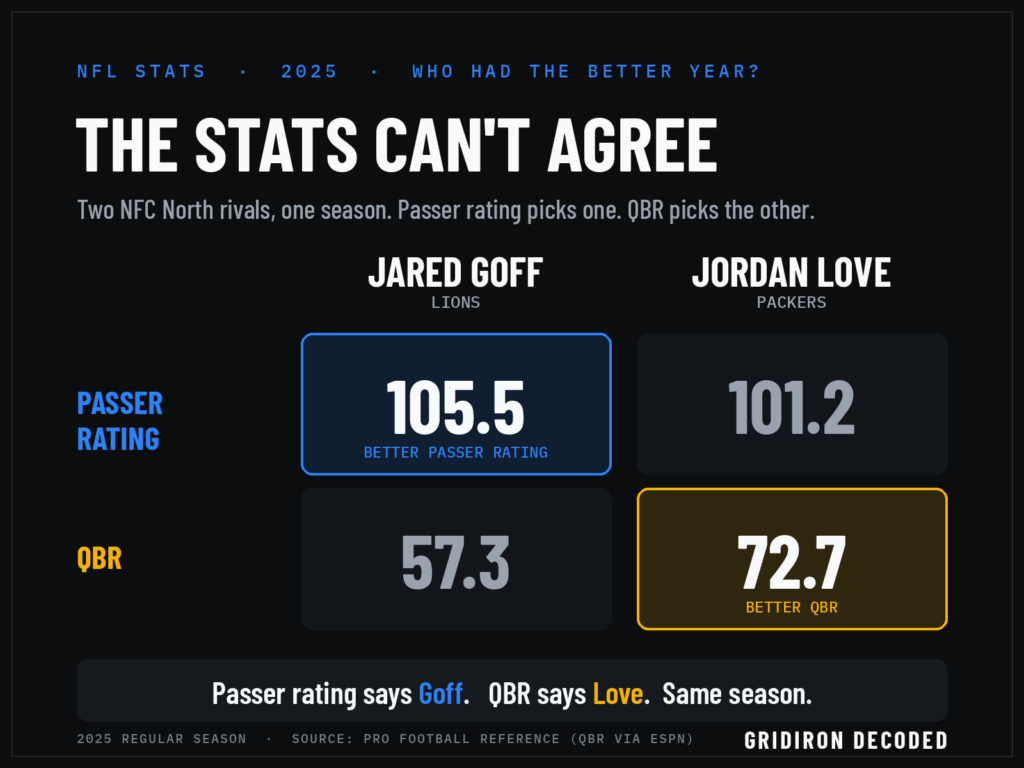
In 2025, passer rating and QBR could not agree on which NFC North rival had the better year. Passer rating rated Jared Goff above Jordan Love; QBR flipped it. Goff’s spotless efficiency won the passing score, while Love’s edge in sacks avoided, running and game situation won the QBR.
The takeaway: when passer rating and QBR clash, they are answering two different questions about the same afternoon.
Can QBR be trusted
This is where QBR gets genuinely controversial, and the criticism is fair to air.
It has produced some odd outliers over the years, the kind of single-game results that make people roll their eyes and reach for the “ESPN made this up” line.
One thing worth correcting, though, because it comes up a lot. The old theory that QBR was secretly built to flatter Tim Tebow does not hold. In 2011, his one full season as a starter, he finished with a QBR of 27.2, third-worst among the 34 qualifying quarterbacks. A stat designed to make him look good did a poor job of it.
Passer rating is transparent but crude. QBR is sophisticated but a closed box. Both have real flaws.
When should you use passer rating vs QBR
You do not have to pick a side. You just have to use the right tool for the question.
Reach for passer rating when you want a fast, like-for-like read, especially comparing quarterbacks across seasons or whole careers, where a public, unchanging formula is a genuine strength.
Reach for QBR when you want the whole game in one number, running included, and you care more about impact on winning than about the raw passing line.
And trust neither on its own. The people who read the game best look at several numbers at once, including ones like adjusted net yards per attempt, which folds in sacks and interceptions that passer rating ignores.
These two stats are not rivals to be ranked, they are different lenses, and knowing which to look through is the actual skill.
So the next time you see the two numbers clash on the same quarterback, you will know neither one broke. They are simply answering different questions, and the gap between them is the information.
That is the habit I want to carry through any of the content I publish. First and foremost, understand what a number is actually saying before letting it decide anything.
Which matters even more with a rookie, where the early stats can mislead you completely.
Next time, I will put one of these numbers to work on Mendoza himself.
In 2021 the NFL added a 17th regular-season game to settle a labour deal and clear the way for a record television contract, not to give fans more football. The league had played 16 games a season since 1978, but according to ESPN’s Kevin Seifert, NFL owners had been pushing to expand for the best part of a decade.
The extra game was a bargaining chip in the 2020 collective bargaining agreement (the CBA, the contract between the league and the players’ union that sets pay and conditions).
A longer season was the by-product. The players got a slightly bigger share of the money, the owners got more to sell, and the audience got a story about being given more football.
What people say Game 17 was for
The version you hear most is that the league added a game because fans wanted more of it. The NFL did not discourage that view. When the deal passed, Commissioner Roger Goodell welcomed a season that would give supporters “more and better football.”
More games sounds like a favour to the audience, and the audience was not going to argue.
The trouble is that a favour to fans would not have taken ten years of negotiation and a near-tied vote to arrive. Something that simple does not get fought over that hard.
The CBA & Players Union Vote 2020
In March 2020, the players’ union voted to accept a new CBA by 1,019 to 959. That is a margin of 60 from nearly 2,000 ballots. Thirty-odd players changing their minds would have sunk it.
It was not an easy or comfortable yes. The union’s own executive committee had recommended against the deal, and stars like Aaron Rodgers and J.J. Watt argued publicly to reject it.
Buried in the terms was the thing the owners had chased for years: the option, from 2021, to make the regular season 17 games.
What the two sides really traded
Underneath the language, the CBA was a swap. The owners got a longer season and an extra playoff game; the players got money and better conditions. The moving parts:
What changed
Before
After the CBA
Regular-season games
16
17 (from 2021)
Preseason games
4
3
Players’ share of revenue
47%
48.5%, up to 48.8% via TV kicker
Playoff teams
12
14
Notice the 17th game did not add a fresh week of football out of nowhere. It replaced the fourth preseason game, the warm-up matches that do not count, so players were swapping a low-stakes exhibition for a real one.
The revenue line is where the intent shows. The players’ base share rose from 47% to 48% from 2021, with a built-in climb toward 48.5% (and as high as 48.8%) that triggers as the new TV money lands, not as the football does. Players under contract when the deal was signed were also handed a bonus worth one seventeenth of their salary in any 17-game year. The extra pay was wired to the extra broadcasting, not the extra game.
The BIG prize, a record $110B TV deal
A year later, the real motive arrived. The NFL signed new television deals worth more than $110 billion, the richest in the history of sport. They run for eleven years, began in 2023, and roughly doubled what the networks had been paying.
A 17-game season is more to broadcast: another Sunday window, one more marquee fixture per team, a fuller slate to auction off. The extra game and the mega-deal are the same decision, taken twelve months apart.
Why the “more football” story stuck
The fan-demand line survives because it is the flattering one. “We gave you another game” reads better than “we negotiated a longer, more punishing season in exchange for a bigger cheque on both sides.”
There is a real tension under it, and it is worth naming rather than smoothing over. The players carry the physical cost of a 17th game; the owners and the union pocketed the financial upside. People inside the sport genuinely disagreed about whether that was a fair trade, which is why it came down to sixty votes.
The mark it left on the record book
The extra game turns up every season in one place. When a quarterback throws for the most yards in a year, or a receiver catches the most touchdowns, that total now comes from 17 games where the older records came from 16. Line up the eras and you are not always comparing like with like. A labour negotiation quietly moved the record book, and it did it for reasons that had nothing to do with the players in the record book.
What did it change for us the fans
The 17-game season is not a scheduling quirk. It is the visible edge of a business decision, and once you can see that, more of the modern NFL falls into place: the international fixtures and the push onto streaming are the same instinct, which is to turn football into more inventory to sell.
The season you watch was shaped in a conference room in 2020, by a vote that could easily have gone the other way. For how the 18-week, 17-game calendar actually fits together, I have set it out in how the NFL season is structured. The same deal reshaped the playoffs, which I cover in the expanded 14-team postseason.
As I promised at the end of my last post, Which NFL division is best, I’ve put together my own picks for who wins all eight divisions this season, with the reasoning behind each one.
This is a first for me, so I’d genuinely love to know what you make of the method, but more importantly the picks. I’m a new fan, I support the Raiders (I know, I know), and I’m learning this as I go.
So rather than pretend I’m a super fan and statistical genius, I took three sources I’ve come to trust, worked out where they agree and where they fall out, and then made my own calls.
When the experts fumble
As I started out looking into how best to approach this I discovered that last season the experts had a shocker.
ESPN’s preseason Super Bowl favourite, the Eagles, never even reached the Super Bowl. The Football Power Index’s No. 1 ranked team, the Ravens, missed the playoffs entirely. And of the eight teams the market and the models made preseason favourites to win their division, exactly one actually did it.
They got ONE out of eight. So when a first-timer tells you she fancies a couple of underdogs, remember the professionals went 1-for-8 last year. My gut currently is not any worse than their data machines and insight – just yet.
The method behind my NFL Division picks
I reviewed three different approaches, before I made my choices (guesses).
ESPN’s FPI is a model. It runs the season thousands of times and gives each team a percentage chance of winning its division, so it’s cold, mathematical, and honest about uncertainty.
FanDuel is the money. Their win totals show where the betting market is leaning, which is a different kind of wisdom, the crowd voting with its wallet. And Bleacher Report is a human analyst going game by game, weighing the stuff a model can’t, like a rookie quarterback or a coaching change.
Where all three agreed, I mostly followed. Where they split, or where ESPN’s own numbers showed a live second-place team, I trusted my read. Here’s the full board, with my pick in the last column.
Division
ESPN FPI
FanDuel
Bleacher Report
My pick
AFC East
Bills (67.6%)
Bills
Bills
Bills
AFC North
Ravens (54.2%)
Ravens
Ravens
Ravens
NFC West
Rams (46.0%)
Rams
Rams
Seahawks
NFC East
Eagles (44.5%)
Eagles
Cowboys
Cowboys
NFC South
Buccaneers (41.2%)
Buccaneers
Saints
Buccaneers
AFC South
Texans (39.7%)
Texans
Texans
Jaguars
NFC North
Lions (38.2%)
Lions
Lions
Packers
AFC West
Chiefs (38.2%)
Broncos
Broncos
Broncos
FPI figures are each favourite’s chance to win the division. FanDuel odds reflect the market as of May 2026 and potentially may have already moved.
The ones I didn’t argue with the experts
Two divisions weren’t worth being clever about. The Bills (AFC East) and the Ravens (AFC North) are the pick of all three sources, and comfortably so, with ESPN giving them 67.6% and 54.2%. When the model, the market and the analyst all agree by that margin, being contrarian is just showing off.
I also sided with the majority on two more. In the AFC West I’ve got the Broncos, which is interesting because this is the one place I’ve gone against ESPN, not with it. FPI still has the Chiefs top of the division, but that model is leaning on Kansas City’s name after they collapsed to 6-11 last year. FanDuel and Bleacher Report both back Denver, the reigning division champions, and so do I. And in the NFC South I’ve kept the Buccaneers, siding with ESPN and FanDuel over B/R’s call of a Saints upset.
The ones where I broke from the pack
This is the fun part, and it’s where I’d most like your verdict.
NFC West: I’m taking the Seahawks over the Rams. Every source has the Rams, but Seattle are the reigning Super Bowl champions, and ESPN’s own model still gives them a 27.8% shot at the division. Backing the defending champs to win their own division is hardly a wild swing. It’s my heart pick, but the numbers don’t laugh at me for it.
AFC South: I’m taking the Jaguars over the Texans. This is the one I’m most confident is defensible. Jacksonville won this division at 13-4 last year, and FPI has them at 34.9% against Houston’s 39.7%. That’s almost a coin flip. Reigning champions who the model rates as a near-equal are worth backing.
NFC North: I’m taking the Packers over the Lions. Detroit are the favourites, but only just, and FPI has Green Bay right behind them at 32.8%. With a healthy roster I think the value is on the Packers, and the model doesn’t think I’m mad.
NFC East: I’m taking the Cowboys over the Eagles. Here I’m not even alone. Bleacher Report picks Dallas outright, on the back of their rebuilt defence, and I agree the swing in that division is on whether that overhaul lands. ESPN and FanDuel still have Philadelphia, so this is a genuine split, and I’ve come down on the Dallas side of it.
The thread running through those four: I only strayed where a respected source was already there with me, or where ESPN’s own index showed the runner-up within touching distance. I’m not claiming to know more than the model. I’m choosing which of its close calls to believe.
And then there are my Raiders
I support the Raiders, so let’s be honest about where they sit. Last season they went 3-14, finished bottom of the AFC West, and tied for the worst record in the entire league, which at least handed them the No. 1 pick. All three sources have them rooted to the foot of the division again this year.
So I’m not picking them to win anything. I’m just here for the climb. There’s a new coach in. Klint Kubiak, a rookie quarterback waiting in the wings – Fernando Mendoza, and a genuine rebuild underway. This year, the only way is up. But feel free to ask me come January.
Now it’s over to you. Tell me where I’ve got it wrong, tell me which underdog you’re backing, and come back at the end of the season so we can see how badly the new fan did against the professionals. I suspect I’ll have earned a bit of stick either way.
Sources and methodology
Here’s exactly where each number comes from and how each source builds it, so you can dig into the data yourself. It’s worth knowing these three aren’t measuring the same thing: one is a model, one is a betting market, and one is a person.
ESPN Football Power Index (FPI) — a prediction model. FPI rates every team, then simulates the full season many thousands of times. The percentage I’ve used for each division is the share of those simulated seasons in which that team finishes top of its division, so it’s a probability, not a verdict. Forward-looking and cold-blooded about uncertainty. The 2026 division figures were shared publicly on r/NFLv2; for how FPI itself is built, ESPN publishes its own explainer.
Here’s the full board I worked from, every team’s FPI chance of winning its division:
FanDuel Sportsbook — the betting market. FanDuel sets a regular-season win total for each team, and bettors take the over or the under; the attached price (for example, a Bills over at -130) tells you which way the money is leaning and how strongly. Where a book quotes them, division-winner odds price each team’s implied chance directly. So this column is the crowd voting with its wallet, not an editorial opinion. The numbers I used are from FanDuel’s schedule-and-win-totals research, reflecting the market as of May 2026, and odds move. 21+. Gambling problem? Call 1-800-GAMBLER.
Bleacher Report — a human analyst. In his predicted 2026 standings, Moe Moton projects a win-loss record for all 32 teams, weighing offseason moves, training-camp news, injuries, coaching changes and the strength of each schedule, then orders every division and names his winners. This is judgement, not maths: the stuff a model struggles to price, like a rookie quarterback or a new defensive coordinator, is exactly what a person can weigh.
Last season’s actual results come from Pro Football Reference, which is the source for every “here’s how the experts did in 2025” claim above.
The numbers behind my NFL division picks
For anyone who wants to check the “the professionals went 1-for-8” line, here’s the 2025 preseason favourite against who actually won each division.
Division
2025 preseason favourite
Actual winner
AFC East
Bills
Patriots
AFC North
Ravens
Steelers
AFC South
Texans
Jaguars
AFC West
Chiefs
Broncos
NFC East
Eagles
Eagles
NFC North
Lions
Bears
NFC South
Buccaneers
Panthers
NFC West
Rams / 49ers
Seahawks
Only the Eagles held serve. Everything else went to a team that wasn’t the favourite, which is the whole reason a first-timer felt brave enough to file her own picks.
Ask which NFL division is the best and you get two answers, both fair, and they can flatly contradict each other. It comes down to one thing: whether you are measuring what already happened, or guessing what happens next.
This also then has another added layer to it. You will find fans like me making, what I like to call “educated guesses” or you have the experts, like ESPN Stats analysts, forecasters and sports betting traders, whose job it is to price it, trying to predict it.
I only noticed this because two graphics did the rounds this summer, both ranking the divisions, both confident, and they didn’t match. One added up last season’s results. The other forecast the season to come. Neither is wrong. They are answering different questions.
NFL Ranking method 1: measure add up every team’s record
The FOX graphic does the simplest thing possible. It takes all four teams in a division, adds their win-loss records together, and ranks the eight divisions by the total.
Every team plays 17 games, and every division has four teams, so each division’s combined record covers 68 games. The number in brackets is the win percentage: wins divided by games, where .500 is exactly half. (If you want the full picture of how a season is built, that 17-game structure is where the 68 comes from.)
You will spot the odd stray “1”, like the NFC East’s 27-40-1. That is a tie (a drawn game). American football lets a game finish level after a period of overtime, and a tie counts as half a win in the percentage, which is why the NFC North’s 38-29-1 comes out at .566 rather than .559.
By this measure, last season’s strongest division was the NFC West and the weakest was the NFC East.
Division
2025 combined record
Win %
NFC West
41-27
.603
NFC North
38-29-1
.566
AFC East
36-32
.529
AFC South
36-32
.529
AFC West
34-34
.500
NFC South
30-38
.441
AFC North
29-39
.426
NFC East
27-40-1
.404
Source: FOX Sports, 2025 final combined records.
The combined record is a scoreboard: it tells you, precisely, who was strong last season.
What that number quietly hides
A combined record can flatter a division that is really just two good teams and two bad ones.
Look at the AFC East. Its .529 looks healthy. But that total was mostly the Bills and the Patriots beating up on the Dolphins and the Jets. A division can post a tidy number while being wildly lopsided, and the record alone will never tell you that.
Notice, too, that FOX paired the graphic with a forward question: which division will have the best record this coming season. That is precisely where the two ways of looking part company.
A good combined record tells you a division was strong. It doesn’t tell you the strength was shared, or that it will last.
NFL Ranking method 2: forecast who wins
The other approach ignores last season’s totals and asks a forward question instead: who is going to win each division this year?
ESPN’s Football Power Index (FPI), a prediction model, puts a percentage on it. It simulates the season many times over and reports how often each team finishes top of its division. The graphic below is that model’s read on 2026.
Looking down the favourites and you learn something the record can’t show: how open each division is. A high favourite means a near-lock. A low one means a genuine scrap.
Division
Model favourite
Chance to win the division
AFC East
Bills
67.6%
AFC North
Ravens
54.2%
NFC West
Rams
46.0%
NFC East
Eagles
44.5%
NFC South
Buccaneers
41.2%
AFC South
Texans
39.7%
NFC North
Lions
38.2%
AFC West
Chiefs
38.2%
Source: ESPN Football Power Index, as shared on r/NFLv2.
The lower the favourite’s number, the closer the race, which is why the AFC West, with its top team barely clear of the field, is the one everyone wants to argue about.
The people doing this by hand
Models aren’t the only ones forecasting divisions. Creators do the same job by eye, and their reasoning is worth seeing, because a ranking without a reason is just a list.
On Variety Sports Network’s Gridiron Central, two hosts ranked all eight divisions worst to best for 2026. They disagreed on the middle but agreed on the ends: the NFC West at number one, and one of the two southern divisions propping up the table (the standings). Their case for the NFC West was depth, with the reigning champion Seahawks, the 49ers and the Rams all treated as contenders. Their knock on the AFC East was the same lopsidedness the record hides: two good teams, two they expect to struggle.
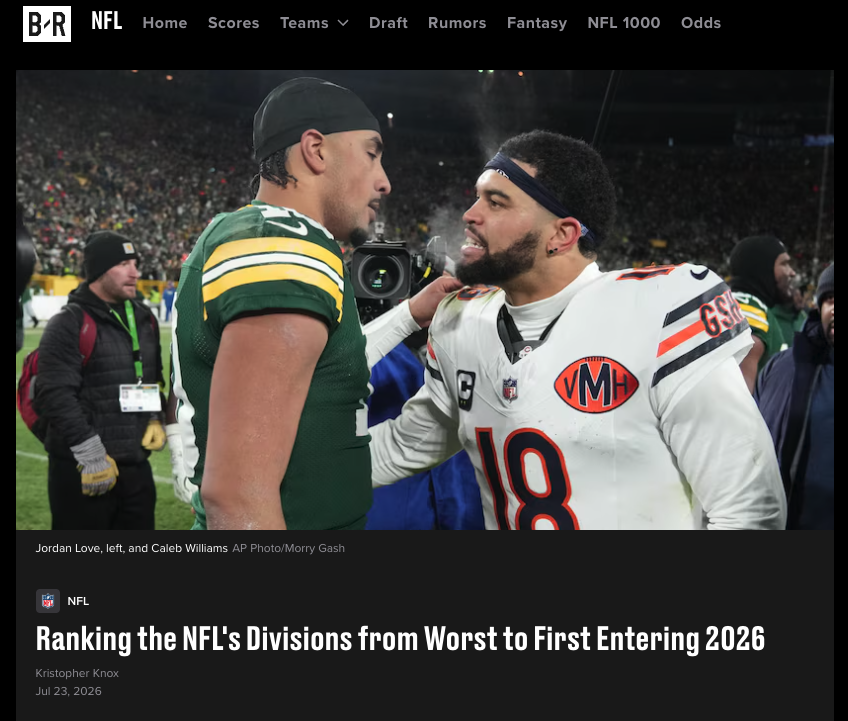
Bleacher Report’s Kristopher Knox reached a similar bottom by a different route. He scored each division on last season’s results, offseason moves and where each team sat in B/R’s power rankings, then landed on the NFC South as the league’s weakest for 2026, with the NFC North second best.
Two methods, model and human, broadly agreeing: strong at the top in the NFC West, thin at the bottom in the South.
Why the two measures disagree
They disagree because rosters don’t stand still.
Between February and September a division can lose its best players or add them, through trades, the draft, injuries and new coaching. So a division that dominated last season can slide, and a weak one can climb.
You can see it in the tables above. The AFC South and AFC East both posted respectable 2025 records, yet sit mid-to-low in the 2026 forecasts. The NFC West tops both, which is why it is the safe answer to “best division” this year. The record scores the past; the forecast bets on the future; only rarely do the two line up cleanly.
One measure is settled history, the other an educated guess, and treating them as the same thing is the mistake.
Even the forecasts get argued with
A model’s percentage isn’t a verdict. It is the start of an argument, and fans treat it exactly that way.
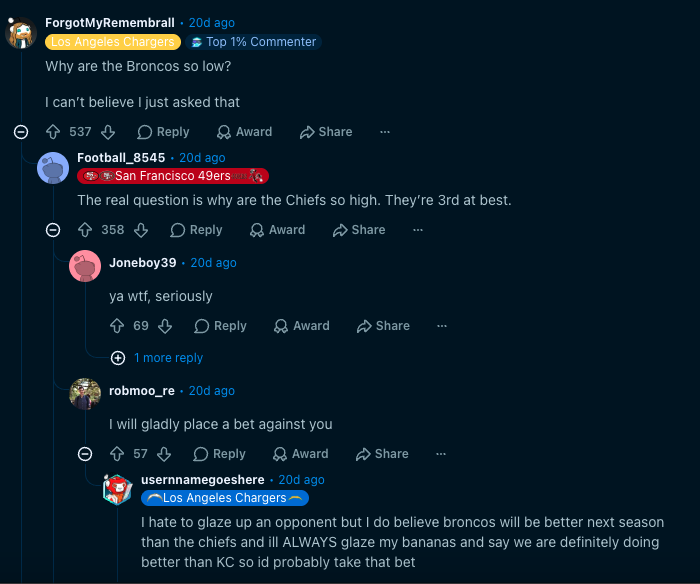
Under the FPI graphic on r/NFLv2, the AFC West set people off. One asked why the Broncos were rated so low. Another insisted the Chiefs were too high, third at best. Then a reply laid out the actual case for the model: Kansas City is expected to rebound, the Chargers brought in a sharp new offensive coordinator, and the Chiefs won a stack of close games last year while facing a tougher schedule this time.
That back-and-forth is the point. Reasonable people read the same roster and disagree.
Source:https://www.reddit.com/r/NFLv2/comments/1v3w0wj/nfl_teams_ranked_by_chance_to_win_division/ thread under the r/NFLv2 FPI post (replies from ForgotMyRemembrall, Football_8545, allthenamesaretaken4 and others).
If a projection makes you want to argue, it is doing its job.
Which NFL Ranking Method should you use?
Use the combined record when you want to know who actually was strong last season. It is factual and settled, a scoreboard.
Use the forecasts when you want to know who to watch this season, but hold them as opinions with reasons attached, not as facts. A model’s percentage and a creator’s ranking are both arguments, and the reasons matter more than the order they land in. Both ultimately point the same way: toward who takes each division and how the playoff seeding falls out.
The one thing to avoid is mixing them up. A great record last year does not promise a great division next year, and a 46% chance is not a plane ticket to January.
So next time a “best division” graphic slides past you, check one thing before you trust it: is it scoring the season that finished, or predicting the one that hasn’t started? That single question tells you what the number is actually worth.
I will be sharing my own NFL Division Rankings shortly, based on a combination of the two methods above. Link to post coming soon!
Six. That is how many games a season an NFL team plays against the same three opponents, for as long as both clubs exist. It is built into the schedule.
Guaranteed. No relegation, so a rival can never drop out of your way. There is always a next one. There is no escape.
Every sport has great rivalries. These ones are compulsory.
What the six games actually are
The league’s 32 clubs sit in eight divisions of four. Your division is your neighbourhood, and it never changes.
You play each of those three rivals twice, home and away. Six games, decided in advance rather than by a draw.
The other eleven rotate. These six never do.
Why that is more than it sounds
Six out of seventeen games is a big share of a short season. Roughly a third of the year, every year, against clubs you have history with.
Compare that to football. In a 38-game Premier League season you meet your biggest rival twice, which is about one game in nineteen. In the NFL it is closer to one in three.
So an NFL rivalry gets roughly seven times the share of the calendar.
It adds up faster than you would think
Do that for a century and the numbers get silly.
I have written up five of these rivalries in full, and between them those five pairs of clubs have played each over 600 times. The Bears and the Packers alone account for 213 of those, which makes it the most-played fixture in the sport.
Here is what each of the five is actually about.
Bears v Packers: the club owned by its fans
Chicago and Green Bay, either side of the Illinois and Wisconsin border. They first met in 1921 and have now played 213 times, more than any other pair of clubs in the sport.
Green Bay is the strange one. Every other club in the league has an owner or an owning family. The Packers have no owner at all, which makes them the only community-owned, non-profit club in American major professional sports. There are more Packers shareholders than there are people in the Green Bay metro area.
On the field it has been a see-saw for a century. The lead has changed hands again and again, and after 213 games it is still narrow.
Read it in full:Bears v Packers, including the third playoff meeting in their history, which happened in January.
Cowboys v Eagles: America’s Team and the city that hates the phrase
Dallas and Philadelphia sit about 1,300 miles apart with nothing local to argue about. What they have instead is a nickname.
An NFL film gave the Cowboys the tag “America’s Team” in 1978 and it stuck. In a proud, blue-collar city like Philadelphia, a glamorous Texas club branding itself the nation’s team was never going to land well. Philadelphia is also one of the hardest places in the sport to visit: in 1989 the crowd threw snowballs and ice at the Dallas coach as police walked him off the field.
The record says Dallas lead comfortably, 75-59. The decade data says they built almost all of it in the 1970s, and it has been near enough level ever since.
Readabout the Cowboys v Eagles rivalry, including the Bounty Bowl and what actually happened.
Steelers v Ravens: two clubs built to hurt each other
Pittsburgh and Baltimore, 250 miles apart, both built around punishing defensive football. The scorelines are low, the hits are enormous, and the games are ugly in the way both sets of supporters mean as a compliment.
It is the youngest of the five. Baltimore only got this club in 1996, and the Ravens still tell every new arrival the same thing: you are not a Raven until you have beaten the Steelers.
Here is the number that captures it. Across 65 meetings, the two clubs are separated by 33 points in total. That is half a point a game, over thirty years.
Read about the Steelers v Ravens rivalry, including the meeting in January that cost a coach his job of eighteen years.
Chiefs v Raiders: the loudest crowd ever recorded
Kansas City and Las Vegas now, but this one goes back to 1960, when both clubs were founder members of a rival league trying to take on the NFL. They have been in the same division ever since.
Arrowhead Stadium in Kansas City holds the Guinness World Record for the loudest crowd roar at a sports stadium: 142.2 decibels, set in 2014. Chiefs supporters first took that record off Seattle a year earlier, during a game against the Raiders.
The Raiders bring the other half of it. They have spent decades cultivating an outlaw image, and they have moved city three times, from Oakland to Los Angeles to Oakland to Las Vegas. The rivalry survived all of it, because it was never really about the map.
Read about the Chiefs v Raiders rivalry, including how the Raiders’ eleven-game lead turned into a twenty-game deficit.
Patriots v Jets: level for fifty seasons, then one letter
Boston and New York, which means this one arrives with a grudge already attached. These cities have been arguing about sport since long before either football club existed, and the fans borrow freely from the baseball version.
The genuinely odd part is how much traffic there has been between the two organisations. Three men have coached both clubs. More than fifty players turned out for both between 1993 and 2008. Rivals do not usually swap this much.
And it stayed astonishingly even. After fifty seasons the series stood at fifty wins each. Then, in January 2000, a coach handed the Jets a handwritten note resigning the job he had held for one day, and went to New England.
Read the fullPatriots v Jets rivalry, including what the record has done since.
If you are still choosing a club, the NFL teams hub has all 32 of them and what each has actually won. Whichever you land on, you inherit its enemies. That is part of the deal, and honestly it is part of the fun of being a fan.
Tampa Bay were top of the NFC South when they went to bed on Saturday 3 January. By the Sunday afternoon they were out of the playoffs, and they had not played again.
That was the final weekend of the 2025 season. No result involving Tampa Bay changed across those two days. Their record didn’t change. What changed was how many teams were tied with them, and that decided everything.
Here’s why, because the mechanism is stranger than the headlines suggested at the time.
What actually happened
On Saturday 3 January 2026, Tampa Bay beat Carolina 16-14 at home, in heavy rain. Both finished 8-9.
That left two teams tied at the top of the NFC South, and the two-team tiebreakers favoured Tampa Bay. As of Saturday night they led the division. They hadn’t won it yet, though: they needed New Orleans to beat or draw with Atlanta the following day. A fifth straight division title was riding on a game they weren’t in.
Then on Sunday 4 January, the last day of the regular season, Atlanta beat New Orleans 19-17. Atlanta had already been eliminated and had nothing to play for. That win took them to 8-9 as well.
Now three teams were tied, not two. The tiebreakers ran again and gave the division to Carolina, their first since 2015.
Team
Record
Result
Carolina Panthers
8-9
Won the division, hosted a playoff game
Tampa Bay Buccaneers
8-9
Missed the playoffs
Atlanta Falcons
8-9
Missed the playoffs
The short version: Atlanta didn’t beat Carolina or Tampa Bay that weekend. They just joined the tie, and joining it was enough.
The two wins that were worth nothing, then everything
This is the bit that explains it, and it’s simpler than it sounds.
When two teams are tied, “head-to-head” means only the games those two played against each other. Carolina and Tampa Bay had split their two meetings, one win each. No separation, so the tiebreakers moved on.
But Carolina had also beaten Atlanta. Twice.
While the tie was just Carolina against Tampa Bay, those two wins counted for nothing. Atlanta weren’t in the tie, so games against Atlanta weren’t head-to-head games.
The moment Atlanta joined, “head-to-head” meant all the games among all three teams. Carolina’s two wins over Atlanta went from irrelevant to decisive.
Team
Record against the other two tied teams
Carolina
3-1
Tampa Bay
2-2
Atlanta
1-3
Carolina had banked an advantage that only existed if Atlanta were in the tie. Atlanta put themselves in it.
What the rulebook actually says
The NFL publishes its tie-breaking procedures in full, and the answer is there in black and white. There are two separate lists for teams in the same division, and they don’t start the same way.
For two clubs, the order runs: head-to-head record, then record within the division, then record in common games.
Carolina and Tampa Bay were 1-1 head-to-head. Both were 3-3 within the division. So it came down to common games, where Tampa Bay were ahead. Tampa Bay won.
For three or more clubs, the first step is head-to-head measured as the combined record among all the tied teams.
Carolina were 3-1. That settled it at the first step. Nothing else was needed.
Same season, same results, two different first questions. That’s the whole explanation.
Worth saying plainly: it took me two attempts to get this right. The rulebook also has a three-club procedure for wild card places, and that one opens with a “head-to-head sweep” that only applies if a team beat all the others or lost to all of them. Grab the wrong list and you get the wrong answer. They sit close together and they aren’t interchangeable.
Why this isn’t a mistake in the rules
It looks like a loophole. It isn’t.
The rule is trying to reward teams who beat the teams they finished level with. In a two-way tie that’s a clean comparison: you played each other twice, who won more.
In a three-way tie there’s no clean pairwise answer, so the league uses the combined record instead. That’s a sensible measure. It just happens to change which games count.
Adding a team to a tie enlarges the pool of games that count as head-to-head. That’s the whole mechanism, and the strange result falls out of it.
The rule behaved exactly as written. It’s the consequence that’s counterintuitive, not the rulebook.
What the coverage got right, and what it skipped
Every outlet I read reported the outcome correctly. Carolina won the three-way head-to-head at 3-1, and Atlanta’s win created the tie. That’s all accurate.
What almost none of it explained was why the two-way and three-way procedures give opposite answers from identical results. That’s the interesting part, and it’s the part that tells you something you can use again.
If a rule surprises you, the explanation is usually in the document rather than in the coverage of it.
What to watch for next time
Two things, and they’ll both come round again.
Late-season games involving eliminated teams matter more than they look. A team with nothing to play for can’t win a division. It can decide one, by joining a tie and changing which games count.
Your own results aren’t the whole picture. If you’re heading for a tie, your record against the specific teams you might be tied with is what matters, and that includes teams who haven’t finished level with you yet.
Carolina, for what it’s worth, then lost their playoff game at home the following weekend, 34-31 to the Los Angeles Rams. A team four wins better had to travel to play them, which is a different oddity in the same system, and how the NFL playoffs work takes that one apart.
The 2026 season starts on 9 September, and its own final weekend lands in early January. Somewhere in the eight divisions, this will very nearly happen again.
If you want the wider structure this all sits inside, how the NFL works covers the league from thirty-two teams down to the Super Bowl, and the AFC and NFC explained covers why the divisions look the way they do. For the game itself rather than the structure around it, start with the NFL rules guides.
Tampa Bay were top of the NFC South on Saturday night. By Sunday afternoon they were out of the playoffs, and they never played again.
No result involving Tampa Bay changed. Their record didn’t change. What changed was how many teams were tied with them, and that decided everything.
Here’s why, because the mechanism is stranger than the headlines suggested.
What actually happened
On the Saturday of the final weekend, Tampa Bay beat Carolina 16-14 at home, in heavy rain. Both finished 8-9.
That left two teams tied at the top of the NFC South, and the two-team tiebreakers favoured Tampa Bay. As of Saturday night they led the division. They hadn’t won it yet, though: they needed New Orleans to beat or draw with Atlanta the following day. A fifth straight division title was riding on a game they weren’t in.
Then on the Sunday, Atlanta beat New Orleans 19-17. Atlanta had already been eliminated and had nothing to play for. That win took them to 8-9 as well.
Now three teams were tied, not two. The tiebreakers ran again and gave the division to Carolina, their first since 2015.
Team
Record
Result
Carolina Panthers
8-9
Won the division, hosted a playoff game
Tampa Bay Buccaneers
8-9
Missed the playoffs
Atlanta Falcons
8-9
Missed the playoffs
The short version: Atlanta didn’t beat Carolina or Tampa Bay that weekend. They just joined the tie, and joining it was enough.
The two wins that were worth nothing, then everything
This is the bit that explains it, and it’s simpler than it sounds.
When two teams are tied, “head-to-head” means only the games those two played against each other. Carolina and Tampa Bay had split their two meetings, one win each. No separation, so the tiebreakers moved on.
But Carolina had also beaten Atlanta. Twice.
While the tie was just Carolina against Tampa Bay, those two wins counted for nothing. Atlanta weren’t in the tie, so games against Atlanta weren’t head-to-head games.
The moment Atlanta joined, “head-to-head” meant all the games among all three teams. Carolina’s two wins over Atlanta went from irrelevant to decisive.
Team
Record against the other two tied teams
Carolina
3-1
Tampa Bay
2-2
Atlanta
1-3
Carolina had banked an advantage that only existed if Atlanta were in the tie. Atlanta put themselves in it.
What the rulebook actually says
The NFL publishes its tie-breaking procedures in full, and the answer is there in black and white. There are two separate lists for teams in the same division, and they don’t start the same way.
For two clubs, the order runs: head-to-head record, then record within the division, then record in common games.
Carolina and Tampa Bay were 1-1 head-to-head. Both were 3-3 within the division. So it came down to common games, where Tampa Bay were ahead. Tampa Bay won.
For three or more clubs, the first step is head-to-head measured as the combined record among all the tied teams.
Carolina were 3-1. That settled it at the first step. Nothing else was needed.
Same season, same results, two different first questions. That’s the whole explanation.
Worth saying plainly: it took me two attempts to get this right. The rulebook also has a three-club procedure for wild card places, and that one opens with a “head-to-head sweep” that only applies if a team beat all the others or lost to all of them. Grab the wrong list and you get the wrong answer. They sit close together and they aren’t interchangeable.
Why this isn’t a mistake in the rules
It looks like a loophole. It isn’t.
The rule is trying to reward teams who beat the teams they finished level with. In a two-way tie that’s a clean comparison: you played each other twice, who won more.
In a three-way tie there’s no clean pairwise answer, so the league uses the combined record instead. That’s a sensible measure. It just happens to change which games count.
Adding a team to a tie enlarges the pool of games that count as head-to-head. That’s the whole mechanism, and the strange result falls out of it.
The rule behaved exactly as written. It’s the consequence that’s counterintuitive, not the rulebook.
What the coverage got right, and what it skipped
Every outlet I read reported the outcome correctly. Carolina won the three-way head-to-head at 3-1, and Atlanta’s win created the tie. That’s all accurate.
What almost none of it explained was why the two-way and three-way procedures give opposite answers from identical results. That’s the interesting part, and it’s the part that tells you something you can use again.
If a rule surprises you, the explanation is usually in the document rather than in the coverage of it.
What to watch for next time
Two things, and they’ll both come round again.
Late-season games involving eliminated teams matter more than they look. A team with nothing to play for can’t win a division. It can decide one, by joining a tie and changing which games count.
Your own results aren’t the whole picture. If you’re heading for a tie, your record against the specific teams you might be tied with is what matters, and that includes teams who haven’t finished level with you yet.
Carolina, for what it’s worth, then lost their playoff game at home to the Los Angeles Rams, 34-31. A team four wins better had to travel to play them, which is a different oddity in the same system, and how the NFL playoffs work takes that one apart.
The 2026 season starts on 9 September, and its own final weekend lands in early January. Somewhere in the eight divisions, this will very nearly happen again.
If you want the wider structure this all sits inside, how the NFL works covers the league from thirty-two teams down to the Super Bowl, and the AFC and NFC explained covers why the divisions look the way they do. For the game itself rather than the structure around it, start with the NFL rules guides.