
Two Quarterback Stats That Refuse to Agree
Passer rating and QBR are not the same stat. They measure different things, they sit on different scales, and people interchange them constantly while not knowing there is a difference.
Once you see why the two numbers disagree, every quarterback argument you will read or listen to will hit differently.
I stumbled across this issue by accident. I have been watching the Raiders pre-season games and the promising early performances of our exciting new rookie quarterback and first overall pick, Fernando Mendoza, and it got me thinking about doing a series on quarterbacks.
Fernando Mendoza threading the needle!
— NFL (@NFL) August 14, 2026
Stream on @NFLPlus pic.twitter.com/PC9UPZvRxA
So, let’s get stuck into this first post on passer rating vs QBR.
Where the confusion between Passer Rating and QBR started
The confusion is not really the reader’s fault. It is a brand naming accident.
For decades, passer rating was casually called “quarterback rating.” Then ESPN launched its own stat and called it Total QBR, on 5 August 2011. The abbreviation landed right on top of the nickname people already used for the older number.
So now someone says “QBR” and means passer rating, or reads “quarterback rating” and thinks of ESPN’s stat. Two different measures, one blurred label.
While I was researching my quarterback post, I stumbled into an r/nfl thread where people had been arguing about the two stats while mixing them up mid-argument, eight years ago. That tangle is what this post is here to sort out.
The key thing to remember is that most of the confusion is a naming problem, not a maths problem, and clearing up the label is half the battle.
You can get a full overview of both stats on the QB stats page. Here I only want enough of each to see why they pull apart.
Passer rating (RTG), the transparent stat
Passer rating is the old, official one, and it only looks at throwing. It looks at four stats:
- completion percentage
- yards per attempt
- touchdowns per attempt
- interceptions per attempt
These four go through a fixed formula that turns them into a single number between 0 and a strangely specific 158.3, which is a perfect game.
Its best quality is that it is transparent. The formula is public, it is the same for every quarterback in every era, and anyone can check the maths.
Its scale takes a little getting used to. A strong day clears 100, a rough one dips below 70, and 158.3 is flawless. The passer rating was created in 1973 by an NFL committee led by Don Smith of the Pro Football Hall of Fame, working with Seymour Siwoff of the Elias Sports Bureau.
Passer rating is, in essence, a clean, honest score for how a quarterback threw the ball, and nothing else.
However, the formula almost nobody understands
Here is the twist that makes passer rating so odd. Public does not mean simple.
The equation is a tangle of ratios and caps that even professionals struggle to explain. Peyton Manning, one of the finest passers the game has seen, leaned right into the joke, taking the calculation to a university maths class and still coming up short.
“I have no idea what you just said, but I’m thrilled that my rating’s higher than yours.” — Kirk Cousins
Peyton Manning and Kirk Cousins try to make sense of the passer rating formula, from Peyton’s Places (Omaha Productions): https://www.youtube.com/watch?v=eJBTiaOqcq8
Passer rating hides nothing and still manages to baffle almost everyone, which is half the reason a stat like QBR ever got invented.
QBR, ESPN’s ambitious stat
QBR, or as it should be called, Total QBR, is ESPN’s attempt to score the whole quarterback, not just the passer.
It still counts the throwing, but it adds the running, folds in sacks, and adjusts for the situation. The situation being the down, the distance, the score, even the strength of the defence faced.
It is built on expected points added, a measure of how much each play shifts a team’s chances of scoring.
It runs on a 0 to 100 scale, which is much easier to understand, where 50 is roughly average and 100 is the ceiling.
Its headline strength is that it finally puts running quarterbacks on the same footing as pocket passers, because their legs actually count towards the score.
But QBR is trying to do something much bigger, and that is to answer a more complex question beyond his throws.
How much did this quarterback help his team win
Here is the same idea as a table, which is the fastest way to see the gap:
| What it counts | Passer rating | QBR (Total QBR) |
|---|---|---|
| Passing (completions, yards, TDs, INTs) | Yes | Yes |
| The quarterback’s own rushing | No | Yes |
| Sacks taken | No | Yes |
| Game situation (down, distance, score) | No | Yes |
| Strength of opponent | No | Yes |
| Formula made public | Yes | No |
| Scale | 0 to 158.3 | 0 to 100 |
Why do Passer rating and QBR disagree
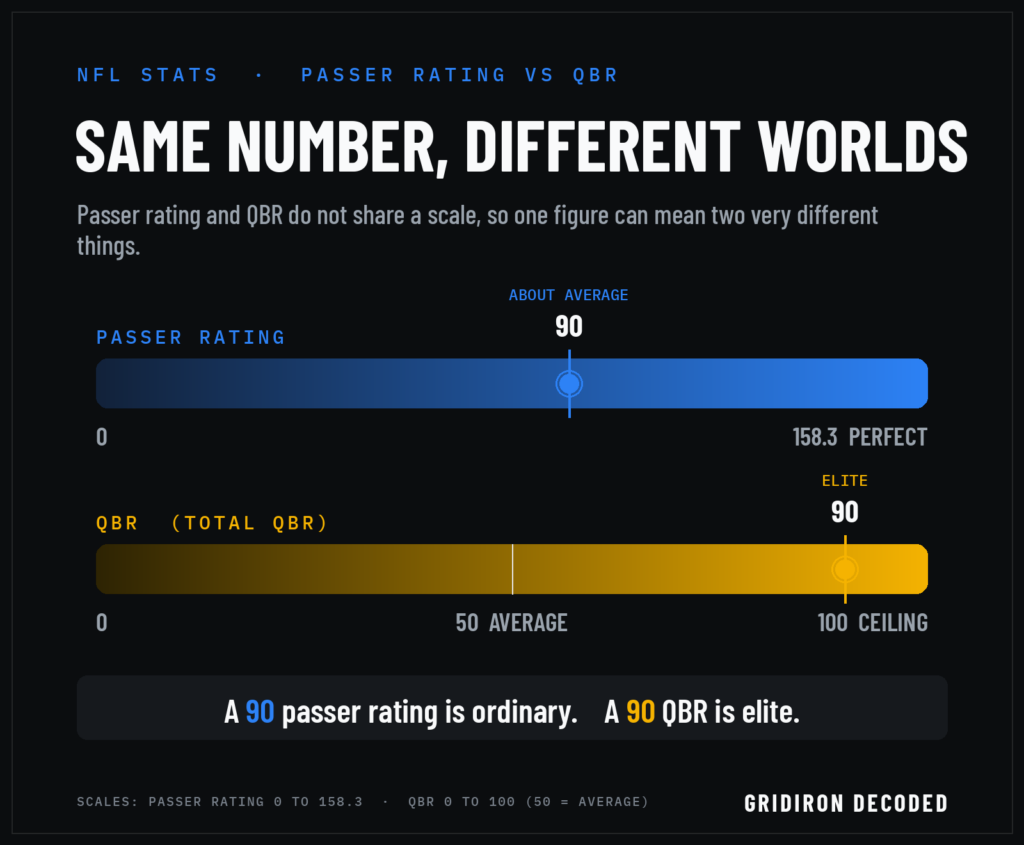
These numbers are not even on the same scale, so a “90” means completely different things depending on which stat you are reading.
Because they are not measuring the same thing, they will often rate the same game very differently. That is not a glitch. That is the whole point.
Take a simple check-down pass, a short throw to a running back who then breaks three tackles and runs 75 yards for a touchdown. Passer rating credits the quarterback with a 75-yard touchdown pass. QBR tries to give him credit only for the safe short throw, and hands the rest to the runner.
Now flip it. QBR does not hand out bonus points for “clutch” moments. What it does instead is discount blowout garbage time, counting those plays as little as a quarter. So a quarterback who piles up numbers after the game is already decided gets less credit for them than his box score suggests, which can pull his QBR below a passer rating that counted every one of those yards the same.
Neither result is wrong. One number rewards the box score, the other rewards the impact on winning.
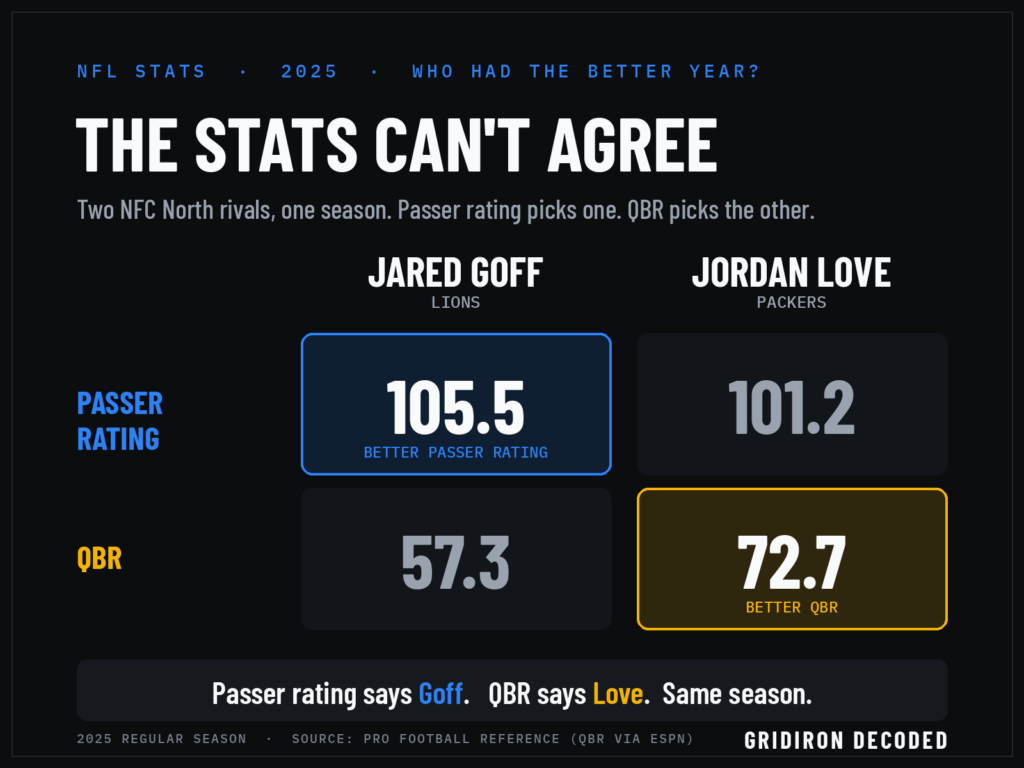
In 2025, passer rating and QBR could not agree on which NFC North rival had the better year. Passer rating rated Jared Goff above Jordan Love; QBR flipped it. Goff’s spotless efficiency won the passing score, while Love’s edge in sacks avoided, running and game situation won the QBR.
The takeaway: when passer rating and QBR clash, they are answering two different questions about the same afternoon.
Can QBR be trusted
This is where QBR gets genuinely controversial, and the criticism is fair to air.
ESPN explains the method but has never published the exact formula and weightings. So when the number surprises you, you cannot open the bonnet and see exactly why. Plenty of sharp fans refuse to use it in a serious argument for that reason: you are asked to trust the result without seeing all the working.
It has produced some odd outliers over the years, the kind of single-game results that make people roll their eyes and reach for the “ESPN made this up” line.
One thing worth correcting, though, because it comes up a lot. The old theory that QBR was secretly built to flatter Tim Tebow does not hold. In 2011, his one full season as a starter, he finished with a QBR of 27.2, third-worst among the 34 qualifying quarterbacks. A stat designed to make him look good did a poor job of it.
Passer rating is transparent but crude. QBR is sophisticated but a closed box. Both have real flaws.
When should you use passer rating vs QBR
You do not have to pick a side. You just have to use the right tool for the question.
Reach for passer rating when you want a fast, like-for-like read, especially comparing quarterbacks across seasons or whole careers, where a public, unchanging formula is a genuine strength.
Reach for QBR when you want the whole game in one number, running included, and you care more about impact on winning than about the raw passing line.
And trust neither on its own. The people who read the game best look at several numbers at once, including ones like adjusted net yards per attempt, which folds in sacks and interceptions that passer rating ignores.
These two stats are not rivals to be ranked, they are different lenses, and knowing which to look through is the actual skill.
So the next time you see the two numbers clash on the same quarterback, you will know neither one broke. They are simply answering different questions, and the gap between them is the information.
That is the habit I want to carry through any of the content I publish. First and foremost, understand what a number is actually saying before letting it decide anything.
Which matters even more with a rookie, where the early stats can mislead you completely.
Next time, I will put one of these numbers to work on Mendoza himself.