
Getting open is the entire purpose of a wide receiver’s job. Puka Nacua spent one October night doing it so relentlessly that his quarterback, Matthew Stafford, more or less stopped looking anywhere else to pass.
The Los Angeles Rams receiver was thrown at 24 times and caught 17 of them for 138 yards and a touchdown, a career high in catches, in an overtime loss to the Buffalo Bills.
Seventeen catches is a big day. But the 24 targets tell you more: Stafford threw to him that often because he kept getting open.
What a wide receiver does
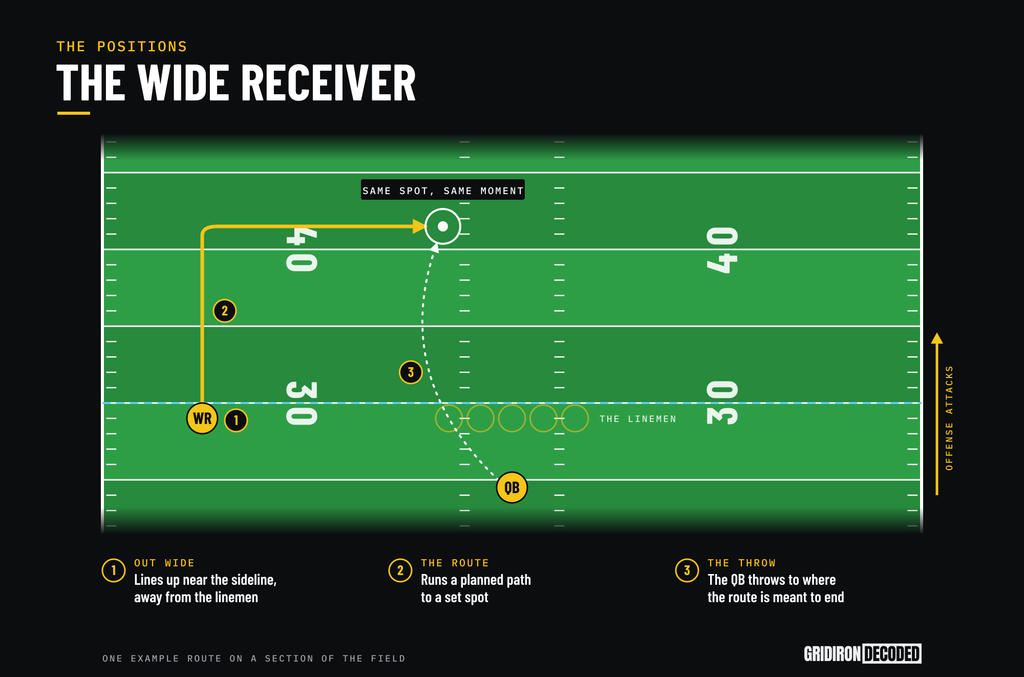
A wide receiver is the player who is, not to state the obvious, out wide. Their job is to get open and catch the ball.
A wide receiver lines up near the sideline, away from the pack of linemen, and runs a planned path called a route.
The quarterback throws to where that route is meant to end, so a receiver and his passer are really running the same play from two ends of the field, trusting each other to arrive at the same spot at the same moment.
If you want the whole attacking unit laid out, I have gone through it in how the offense is built. The man trying to stop all this is the cornerback, whose side of the same duel I pulled apart in its own spotlight.
The real skill is getting open, not catching
Here is the thing that took me a while to see. The hard part of playing receiver is not the catch. It is being somewhere the defender is not.
Watch a receiver and your eye goes to the grab at the end, because that is the bit that looks difficult. But a quarterback will not throw to a covered man, however good his hands are.
The yards and the catches everyone counts on a Sunday are downstream of one thing that happens first: the receiver has to shake free, even by a step, so there is a window to throw into. A receiver who cannot get open does not drop passes. He simply never gets thrown the ball at all.
That is why Nacua’s twenty-four targets say more than his seventeen catches. Stafford aimed there again and again because the man kept coming.
The NFL rule that decides what counts as a catch
Catching looks like a black and white area of the game, held or dropped, but the rulebook is fussier than that. The fine print has overturned more big plays than any other line in the book. Even the experts can’t always agree!
NFL rulebook, Rule 3, Player Possession. To gain possession of a loose ball that has been caught, intercepted, or recovered, a player (a) must have complete control of the ball with his hand(s) or arm(s) and (b) have both feet or any other part of his body, other than his hands, completely on the ground inbounds, and, after (a) and (b) have been fulfilled, then (c) clearly perform any act common to the game (e.g., extend the ball forward, take an additional step, tuck the ball away and turn upfield, or avoid or ward off an opponent).
Read that third part again, because it is the one that trips people up.
Controlling the ball and getting two feet down is not yet a catch. The receiver must then do something ordinary and football-like with it, take a step, reach out, turn upfield, or at least hold it long enough that he could have.
Grab the ball, land, and have it jarred loose the same instant, and in the eyes of the rule you never caught it.
That is the clause behind nearly every “was that a catch?” argument you have sat through.
Seventeen times against Buffalo, Nacua finished the process. Most weeks, some receiver somewhere loses a big play on exactly this requirement.
Puka Nacua had 17 receptions vs the Bills. With that many targets and catches, he is expected to get 100+ yards. The Rams should look to spread the ball around more efficiently if they want to win a super bowl this season. #WoodVilleTV #NFL #PukaNacua #Rams #WideReceiver https://t.co/mncWrdqhcj
— Mike (@WoodVilleTV_) October 17, 2026
Separation: the stat that measures getting open
There is a simple word for how open a receiver gets, and it is separation.
It just means the gap the receiver opens up between himself and the defender covering him. It is measured at the moment the ball reaches, him caught or not. The bigger the gap, the more open he was.
You will not see separation on the broadcast score bug, but it is the thing coaches and analysts actually chase, usually through a figure called yards per route run, which rewards a receiver for being a threat on every play rather than just padding totals in garbage time.
It is the receiver’s version of a cornerback’s coverage numbers: the stat that explains the flashy ones sitting on top of it. Nacua’s blunt, visible proxy for it is that target count. A man does not get thrown at two dozen times in a night unless he is winning his route almost every snap.
There is a season-long version of the same signal. Nacua missed time early with a hip injury and has played on through a calf problem since, and even so he has caught 56 passes in the six games he has played, around nine a game. A quarterback does not keep feeding a hobbled receiver that often unless the man is still winning his routes.
The best receivers don’t always need to get open
As we have just seen in the previous sections if a wide receiver wins the separation, then the target follows. But a small number of receivers are such strong, sure-handed targets that a quarterback will throw to them while they are still covered, trusting them to take the ball away in a crowd.
Nacua has become one of them. Detroit’s Amon-Ra St. Brown, himself one of the best going, broke him down alongside the San Francisco linebacker Fred Warner:
What makes him so special is his hands are insane. You can throw it anywhere, whether he’s covered or not.
St. Brown’s phrase for it was “unguardable, covered or not”. That is the tier above separation, where a receiver no longer just creates space but makes it optional.
Amon-Ra St. Brown says Puka Nacua is completely unguardable and explains why his unstoppable hands make him a nightmare for defenses. Amon-Ra and Fred Warner break down Puka Nacua’s elite traits, highlighting his ridiculous contested catches, physical run-after-catch ability, and the blind trust Matthew Stafford has in him. "I think what separates Puka, what makes him so special is his hands are insane. Like you can you can throw it anywhere, whether he’s covered or not.” 🔥 “I feel like Stafford has that mentality where I don’t care if he’s near him, I don’t care if there’s who’s on him, I’m just going to put it near him and he’s going to make the play." "The shit that Puka has been doing all year, bro, is like he I feel like he’s unguardable whether he’s covered or not, he’s open.” 😮💨 “I mean, he’s hard to tackle, like he never he rarely gets tackled by the first guy and if he does he’s like falling two or three extra yards if it’s a DB body." "He’s strong, can can block in the run game, I feel like he does it all. He’s that heartbeat of that team so I’ve been a fan of Puka and watching him play." [ via @GOATfarmmedia ft @amonra_stbrown / @fred_warner / #ramshouse ]
— CulturedUpdatez (@CulturedUpdatez) October 10, 2026
2025’s top receivers by receiving yards
For the fuller picture, here are last season’s leading wide receivers by receiving yards, with catches and touchdowns alongside. Note where the Monday-night man already sat.
| Rank | Receiver | Team | Rec | Yds | TD |
|---|---|---|---|---|---|
| 1 | Jaxon Smith-Njigba | Seattle Seahawks | 119 | 1,793 | 10 |
| 2 | Puka Nacua | Los Angeles Rams | 129 | 1,715 | 10 |
| 3 | George Pickens | Dallas Cowboys | 93 | 1,429 | 9 |
| 4 | Ja’Marr Chase | Cincinnati Bengals | 125 | 1,412 | 8 |
| 5 | Amon-Ra St. Brown | Detroit Lions | 117 | 1,401 | 11 |
| 6 | Zay Flowers | Baltimore Ravens | 86 | 1,211 | 5 |
| 7 | Chris Olave | New Orleans Saints | 100 | 1,163 | 9 |
| 8 | Nico Collins | Houston Texans | 71 | 1,117 | 6 |
| 9 | Jameson Williams | Detroit Lions | 65 | 1,117 | 7 |
| 10 | CeeDee Lamb | Dallas Cowboys | 75 | 1,077 | 3 |
Wide receivers only (players listed at wide receiver); tight ends and running backs are excluded. Ranked by receiving yards. Nico Collins and Jameson Williams tie on 1,117 yards, split here by Collins’ extra catches. Source: Pro Football Reference, 2025 NFL receiving.
Nacua finished second in the entire league in receiving yards last season, behind only Seattle’s Jaxon Smith-Njigba. So the Buffalo game was not a bolt from nowhere. It was the player he already was, turned up loud for one night.
The two who defined the position
Every position has its handful of names, and at receiver the argument usually comes down to two of them.
Jerry Rice is the near-unanimous answer to “greatest ever”, and not because he was the fastest man out there. He ran the cleanest routes in the sport’s history and simply would not stop, finishing as the all-time leader in catches, receiving yards and touchdowns by distances nobody has since threatened.
Randy Moss was the opposite kind of nightmare: a deep threat so tall, fast and sure-handed that defences changed their whole shape to keep him in front of them, and who still holds the single-season record for touchdown catches.
Back to that Monday night
Which brings us back to Nacua and those 24 targets.
It is easy to watch a receiver and count only the catches, because the catch is the part that looks hard.
The real work is the half-second of space he created just before it, the part no highlight shows.
The rarest receivers, like Nacua on his best nights, do not even need that space. Either way, the catch is only the last step of the job, not the whole of it. One won with craft, the other with sheer unfair physical gift.
Both made the same point, which is that a receiver good enough bends the entire defence around himself before the ball is even snapped.