
Three interceptions in three games, and they belong to a fifth-round rookie almost nobody had heard of in August.
That rookie is Hezekiah Masses, a cornerback for the Las Vegas Raiders. His three picks in three games lead the Raiders and put him among the league’s interception leaders. He has also taken a starting job he was not handed in the summer. He was a receiver in high school, switched to cornerback, and came into the league as the 175th pick out of California.
🚨 Rookie of the Week (again) 🚨
— Panini Senior Bowl (@seniorbowl) September 29, 2026
Hezekiah Masses recorded 6 tackles, a PBU and another INT in Sunday’s win over New Orleans!
Masses now has 3 interceptions through his first three NFL games, tied for the league lead, while helping the Raiders start the season 3-0!… pic.twitter.com/SG31F9c8x5
What makes that remarkable is not really the rookie. It is the position. Cornerback is the hardest job on the field to do quietly, and the easiest to do badly in front of everyone.
What a cornerback actually does
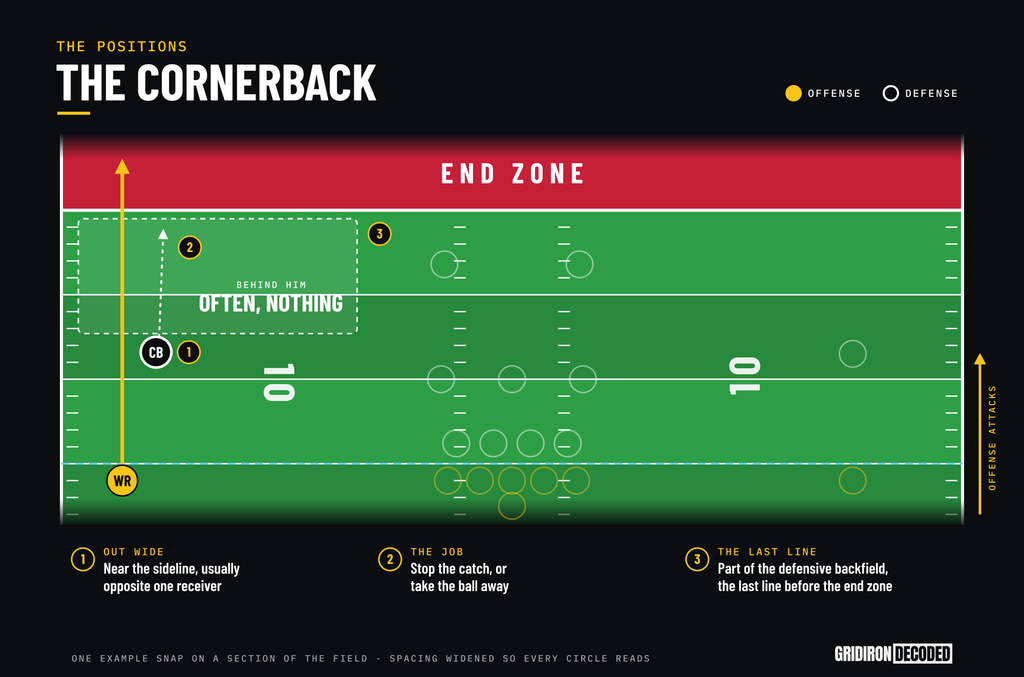
A cornerback covers the wide receivers, the fastest and most dangerous attackers the other team has.
A cornerback lines up out wide, near the sideline and usually opposite one receiver, and his job is quick to say and brutal to do: stop the catch, or take the ball away.
He’s part of the defensive backfield, the last line before the end zone, which I’ve pulled apart in how the defence is built in three layers (defence is the British spelling of the US “defense”).
What makes the job so exposed is the space behind him, which is often empty. You can see where he fits among the other ten on the positions page.
Why the corner plays “on an island”
When a cornerback is left to cover his man with no help behind him, coaches call it being “on an island”.
It is the loneliest arrangement in the sport. No safety net, no second defender to clean up a mistake. If the receiver beats him, the whole stadium sees it, and it is rarely a small mistake. A beaten corner is often six points, because the man he lost is now running at an empty end zone.
That is the trade every corner lives with. Get it right and nobody notices. Get it wrong and it is on every replay by Monday morning.
The rule that made the job harder
For a long time a corner could keep hitting a receiver well beyond the line of scrimmage. Then the rulebook drew a line, five yards out.
NFL rulebook, Rule 8, Section 4, Article 1 (Legal Contact Within Five Yards). Within the area five yards beyond the line of scrimmage, a defensive player may chuck an eligible receiver in front of him.
In plain terms: inside those first five yards a corner can jam the receiver, get hands on him, knock him off his route. Past five yards, hands off. Grab or shove a receiver beyond that line while the ball is still in the quarterback’s hands and it is illegal contact, worth five yards and an automatic first down to the attacking team.
That five-yard line is not old. Before the 1978 season a defender could hound a receiver much further downfield. The change was aimed so squarely at one man, the Pittsburgh Steelers’ Mel Blount, that it is still informally called the Mel Blount Rule, after the cornerback whose coverage the league decided was too good for its own health. It opened up the passing game, and it made life harder for every corner since. What counts as a foul once the ball is in the air is pass interference.
A corner gets five yards to be physical. After that, the rules are written for the receiver.
Why interceptions do not tell you who the best corner is
Here is the part that confused me for ages. The best cornerback in a given year often has almost no interceptions.
It sounds backwards, because picks are the highlight, the play that goes viral. But a truly feared corner gets thrown at less. Quarterbacks look at his side, decide it is not worth the risk, and aim somewhere else all afternoon. You cannot intercept a pass that is never sent your way.
So the number that often tells you more is passes defended (also written “passes defensed”, and shown as PD): the throws a defender knocks away or breaks up. In 2025, Philadelphia’s Quinyon Mitchell was voted a first-team All-Pro with 17 passes defended and zero interceptions across the whole season. Not one. The coverage numbers live on the defensive stats page.
So read passes defended next to interceptions: the quietest corner can be the one nobody dares to test.
Hezekiah Masses’ stat line through his first three games is UNBELIEVABLE:
— Rookie Watch (@RookieWatxh) September 28, 2026
• 86 total coverage snaps
• 14 total targets
• 6 receptions allowed (70 total yards)
• 3 INT’s (1st in NFL)
• 19.0 passer rating allowed (2nd in NFL)
The Raiders rookie CB has arguably been the NFL’s… pic.twitter.com/gxr2K6PufP
The corners who took the ball away most in 2025
With that caveat sitting right next to it, here is who did grab the picks. These are the cornerbacks with the most interceptions last season, with passes defended and tackles alongside, so you get the fuller shape of each one.
Most interceptions by a cornerback, 2025 NFL regular season
| Rank | Cornerback | Team | INT | PD | Tackles |
|---|---|---|---|---|---|
| 1 | Nahshon Wright | Chicago Bears | 5 | 11 | 80 |
| 2 | Jaycee Horn | Carolina Panthers | 5 | 8 | 37 |
| 3 | Michael Jackson | Carolina Panthers | 4 | 19 | 68 |
| 4 | Kamari Lassiter | Houston Texans | 4 | 17 | 91 |
| 5 | Derek Stingley Jr. | Houston Texans | 4 | 15 | 36 |
| 6 | Marlon Humphrey | Baltimore Ravens | 4 | 13 | 68 |
| 7 | Mike Sainristil | Washington Commanders | 4 | 12 | 85 |
| 8 | Donte Jackson | Los Angeles Chargers | 4 | 12 | 24 |
| 9 | Emmanuel Forbes | Los Angeles Rams | 3 | 18 | 45 |
| 10 | Kool-Aid McKinstry | New Orleans Saints | 3 | 17 | 76 |
Cornerbacks only (players listed at cornerback); safeties and other defensive backs are excluded. Ranked by interceptions, then passes defended. Source: Pro Football Reference, 2025 NFL defense.
Look at Michael Jackson in third: four picks and nineteen passes defended, the most balls broken up of anyone on the list. That is the profile Masses is chasing. In his final college season at California he led the nation in passes defended, which is the same ball-hunting habit now showing up on Sundays. You can see more about Masses’ Week 3 interception on Tyler Shough, from the Raiders’ official video channel.
The 2025 leaders were ball-hawks. Read the list for what it is: who took the ball away, not who covered best.
The corners who defined the position
Every position has a short list of names that shaped it. For cornerback, that list is really about coverage turning into an art.
Mel Blount, the man behind that 1978 rule, was the prototype of the big, physical corner. Deion Sanders turned the job into a spectacle, a shutdown corner who also ran kicks and punts back for touchdowns. Darrelle Revis gave the game its best phrase for the position: receivers vanished so completely on his side of the field that the space became known as “Revis Island”. Each of them made the same point a different way, which is that a great corner changes what the other team is even willing to attempt. The corners we remember are the ones quarterbacks simply stopped throwing at.
Back to the rookie
When a fifth-round rookie is intercepting passes at this rate, the picks are the loud part.
The quieter story is a converted receiver, standing alone on the sideline, doing the one job on defence where every mistake is public, and so far making none worth remembering. You now know why a corner with no interceptions at all can still be the best one on the field, and why the loudest number on the stat sheet is rarely the whole truth.