Author: alison b

  • The Immaculate Reception and the rule that made it a coin flip

    The Immaculate Reception and the rule that made it a coin flip

    A deflected pass, scooped inches off the turf and run in for the winning touchdown, is the most famous play in NFL history. What almost nobody remembers is that under the rules of the day it was arguably illegal, and referee Fred Swearingen had to work out which of two players the ball had touched before he could decide whether to allow it. Get that wrong and the Steelers lose.

    This is the second of three plays so contentious the NFL changed its book because of them, and the Raiders are on the wrong end of this one. Six years later they would even the score against the Chargers with the Holy Roller, a play the losing side named in direct revenge for this one.

    What happened at Three Rivers Stadium
    Raiders vs Steelers screen grab of a still from the NFL YouTube video on the 'Immaculate Reception'

    Image still is from the NFLs YouTube Channels, ‘The Immaculate Reception’ Raiders vs. Steelers 1972 AFC Divisional Round

    It was 23 December 1972, an AFC divisional playoff game between the Pittsburgh Steelers and the visiting Oakland Raiders. The Steelers had led 6-0 on two Roy Gerela field goals. With 1:17 left, Raiders quarterback Ken Stabler ran 30 yards for a touchdown, and George Blanda’s extra point put Oakland ahead 7-6. If that name is familiar, it should be: Stabler is the same quarterback who would beat the Chargers with the Holy Roller six years later.

    That left Pittsburgh with fourth down and ten yards to go from their own 40-yard line, 22 seconds on the clock, and no timeouts. Fourth down is the last of the four attempts a team gets to advance the ball ten yards, so this was the final play of their season if it failed.

    Quarterback Terry Bradshaw scrambled away from the rush and threw downfield toward running back John “Frenchy” Fuqua. Raiders safety Jack Tatum arrived at the same instant, the collision sent the ball flying backwards, and rookie running back Franco Harris caught it just before it hit the ground and for a 60-yard touchdown. Pittsburgh won 13-7.

    The rule that made it a coin flip

    Here is the part that gets lost behind the highlight. Under the 1972 rules, two offensive players could not legally touch the same pass one after the other. If the ball came off Fuqua and went straight to Harris, both Steelers, the catch was illegal and the pass incomplete.

    A defender touching it changed everything. If the ball hit Tatum, or hit both men in any order, the play was legal and the touchdown stood.

    So the entire game hung on a contact nobody could see clearly at full speed: did the ball graze Tatum, or only Fuqua?

    How the referee decided

    Swearingen could not call it alone. He consulted umpire Pat Harder and field judge Adrian Burk, who both reported seeing the ball hit Tatum as well as Fuqua. He then went to a sideline telephone to speak to Art McNally, the NFL’s supervisor of officials, before emerging and signalling touchdown.

    There was no instant replay in 1972, so nobody could go to a screen and settle it. The crew’s own eyes were the entire evidence base, and his position on the field gave him no view of the collision at all.

    Raiders coach John Madden ran onto the field to argue. Fans still argue. The honest answer is that the play was too fast and the footage too limited for certainty, which is precisely why it remains contested.

    Why the NFL scrapped the rule

    The double-touch rule survived this game, but not for long. The NFL repealed it for the 1978 season, and today there is no restriction on deflections at all. A pass can bounce off any number of players, attacking or defending, and a catch is a catch.

    The Immaculate Reception was not the only reason. The same rule had caused a disputed touchdown in Super Bowl V, and the league took years to act on both.

    Run the play under today’s rules and there is no controversy to have. Whoever the ball touched, Harris made a legal catch and the touchdown counts.

    The year both these plays point at

    Here is what makes this pair worth reading together. The double-touch rule was repealed for the 1978 season. The Holy Roller happened in September 1978, and its rule change followed that same winter.

    So 1978 is the hinge: the league scrapped the rule that nearly voided this touchdown, then within months wrote a new one to void the Raiders’ trick against the Chargers. Two plays, one short stretch of rewriting, and Ken Stabler on the field for both.

    Watch it: the NBC broadcast footage is on YouTube, and there is a slow-motion version if you want to judge the deflection for yourself. Fair warning: fifty-odd years of people staring at it has not produced agreement.

    That leaves one more play in this series, and one more Raiders rule change. The third is the one still shouted about in bars, and the only one where the league took eleven years to admit the rule was the problem.
  • The Super Bowl party has its own game, and it isn’t the football

    The Super Bowl party has its own game, and it isn’t the football

    Twenty-eight million. That is roughly how many Americans, going into the 2023 Super Bowl, planned to bet casually with friends in a pool or a squares contest rather than at a sportsbook.

    Most of the betting around the Super Bowl is not what you would picture. It is not a room of serious gamblers studying the odds. It is a party game, often for a dollar or two, and plenty of the people playing it could not name a single player on the field. If you are watching from outside the US, the whole thing looks a little strange, and from the UK it is a smaller, later affair anyway, which I have covered in how to watch the Super Bowl.

    What the grid on the fridge actually is

    The party’s engine is Super Bowl squares. It is a ten-by-ten grid, so a hundred squares, and people write their name in as many as they fancy, usually for a small buy-in.

    Only once the grid is full does anyone get a number. Each row and each column is randomly assigned a digit from 0 to 9. You win if the last digit of each team’s score lands on your square at the end of a quarter.

    There is no skill in it and no football knowledge required, which is the entire point. A grandmother who has never seen a game has exactly the same chance as the friend who watches every week.

    The bets that have nothing to do with football

    The other party staple is the prop bet, short for proposition bet, a wager on something other than who wins.

    The famous ones have nothing to do with the sport. People bet on the coin toss, on how long the national anthem lasts, on the colour of the Gatorade (the sports drink) tipped over the winning coach, and on which song opens the halftime show.

    That is the cultural trick. A prop turns a moment nobody cares about into a reason to shout at the television, so a casual watcher has something riding on the night from the first whistle.

    Why this became the main event

    Since the US began legalising sports betting in 2018, the betting has moved from the edges of the broadcast to the middle of it. I spent years doing SEO in sports betting, so I watched that shift from the inside: the pools and the novelty props exist to hand a casual viewer a stake in a game they have no team in.

    The scale now is genuinely large. Americans were expected to wager a record $1.76 billion legally on the 2026 game, and that figure counts only regulated bets, not the dollar-a-square pools running in a hundred thousand kitchens.

    A note on the betting itself

    Squares and a friendly pool are a party game. Actual sportsbook betting is a different thing: legal and regulated across much of the US since 2018, and long-established but differently regulated in the UK.

    Wherever you are, it is meant to be entertainment, not a way to make money, and over time the odds are built to favour the house, not you. I don’t run betting links on these pages. If that ever changes, they will be clearly marked as paid, because I would rather you trusted the guide than the ad.

    So if you get invited to one

    The grid on the fridge is not a test you can fail. It is a raffle.

    Put your name in a square, pick a prop that makes you laugh, and you will have a stake in the game before kickoff, sat right next to the people who have watched football their whole lives. For one night, that is the great leveller, and it is a surprisingly good way in. If you want to know what you are actually watching once the game starts, the Super Bowl explained is the place to begin.

  • How the ‘Holy Roller’ rewrote the NFL rulebook

    How the ‘Holy Roller’ rewrote the NFL rulebook

    Ken Stabler dropped the ball on purpose. Two Raiders team-mates, Pete Banaszak and Dave Casper, knocked it forward toward the goal line, and Casper fell on it in the end zone. Errol Mann’s extra point won the game 21-20.

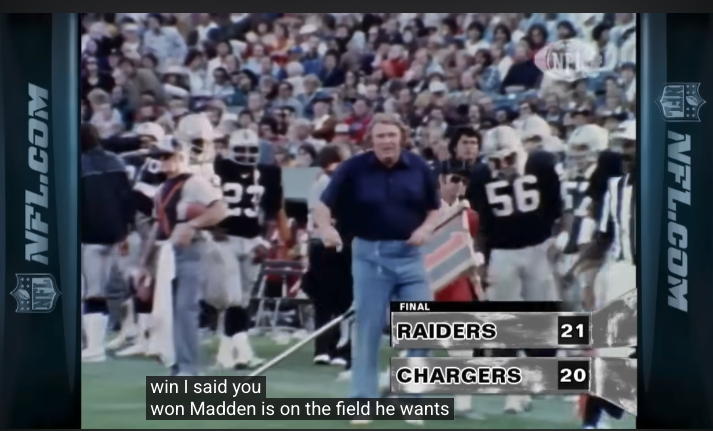
    Raiders vs Chargers screen grab of a still from the NFL YouTube video on the 'Holy Roller'.

    Image still is from the NFLs YouTube Channels, Top Controversial Plays: ‘The Holy Roller’

    Then the NFL was so unimpressed it rewrote the rulebook that spring so nobody could ever do it again. That is the Holy Roller, a 1978 Raiders win the Chargers still call the Immaculate Deception, a bitter pun on the Immaculate Reception, the play that had knocked the Raiders out six years earlier. Same league, same era, opposite luck.

    I’m telling you about it now because this Sunday the Las Vegas Raiders (my team, so I’ll keep myself honest about how they won this one) travel to the Los Angeles Chargers in Week 2, their first divisional game of the season. It is the same fixture as the Holy Roller, both clubs relocated since: in 1978 it was the Oakland Raiders at the San Diego Chargers. The Raiders go in 1-0 after a Week 1 win over Miami. Every tight finish this rivalry throws up now runs on the rule this one play created.

    What happened in the final ten seconds

    Ten seconds were left, the Raiders trailed 20-14, and they had the ball on the Chargers’ 14-yard line. Quarterback Ken Stabler, a left-hander known as “The Snake,” rolled to his right as the Chargers’ rush broke through, an awkward way for a left-handed passer to move, and with nothing on he threw the ball forward onto the turf. A fumble: a ball dropped rather than passed, which either team can grab.

    What followed was not luck. Running back Pete Banaszak reached the ball, could not keep his feet, and shoved it forward again. Tight end (an attacking player who blocks and catches passes) Dave Casper got there next, batted and kicked it into the end zone, and fell on it for the touchdown as time expired. Errol Mann kicked the extra point, and the Raiders won 21-20.

    Three Raiders touched the ball on its way to the goal line, and every touch moved it closer. That is the whole controversy in one sentence.

    Watch it happen: the full enhanced video of the play is on YouTube, as is the radio call by the Raiders’ Bill King, which became one of the most famous in the sport.

    The rule that was already in the book

    Here is the part almost nobody mentions. The rules already had a line for this. A fumble sent forward on purpose was not meant to count as a fumble at all: ruled deliberate, it becomes a forward pass, not a loose ball.

    That one distinction decides the game. A forward pass that hits the ground untouched is simply incomplete: the ball comes back, the down ends, and at zero on the clock the Chargers win 20-14. Ruled a fumble, the ball stays live and Casper’s recovery counts. So the officials were not staring at a hole in the rules. They were staring at a rule that turned on a single word: intent.

    The rulebook had already imagined this exact trick. It just could not prove it in real time.

    Why the referee let it stand

    Referee Jerry Markbreit ruled it a legal play, and the league backed him. The reasoning was that the crew could not be sure the forward taps were deliberate, and without that certainty they could not upgrade the fumbles to illegal forward passes. In a live scramble, that is a defensible call.

    The trouble is what the players said afterwards. Stabler was blunt about his own fumble: “I fumbled it on purpose.” His team-mates insisted their touches were real attempts to recover, and the doubt never lifted.

    The call held not because the play was clean, but because intent is almost impossible to judge in the half-second you get to judge it.

    The rule the Holy Roller created

    The NFL does not usually rewrite its book over one game. It did over this one. After the 1978 season the league added a rule, now Rule 8, Section 7 of the rulebook, restricting who can advance a fumble.

    As it stands today:

    On fourth down, or after the two-minute warning in either half, only the player who fumbled may recover and advance the ball for his team.

    If a team-mate recovers it in those situations, the ball is dead. It goes back to the spot of the fumble if it travelled forward. The two-minute warning, for anyone new to it, is the automatic clock stoppage two minutes before the end of each half.

    Run the Holy Roller under that rule and it dies on contact. Banaszak touches the ball, and because he is not the man who fumbled, the play is dead and the ball goes back to where Stabler lost it. No forward crawl, no Casper touchdown, no win. The loophole was not clarified. It was shut.

    Why it matters when the Raiders visit the Chargers on Sunday

    The reason this is the play to start with is that the fixture is live again, and the rivalry has a long memory. These two have met well over a hundred times, and rivalries like this one don’t fade.

    Watch the late-game fumbles this Sunday. Any loose ball in the final two minutes now gets whistled dead the instant a team-mate of the fumbler touches it, and the ball trots back upfield while newcomers wonder why the recovery did not count. That is not officials being fussy. That is a 1978 Raiders trick, written into law and still enforced 48 years later.

    You now know something most people watching the game do not: the fumble rule they are half-ignoring exists to stop the Raiders doing this to the Chargers a second time.

    This is the first of three plays so notorious the NFL changed its book because of them. The Raiders turn up in all three, which tells you something about the Raiders.

  • Raiders Week 1 Review: what the 27-13 win actually told us

    Raiders Week 1 Review: what the 27-13 win actually told us

    I have spent a lot of Septembers braced for the Raiders to invent a new way to lose. Not this one, this one was a fun one. Las Vegas opened 2026 with a 27-13 win over Miami, led from the first quarter to the last, and for once I got to enjoy every minute of it (NFL.com, ESPN).

    Not a classic game, and it didn’t need to be. A win is a win. Miami are the youngest team in the league and were always likely to be outmatched. But a comfortable home win, with a new quarterback settling in and the defence setting the tone, is exactly the start I wanted. I will take that any day!

    How the Raiders first game went down

    The Raiders never trailed. Scoring first, they led 17-6 at the half, stretched it to 27-6 through three quarters, then let Miami close the gap to the final margin once the game was already decided.

    QuarterDolphinsRaiders
    Q107
    Q2610
    Q3710
    Q400
    Final1327

    The Raiders sacked Miami quarterback Malik Willis five times, with Maxx Crosby credited for a share of them, and Willis spent most of the afternoon throwing before he wanted to (ESPN).

    A sack is simply tackling the quarterback behind the line before he can get rid of the ball, and it does two things at once: it loses the offence yards, and it rattles the person the whole thing depends on. Do it five times and you are not really letting the other team play. If you want the rest of the ways a defence takes a game over, I have the defence, decoded.

    The key number: 300

    Kirk Cousins, playing his first season in silver and black after arriving from Atlanta, completed his first ten passes and finished 21 of 30 for 160 yards and three touchdowns. Somewhere in there he threw the 300th touchdown pass of his career, only the fifteenth quarterback in NFL history to reach that mark, nudging one clear of John Elway (ESPN).

    A touchdown pass is what it sounds like, a throw the receiver catches in the end zone for six points, and 300 of them is a career, not a season. To put the scale on it: the league has been played since 1920 and fewer than fifteen men have ever got there. It is the kind of number that tells you what a steady quarterback is worth, which is most of what the Raiders were buying.

    He also threw two interceptions, so let us not get completely carried away, but the efficiency was the point. If you want to know why completion percentage and the numbers around it matter more than they look, QB stats, decoded lays it out.

    The key Raider Nation takes

    Jack Bech caught the first touchdown of his career, and the Raiders were quick to mark it.

    Then the milestone that had Raiders social buzzing all night: Maxx Crosby became only the third player in franchise history to reach 70 career sacks (ESPN). Seventy sacks from a defensive end is a decade of Sundays being the problem, and he is doing it in silver and black.

    I was not the only one who liked what I saw. Sports Illustrated’s Raiders desk ran three “overreactions” to the win, and their headline one is Ashton Jeanty, the second-year running back who looked like a genuine workhorse behind a rebuilt offensive line (Sports Illustrated).

    That is their read, framed as an overreaction on purpose, and I would only add that an offensive line going from a punchline to a strength is the quietest, most important thing that happened on Sunday.

    Where they sit now after NFL Week 1

    Raiders are 1-0 and, for a change, the AFC West is easy on the eyes. Kansas City did Kansas City things and beat Denver 31-10, but the Los Angeles Chargers, the team most people fancied to push the Chiefs, were upset at home by Arizona.

    AFC WestRecordWeek 1
    Las Vegas Raiders1-0beat Miami 27-13
    Kansas City Chiefs1-0beat Denver 31-10
    Denver Broncos0-1lost to Kansas City
    Los Angeles Chargers0-1lost to Arizona

    It is one week, and the division still runs through Kansas City until somebody proves otherwise, which is a story as old as the Chiefs and Raiders themselves. But there was a nice outside marker too: Pro Football Network’s Defense Impact metric for Week 1 put the Raiders fifth in the league, inside a top ten it shared on Monday (PFN). Read that for what it is, one analyst’s summary of a single afternoon that already happened, not a forecast. If you want to know how a record turns into a playoff place come January, the NFL playoffs and seeding explains where 1-0 actually gets you, and the AFC and NFC covers why the division matters most of all.

    The rest of the league

    The Raiders were one of sixteen games, and Week 1 had a 96-point shootout, an overtime rule earning its keep and two games decided by a two-point conversion. I wrote all of it up in the full Week 1 roundup across the league.

    Before I get carried away

    Week 1 lies, and it lies to Raiders fans as readily as anyone. A comfortable win over a rebuilding team is a good day, not a guarantee of the season ahead. The real test comes next Monday morning UK time, when Las Vegas travel to face the Chargers on the road in a division game that will tell us far more than this one did.

    For now, though, I am allowed to enjoy a 1-0 start. Well done Raiders. See you next week.

  • NFL Week 1 Review: what actually mattered

    NFL Week 1 Review: what actually mattered

    Ninety-six points. That is what the Chicago Bears and Carolina Panthers scored between them on Sunday afternoon, the most in any season-opening game in NFL history (ESPN). The Bears put up 59 of them, their highest total in a single game since 1980 (NFL.com).

    That was the standout moment of Week 1. But it wasn’t the only one that was worth understanding. A game in Detroit came down to the league’s new overtime rule. A team in Philadelphia was stopped one play short of tying a match it had clawed back into. And a couple of defences won games their offences never really controlled.

    This was a fun NFL Week 1 for me, so let’s get straight into it and start with the results!

    The NFL Week 1 results

    Every one of the 32 teams plays in Week 1, so there are no byes and nobody sitting out. Kickoff times are US Eastern, so for anyone reading in the UK, the Sunday-afternoon games land on Sunday evening our time, and Monday Night Football runs into the early hours of Tuesday.

    Matchup (away at home)Result
    New England Patriots at Seattle SeahawksSeahawks 13-10
    San Francisco 49ers at Los Angeles Rams49ers 27-7
    Chicago Bears at Carolina PanthersBears 59-37
    Baltimore Ravens at Indianapolis ColtsRavens 41-23
    Atlanta Falcons at Pittsburgh SteelersSteelers 20-13
    Cleveland Browns at Jacksonville JaguarsJaguars 34-10
    Tampa Bay Buccaneers at Cincinnati BengalsBengals 33-27
    New York Jets at Tennessee TitansJets 23-10
    New Orleans Saints at Detroit LionsLions 31-30 (OT)
    Buffalo Bills at Houston TexansBills 36-31
    Arizona Cardinals at Los Angeles ChargersCardinals 26-14
    Green Bay Packers at Minnesota VikingsVikings 39-22
    Miami Dolphins at Las Vegas RaidersRaiders 27-13
    Washington Commanders at Philadelphia EaglesEagles 24-22
    Dallas Cowboys at New York GiantsGiants 28-20
    Denver Broncos at Kansas City ChiefsChiefs 31-10

    Following the Raiders? They opened the season with a 27-13 win over Miami. I break their game down properly, and what it sets up for the weeks ahead, in the Raiders Week 1 review.

    The Bears scored 59, and the number that frames it

    Chicago gained 552 total yards and ran in six touchdowns, which is not a typo (NFL.com). Total yards is just every yard a team gains, running and passing added together, and 552 is an enormous day; a healthy offence might manage 350 to 400. Caleb Williams threw for 269 yards and two scores, ran in two more himself, and finished with a passer rating of 124.1.

    Passer rating is one number that tries to sum up how well a quarterback threw the ball, on a scale that tops out at 158.3. Anything above 100 is a strong afternoon, so 124.1 tells you Williams was close to faultless as a passer, before you even count his running. If you want the full picture of what that number rewards and what it quietly ignores, I have it here: QB stats, decoded.

    The combined-points record does not tell you Chicago is a contender or Carolina a disaster. It tells you both defences had a rotten afternoon on the same field at the same time. Enjoy it for what it is, and no more.

    How Detroit won in overtime, and why New Orleans was not robbed

    The Lions and Saints were level at 24-24 when regulation ended, so the game went to overtime, and overtime is where a rule change from last season earned its keep. Detroit got the ball first and scored a touchdown. Under the rule the NFL used until 2025, that would have ended the game on the spot, and New Orleans would have lost without their offence taking a single snap in the extra period.

    That is exactly what happened to the Buffalo Bills in a famous 2022 playoff defeat, and it is why the league changed the rule. Now, in the regular season, both teams are guaranteed a possession in overtime, the same as the playoffs (I have the full NFL season and overtime breakdown here). So New Orleans got the ball back and answered with a touchdown of their own, which pulled them within one, at 31-30.

    Then came the decision. They could kick a routine extra point to tie the game at 31-31 and play on, or go for a two-point conversion to win it there and then. They went for the win, the pass fell incomplete, and Detroit survived 31-30. Regular-season overtime lasts ten minutes, and if nobody is ahead when it ends, the game is recorded as a tie. New Orleans decided they would rather win or lose than settle.

    The defences that showed up like an offence

    A defence does not only stop the other team. The defense can take the ball away, and it can score. NFL Week 1 gave clean examples of both.

    In Pittsburgh, T.J. Watt put away a 20-13 win over Atlanta with a pick-six, an interception carried all the way back to the end zone for a touchdown (NBC Sports). A defender catches a pass meant for the other side and runs it in to score. It is the most deflating play in football if it happens to your team.

    In Cincinnati, the Bengals took the ball off Tampa Bay four times and turned one into points, Demetrius Knight Jr. scooping up a loose ball and carrying it 27 yards for a touchdown (NFL.com). A takeaway is any turnover a defence forces, an interception or a recovered fumble, and each one hands the ball straight back to your own offence. Four in a single game is daylight robbery.

    Individual plays are one thing; rating a whole unit’s afternoon is another, and this is where defensive stats come in. The plain ones count what you can see: sacks (tackling the quarterback before he can throw), takeaways, and the points and yards a defence gives up. The cleverer ones roll all of that into a single number so one defence can be ranked against another. Pro Football Network published one such measure after Week 1, their Defense Impact score, and it put Kansas City top, which fits the way the Chiefs smothered Denver on Monday night. Several of the defences from this review sit just behind them, with the Steelers, Bengals, Seahawks, Jaguars and the Raiders all inside the top ten.

    A number like that is worth reading for what it is: one analyst’s summary of what already happened, not a verdict on who is best or a hint at next week. If you want to know which defensive stats are worth watching, and what each one is really telling you, defense stats, decoded lays them out.

    Two-point conversion decided two games

    After a touchdown, a team almost always kicks a short extra point for one point. The alternative is to line up and run a single play from close to the goal line for two points instead. That is a two-point conversion, and it is rarer because it is riskier: come up short, and you get nothing.

    Week 1 served up both reasons a team goes for it. In Philadelphia, Washington scored a late touchdown to trail 24-22, which left them needing two points to draw level, since a kick would still have them a point behind. They went for two to force overtime, the Eagles broke it up, and Philadelphia won by that exact margin (Bleacher Report).

    In Detroit’s overtime, New Orleans met the other version of the same sum: a kick would only have tied it and dragged the game on, so they went for two to win outright. Both attempts came up empty. When a team waves away the easy extra point, the scoreboard nearly always explains why. If you want the rest of the ways points go up, how scoring works has it.

    The Monday night finish

    Kansas City closed the week out on Monday night with a comfortable 31-10 win over Denver, and it was built on defence and the run rather than anything flashy. The Chiefs held the Broncos to 176 total yards, sacked their quarterback four times, and broke a 60-yard touchdown run as part of a 220-yard rushing night. Not a classic match by any means, but a tidy way to end the round. If you are new to why every week finishes with a single prime-time game on a Monday, I have written up what Monday Night Football is and why it matters separately.

    One thing before you overreact

    NFL Week 1 is a single game out of seventeen, and it lies every year without fail. A team can look unstoppable in the opener and can then go on to miss the playoffs. At the same time another team looks finished and wins its division.

    The Bears scoring 59 is real, and it was the most fun anyone had all weekend, but it is not a cast iron guarantee. Enjoy the overreactions this week, mine included. Well done Raiders, and come back next week for the NFL Week 2 review!

  • I thought Monday Night Football was just a game that fell on a Monday

    I thought Monday Night Football was just a game that fell on a Monday

    When I started following the NFL, I took Monday Night Football to mean the obvious thing: the week’s game that happened to land on a Monday. It means far more than that. Monday Night Football is the longest-running primetime show in American television history, and it has aired every season since 1970.

    What I thought Monday Night Football was

    Back home, a Monday-night fixture is nothing to get excited about. Football (soccer, and it still stings to type it that way) is spread across the week for the cameras, and a Monday kick-off is just one more slot on the schedule. We even have our own Monday Night Football on the telly. So when American fans spoke about theirs like a proper event, I filed it as the same idea wearing a different accent.

    Why that seemed reasonable

    The name is word-for-word identical, and midweek football genuinely is routine in the game I grew up with. Nobody here clears an evening for a Monday fixture; it is television furniture. Reading the American version through that frame was not lazy. It was just me using the only map I had.

    What Monday Night Football actually is

    American Monday Night Football was built on purpose. In 1970 the NFL and the ABC network put one game in primetime on a weeknight and produced it like entertainment rather than sport, with far more cameras and big personalities in the commentary booth.

    The clever part is scarcity. The full run of fixtures happens on Sunday, so by Monday there is a single game left standing, and the whole country turns to it with nothing else competing for attention. One match, the national stage to itself. That is how it became an institution and stayed one for over half a century.

    If the rhythm of the NFL week is new to you, I walk through how the fixtures fall in the NFL season explained guide.

    The game that made it click

    It landed for me with a specific fixture. As I write this, on 14 September 2026, the season’s first Monday-nighter is the Denver Broncos at the Kansas City Chiefs, kicking off at 8:15pm on the US East Coast, which is 1:15am here in the UK.

    There is no rival game pulling the room in another direction. If you have ever wondered what the fuss is about, that is the whole of it: one match carrying an entire country’s Monday night.

    Every Monday-night game this season

    Here is the full 2026 Monday-night slate. In the American style the away team is named first, so “Broncos at Chiefs” means Denver travelling to Kansas City. Every game kicks off at 8:15pm US Eastern time (1:15am in the UK). “ABC/ESPN” means the game is shown on both US networks at once; “ESPN” means ESPN only. Over here the primetime games are on Sky Sports NFL, and every game is on NFL Game Pass via DAZN.

    WeekDateGameUS TV
    114 SepBroncos at ChiefsABC/ESPN
    221 SepGiants at RamsABC/ESPN
    328 SepEagles at BearsABC/ESPN
    45 OctFalcons at SaintsESPN
    512 OctBills at RamsABC/ESPN
    619 OctCommanders at 49ersABC/ESPN
    726 OctCowboys at EaglesABC/ESPN
    82 NovBears at SeahawksESPN
    99 NovBills at VikingsABC/ESPN
    1016 NovChargers at RavensESPN
    1123 NovBengals at CommandersESPN
    1230 NovPanthers at BuccaneersESPN
    137 DecCowboys at SeahawksABC/ESPN
    1414 DecSteelers at JaguarsESPN
    1521 DecPatriots at ChiefsABC/ESPN
    1628 DecGiants at LionsESPN
    174 Jan 2027Texans at PackersESPN

    All dates are 2026 except Week 17, which falls on 4 January 2027. Weeks 12 to 17 can still change under flex scheduling, where the NFL swaps in a better matchup closer to the date. There is no Monday game in Week 18: the season’s final week is played across the weekend. Schedule from CBS Sports.

    So, is MNF worth staying up for?

    It is the small hours of a school night here before any of this kicks off. Pick one Monday, make it through to the fourth quarter, and the fuss will stop being a mystery. Enjoy and look forward to the Tuesday morning coffee run, because I know I will need it!

  • The Super Bowl MVP is basically a quarterback award

    The Super Bowl MVP is basically a quarterback award

    Thirty-four. That is how many of the 60 Super Bowls have given their MVP award to a quarterback.

    The MVP, most valuable player, goes to the standout of the game. A panel of media voters decides it, with fans now getting a small say from the fourth quarter onwards. In theory the trophy can go to any player on the field. In practice it goes to the one taking the snap.

    Quarterback stats don’t lie

    Here is every position that has won it across all sixty games.

    PositionTimes won
    Quarterback34
    Wide receiver9
    Running back (including fullback)8
    Linebacker4
    Defensive lineman3
    Safety2
    Cornerback1

    Source: Pro Football Reference, Super Bowl MVP list; counts recomputed across all 60 games. The total comes to 61 because Dallas shared the award between two players in 1978. Outlets differ by a name or two on whether a player was a running back or a fullback, but the shape does not move.

    Quarterbacks have won it more times than every other position on the field put together. That is the whole argument in one line.

    And the MVP award is not getting wider

    If anything the tilt has got steeper. Since 2010, quarterbacks have won 12 of the last 17. That is just over seven in every ten.

    The game has leaned harder on passing over the same stretch, and the award has followed the ball.

    The exceptions are rare enough to name

    A running back had not won the MVP since Terrell Davis in 1998. Then Kenneth Walker III ran Seattle past New England in February and broke a gap of 28 years.

    A defensive player has not won it since Von Miller in 2016. When the trophy leaves the quarterback at all, it tends to make headlines precisely because it so seldom does.

    So why the Quarterback, and it’s not a consipracy

    This doesn’t mean that voters are lazy. The quarterback touches the ball on nearly every offensive play, so the yards, the touchdowns and the shape of the game will naturally centre around him. If you vote for the biggest stat line, then you are usually voting for a quarterback. If you want to see why those numbers pile up where they do, what quarterback stats actually measure is the place to start. And if you think this award skews, the league’s season-long MVP is an even tighter quarterback lock.

    My honest take is this. The Super Bowl MVP is trying to name the best player and the most important position in the same breath, and it cannot fully tell them apart. Kenneth Walker III is the rare year it managed to.

    For the full list of winners and the records around the award, see Super Bowl records.

  • The NFL’s other MVP is even more of a quarterback award

    The NFL’s other MVP is even more of a quarterback award

    American football hands out two big MVP awards every season, and when I started watching I filed them together as much the same thing. There is the Super Bowl MVP, for the standout of the final, and the season MVP, the league-wide award for the best player across the whole year. Both usually go to a quarterback, so I assumed they behaved the same way. They actually don’t, and the season award is a far tighter quarterback lock than the Super Bowl one.

    The Super Bowl MVP has roughly gone to a quarterback a little over half the time. The season MVP, in the modern game, goes to one almost every single year.

    The Super Bowl version at least can throw a surprise

    A running back won the Super Bowl MVP this year, Kenneth Walker III, the first at his position since 1998, and a defensive player sneaks in now and then. I wrote about how quarterback-heavy that award is here, but set beside the season MVP it looks almost broad-minded.

    The season award barely moves. A quarterback has won it every single year since 2012. The last player at any other position to take it was the running back Adrian Peterson, that same year. The reigning winner, announced in February, is Rams quarterback Matthew Stafford.

    No defenders, and not a single receiver named as MVP

    Go right back to the start, in 1957, and the pattern is clearer still. Only two defensive players have ever won it. Alan Page took it in 1971, Lawrence Taylor in 1986, and no defender has come close since.

    No wide receiver has ever won it, not even Jerry Rice, who had a decent claim to being the finest player the sport has produced. The winner is decided by a panel of fifty sportswriters at the end of the regular season, a similar media vote to the Super Bowl award but a far narrower result.

    AP NFL Most Valuable Player winners, 1957–present
    Season Winner Team Position
    1957 Jim Brown Cleveland Browns Fullback
    1958 Jim Brown Cleveland Browns Fullback
    1959 Johnny Unitas Baltimore Colts Quarterback
    1960 Norm Van Brocklin Philadelphia Eagles Quarterback
    1961 Paul Hornung Green Bay Packers Running back
    1962 Jim Taylor Green Bay Packers Running back
    1963 Y. A. Tittle New York Giants Quarterback
    1964 Johnny Unitas Baltimore Colts Quarterback
    1965 Jim Brown Cleveland Browns Fullback
    1966 Bart Starr Green Bay Packers Quarterback
    1967 Johnny Unitas Baltimore Colts Quarterback
    1968 Earl Morrall Baltimore Colts Quarterback
    1969 Roman Gabriel Los Angeles Rams Quarterback
    1970 John Brodie San Francisco 49ers Quarterback
    1971 Alan Page Minnesota Vikings Defensive tackle
    1972 Larry Brown Washington Redskins Running back
    1973 O. J. Simpson Buffalo Bills Running back
    1974 Ken Stabler Oakland Raiders Quarterback
    1975 Fran Tarkenton Minnesota Vikings Quarterback
    1976 Bert Jones Baltimore Colts Quarterback
    1977 Walter Payton Chicago Bears Running back
    1978 Terry Bradshaw Pittsburgh Steelers Quarterback
    1979 Earl Campbell Houston Oilers Running back
    1980 Brian Sipe Cleveland Browns Quarterback
    1981 Ken Anderson Cincinnati Bengals Quarterback
    1982 Mark Moseley Washington Redskins Placekicker
    1983 Joe Theismann Washington Redskins Quarterback
    1984 Dan Marino Miami Dolphins Quarterback
    1985 Marcus Allen Los Angeles Raiders Running back
    1986 Lawrence Taylor New York Giants Linebacker
    1987 John Elway Denver Broncos Quarterback
    1988 Boomer Esiason Cincinnati Bengals Quarterback
    1989 Joe Montana San Francisco 49ers Quarterback
    1990 Joe Montana San Francisco 49ers Quarterback
    1991 Thurman Thomas Buffalo Bills Running back
    1992 Steve Young San Francisco 49ers Quarterback
    1993 Emmitt Smith Dallas Cowboys Running back
    1994 Steve Young San Francisco 49ers Quarterback
    1995 Brett Favre Green Bay Packers Quarterback
    1996 Brett Favre Green Bay Packers Quarterback
    1997 Brett Favre & Barry Sanders Green Bay Packers / Detroit Lions Quarterback / Running back
    1998 Terrell Davis Denver Broncos Running back
    1999 Kurt Warner St. Louis Rams Quarterback
    2000 Marshall Faulk St. Louis Rams Running back
    2001 Kurt Warner St. Louis Rams Quarterback
    2002 Rich Gannon Oakland Raiders Quarterback
    2003 Peyton Manning & Steve McNair Indianapolis Colts / Tennessee Titans Quarterback
    2004 Peyton Manning Indianapolis Colts Quarterback
    2005 Shaun Alexander Seattle Seahawks Running back
    2006 LaDainian Tomlinson San Diego Chargers Running back
    2007 Tom Brady New England Patriots Quarterback
    2008 Peyton Manning Indianapolis Colts Quarterback
    2009 Peyton Manning Indianapolis Colts Quarterback
    2010 Tom Brady New England Patriots Quarterback
    2011 Aaron Rodgers Green Bay Packers Quarterback
    2012 Adrian Peterson Minnesota Vikings Running back
    2013 Peyton Manning Denver Broncos Quarterback
    2014 Aaron Rodgers Green Bay Packers Quarterback
    2015 Cam Newton Carolina Panthers Quarterback
    2016 Matt Ryan Atlanta Falcons Quarterback
    2017 Tom Brady New England Patriots Quarterback
    2018 Patrick Mahomes Kansas City Chiefs Quarterback
    2019 Lamar Jackson Baltimore Ravens Quarterback
    2020 Aaron Rodgers Green Bay Packers Quarterback
    2021 Aaron Rodgers Green Bay Packers Quarterback
    2022 Patrick Mahomes Kansas City Chiefs Quarterback
    2023 Lamar Jackson Baltimore Ravens Quarterback
    2024 Josh Allen Buffalo Bills Quarterback
    2025 Matthew Stafford Los Angeles Rams Quarterback

    Shaded rows in bold mark a non-quarterback winner. The award was shared in 1997 and 2003; pre-1961 winners were recognised as “Most Outstanding Player”. Source: Pro Football Reference.

    Why the season MVP award is typecast

    The difference comes down to one game against a whole season. A single Super Bowl can be hijacked by one player, a running back who goes for 150 yards, a pass-rusher who lives in the backfield all night.

    Across seventeen regular-season games, that noise averages out, and what is left standing is the quarterback, who touches the ball on nearly every snap and steers nearly every drive.

    Over a full year, it’s very hard to argue the best quarterback isn’t also the most valuable player, which is exactly what the counting stats reward. So the voters rarely bother arguing.

    With a new season just under way and the MVP talk already loud, here is a prediction that costs me nothing to make. Whoever wins it, they will be a quarterback.

  • I thought the NFL power rankings were official. They’re not.

    I thought the NFL power rankings were official. They’re not.

    As the kick off to the NFL 2026 Season happens today, like many of you I have been reading a tonne of news stories and getting excited for my first proper watch of an NFL season.

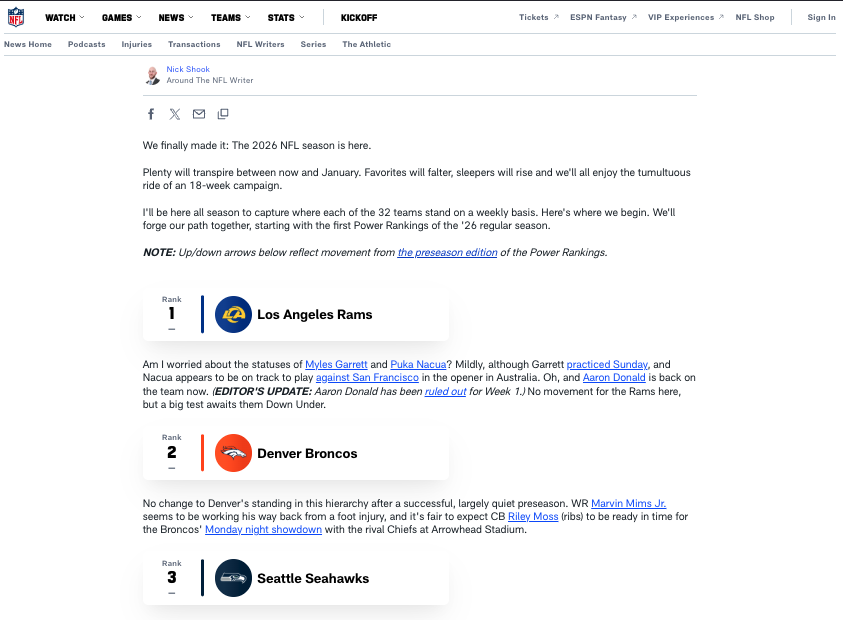
    I came across this NFL blog NFL Power Rankings, Week 1 and assumed that this was an some form of an official rankings table for the new season that I was not aware of. But it isn’t.

    Image source: https://www.nfl.com/news/nfl-power-rankings-week-1-2026-nfl-season

    Why that’s an easy mistake to make

    Although it looks exactly like the an official thing it isn’t. The confusion if when you are not familiar with NFL comes from the fact the standings, the real table that decides who reaches the playoffs, are also a numbered list of every team, also on NFL.com. The two sit a click apart and look very similar, and nothing on the page shouts “this is one person’s opinion.”

    What a power ranking actually is

    In a nutshell it is a columnist’s argument, published weekly, about how good each team looks right now. One person makes the call. They shift teams up and down on injuries, on how a game felt, on a signing, on a mood in the building, and sometimes on results. That’s the whole point of them: they try to catch form and momentum, the things a win-loss record is too blunt to show.

    They are not a measurement. Unlike, a table with points or NFL Stats which are objective, these are subjective, an opinion. Two writers rank the same thirty-two teams and hand you two different lists, because there’s no correct answer to check them against.

    The ranking that counts is the standings, and that one is settled only by who won. How those results turn into playoff places is its own piece of machinery, and I’ve explained it properly over on how the NFL playoffs and seeding work.

    A power ranking is an opinion about form; the standings are a record of results.

    The example that made it click

    So I did the obvious thing and went back to last year’s opening rankings to see how much they’d been worth. I read the first power rankings of the 2025 season, then checked them against how that season actually ended. The gap was almost funny.

    The two teams that reached the Super Bowl, the Seattle Seahawks and the New England Patriots, had started that year ranked 19th and 22nd out of 32. The team ranked second, the Baltimore Ravens, finished 8-9 and missed the playoffs altogether. My own Raiders sat 25th, for what little that turned out to be worth in either direction.

    TeamRank in the Week 1 2025 listHow the 2025 season ended
    Seattle Seahawks19thWon Super Bowl LX
    New England Patriots22ndLost Super Bowl LX
    Baltimore Ravens2ndFinished 8-9, missed the playoffs

    This is not a criticism of the writer. Nobody had Seattle against New England, because a season is long and full of injuries, breakouts and plain luck, and in Week 1 none of that has happened yet. That’s the point. We saw this in my NFL Draft Picks piece where not many of the official stats and analyst sites got last season right. A preseason ranking is a forecast at its most uncertain moment, before a single result exists to test it.

    The preseason order told you almost nothing about who’d be standing at the end.

    So how should you treat them?

    Read a power ranking as one sharp person’s argument, not a verdict. It’s genuinely worth reading: a good one tells you who’s trending and why, in a way the standings can’t. Just hold it loosely. Notice it’s one byline, check the date, and remember a different writer would have handed you a different order. The season is what settles it, and the season is why we watch.

    A quick word on betting

    You’ll also see rankings treated as betting tips, and they’re not that either. A team being ranked first is someone’s opinion on quality; a betting line is a price set by a market. They answer different questions, and one is never a shortcut to the other.

    So a power ranking isn’t the league’s word from on high. It’s a column dressed as a scoreboard, and once you can see that, you can read it for what it is: an argument you’re allowed to talk back to.

    Common questions

    Are NFL power rankings official?

    No. Power rankings are opinion pieces, usually written by one journalist and updated every week. The NFL doesn’t produce or endorse them, even when they run on NFL.com. The only official order of teams is the standings, which are set by win-loss record and the league’s tiebreakers.

    Do NFL power rankings predict the season?

    Not reliably. They’re a snapshot of opinion, and they’re at their least certain in Week 1, before any games. In 2025 the two teams that reached the Super Bowl began the season ranked 19th and 22nd, while the preseason No. 2 missed the playoffs. Treat them as form, not forecast.

  • The season opens with a rematch of last year’s Super Bowl

    The season opens with a rematch of last year’s Super Bowl

    Update, 14 September 2026: this game has now been played, and Seattle won it 13-10. I’ve left the original preview below exactly as it was, and added what actually happened, and what it teaches, right here at the top.

    The opener has been played: Seahawks 13, Patriots 10

    The game went to the champions, but not the way the first half suggested. New England led 10-0 and looked in control, then Seattle scored the last 13 points of the night to win 13-10 at Lumen Field. The night turned on turnovers. Drake Maye threw three fourth-quarter interceptions, the last of them picked off in the end zone in the final seconds by cornerback Josh Jobe, and Seattle’s defence did the rest.

    There was drama on both sides before that. Seattle lost their starting quarterback, Sam Darnold, to an injury on the opening drive, so the comeback was led by his backup, Drew Lock. The go-ahead touchdown was a 45-yard catch-and-run by Jaxon Smith-Njigba on a fourth-and-one, and Jason Myers kicked the winning 26-yard field goal. New England’s new receiver A.J. Brown left in the third quarter with an ankle injury, so it was a bruising start for both teams.

    Here is the shape of it in numbers, which is where it gets interesting if you are learning the game.

    2026 NFL Kickoff Game, 9 September: Seahawks 13, Patriots 10. Key team stats. Source: NFL.com game report.
    Team stat Seattle New England
    Final score 13 10
    Giveaways (turnovers) 0 3
    Takeaways (interceptions) 3 0
    Sacks 3 2
    Total yards 285 277
    First downs 13 19
    Time of possession 25:43 34:17
    Penalties (yards) 10 (98) 7 (50)

    Why the losing team out-gained the winner. New England had more first downs and held the ball nine minutes longer, and still lost. That is the single most useful lesson a new fan can take from this game: yards and possession are nice, but takeaways decide matches. Seattle forced three interceptions and three sacks and gave the ball away zero times. If you want to understand why the turnover column matters more than the yardage column, I’ve pulled apart the numbers that actually win games in my NFL defense stats guide.

    Maye’s night is a passer-rating lesson. He arrived as the 2025 MVP runner-up, the man who had just led the league in passer rating and completion percentage, and here he posted a rating in the fifties, because three interceptions drag that number down fast. The league’s own tracking had him at nought from four with three picks on throws of 20 yards or more. Passer rating and completion percentage are exactly the stats I explain, in plain English, in the NFL QB stats guide.

    The play that won it was a decision, not just a catch. On fourth-and-one, most teams run for the yard. Seattle threw, and Smith-Njigba turned a short pass into 45 yards and the tying score. That is play-calling, the running argument coaches have with themselves on every fourth down. If the logic of going for it rather than playing safe interests you, I’ve covered how coaches make that call in coaches and play-calling.

    One last oddity worth a glance: Seattle won despite 10 penalties for nearly 100 yards, which tells you penalties can hurt without ever deciding a game on their own. If you’re not sure what all those flags mean, here’s how NFL penalties work.

    So the preview below stands, the champions were meant to be there and they held on. It just took a comeback, a backup quarterback, and a defence that refused to lose to make it happen.


    So it is almost start of the season and the opener is a bit of a fun one with it being a Super Bowl replay – or a grudge match if you are a patriots fan. Season kicks off on Wednesday 9 September, with the Seahawks hosting the Patriots at Lumen Field.

    What’s happening on Wednesday

    Seattle Seahawks against New England Patriots, 8:20pm Eastern, live on NBC and streaming on Peacock. This is the NFL Kickoff Game, the single fixture that opens the season a few days before the rest of the league plays.

    The two last met on 8 February, when Seattle won Super Bowl LX 29-13 at Levi’s Stadium in California. Now the losing side travels to the winner’s home ground to start the year, in front of a Seattle crowd that has spent seven months waiting to celebrate.

    A champion opening at home is an annual tradition. A season opener that replays the Super Bowl is unusual, because the schedule had to pair these exact two teams in the very first week, with thirty-one other opponents it could have chosen instead.

    Why the champions get opening night

    The defending Super Bowl champion hosts the first game of every season. It is a standing tradition, not a one-off: the league gives the title holder a home fixture on the Wednesday or Thursday after Labor Day, wraps it in a concert and a banner ceremony, and lets them raise the championship flag in front of their own fans before kickoff.

    What changes each year is the opponent. Usually it is a strong visitor picked for the occasion. This year it happens to be the same team the champions beat in the final, which turns a routine opener into a rematch.

    If you want the full picture of how a season is built, from this opener through the eighteen weeks that follow, I’ve laid it out here: how the NFL season works.

    The opening weekend at a glance

    Wednesday is kick off of the season, the first full weekend runs Thursday to Monday, and it includes the league’s first regular-season game in Australia.

    NFL 2026 opening weekend: the headline games. Times are US Eastern. Source: NFL.com 2026 schedule.
    Game When Where Watch
    Patriots at Seahawks
    Kickoff Game
    Wed 9 Sep, 8:20pm Lumen Field, Seattle NBC / Peacock
    49ers vs Rams
    International
    Thu 10 Sep Melbourne, Australia Netflix
    Cowboys at Giants
    Sunday Night Football
    Sun 13 Sep, 8:20pm MetLife Stadium, New Jersey NBC / Peacock
    Broncos at Chiefs
    Monday Night Football
    Mon 14 Sep, 8:15pm Arrowhead Stadium, Kansas City ESPN / ABC

    The Thursday game in Melbourne is the eye-catching one: the first regular-season NFL game ever played in Australia, and it streams on Netflix rather than a traditional US network. It is part of a record run of international fixtures this season, nine games across seven countries, with the league playing for the first time in Melbourne, Rio de Janeiro and Paris, and the Jacksonville Jaguars staging two games in London.

    New to this? Where to start before Wednesday

    If you are coming to this cold, I have three guides that will help you get a quick start before the season starts!

    First up, get to grips with how the season is shaped, eighteen weeks, then the playoffs, and then the Super Bowl. Read this guide how the NFL season works.

    Secondly we need to look at the Super Bowl and what these two teams did to get here. Seattle are the reigning champions, and you can see every past winner and how the Super Bowl actually works on the Super Bowl guide.

    Thirdly, the Patriots themselves, if you want a way into one of the sides. Their long rivalry with the Jets is a good introduction to how New England have been so dominate the Patriots and Jets rivalry, explained.

    Don’t worry if you didn’t see the game last year, all you need to know that it’s a rematch. That the champions are meant to be there, and that the team across from them is the one they beat.

    So enjoy this seasons opener!