Back home, a Monday-night fixture is nothing to get excited about. Football (soccer, and it still stings to type it that way) is spread across the week for the cameras, and a Monday kick-off is just one more slot on the schedule. We even have our own Monday Night Football on the telly. So when American fans spoke about theirs like a proper event, I filed it as the same idea wearing a different accent.
Why that seemed reasonable
The name is word-for-word identical, and midweek football genuinely is routine in the game I grew up with. Nobody here clears an evening for a Monday fixture; it is television furniture. Reading the American version through that frame was not lazy. It was just me using the only map I had.
What Monday Night Football actually is
American Monday Night Football was built on purpose. In 1970 the NFL and the ABC network put one game in primetime on a weeknight and produced it like entertainment rather than sport, with far more cameras and big personalities in the commentary booth.
The clever part is scarcity. The full run of fixtures happens on Sunday, so by Monday there is a single game left standing, and the whole country turns to it with nothing else competing for attention. One match, the national stage to itself. That is how it became an institution and stayed one for over half a century.
If the rhythm of the NFL week is new to you, I walk through how the fixtures fall in the NFL season explained guide.
The game that made it click
It landed for me with a specific fixture. As I write this, on 14 September 2026, the season’s first Monday-nighter is the Denver Broncos at the Kansas City Chiefs, kicking off at 8:15pm on the US East Coast, which is 1:15am here in the UK.
There is no rival game pulling the room in another direction. If you have ever wondered what the fuss is about, that is the whole of it: one match carrying an entire country’s Monday night.
Every Monday-night game this season
Here is the full 2026 Monday-night slate. In the American style the away team is named first, so “Broncos at Chiefs” means Denver travelling to Kansas City. Every game kicks off at 8:15pm US Eastern time (1:15am in the UK). “ABC/ESPN” means the game is shown on both US networks at once; “ESPN” means ESPN only. Over here the primetime games are on Sky Sports NFL, and every game is on NFL Game Pass via DAZN.
Week
Date
Game
US TV
1
14 Sep
Broncos at Chiefs
ABC/ESPN
2
21 Sep
Giants at Rams
ABC/ESPN
3
28 Sep
Eagles at Bears
ABC/ESPN
4
5 Oct
Falcons at Saints
ESPN
5
12 Oct
Bills at Rams
ABC/ESPN
6
19 Oct
Commanders at 49ers
ABC/ESPN
7
26 Oct
Cowboys at Eagles
ABC/ESPN
8
2 Nov
Bears at Seahawks
ESPN
9
9 Nov
Bills at Vikings
ABC/ESPN
10
16 Nov
Chargers at Ravens
ESPN
11
23 Nov
Bengals at Commanders
ESPN
12
30 Nov
Panthers at Buccaneers
ESPN
13
7 Dec
Cowboys at Seahawks
ABC/ESPN
14
14 Dec
Steelers at Jaguars
ESPN
15
21 Dec
Patriots at Chiefs
ABC/ESPN
16
28 Dec
Giants at Lions
ESPN
17
4 Jan 2027
Texans at Packers
ESPN
All dates are 2026 except Week 17, which falls on 4 January 2027. Weeks 12 to 17 can still change under flex scheduling, where the NFL swaps in a better matchup closer to the date. There is no Monday game in Week 18: the season’s final week is played across the weekend. Schedule from CBS Sports.
So, is MNF worth staying up for?
It is the small hours of a school night here before any of this kicks off. Pick one Monday, make it through to the fourth quarter, and the fuss will stop being a mystery. Enjoy and look forward to the Tuesday morning coffee run, because I know I will need it!
Thirty-four. That is how many of the 60 Super Bowls have given their MVP award to a quarterback.
The MVP, most valuable player, goes to the standout of the game. A panel of media voters decides it, with fans now getting a small say from the fourth quarter onwards. In theory the trophy can go to any player on the field. In practice it goes to the one taking the snap.
Quarterback stats don’t lie
Here is every position that has won it across all sixty games.
Position
Times won
Quarterback
34
Wide receiver
9
Running back (including fullback)
8
Linebacker
4
Defensive lineman
3
Safety
2
Cornerback
1
Source: Pro Football Reference, Super Bowl MVP list; counts recomputed across all 60 games. The total comes to 61 because Dallas shared the award between two players in 1978. Outlets differ by a name or two on whether a player was a running back or a fullback, but the shape does not move.
Quarterbacks have won it more times than every other position on the field put together. That is the whole argument in one line.
And the MVP award is not getting wider
If anything the tilt has got steeper. Since 2010, quarterbacks have won 12 of the last 17. That is just over seven in every ten.
The game has leaned harder on passing over the same stretch, and the award has followed the ball.
The exceptions are rare enough to name
A running back had not won the MVP since Terrell Davis in 1998. Then Kenneth Walker III ran Seattle past New England in February and broke a gap of 28 years.
A defensive player has not won it since Von Miller in 2016. When the trophy leaves the quarterback at all, it tends to make headlines precisely because it so seldom does.
So why the Quarterback, and it’s not a consipracy
This doesn’t mean that voters are lazy. The quarterback touches the ball on nearly every offensive play, so the yards, the touchdowns and the shape of the game will naturally centre around him. If you vote for the biggest stat line, then you are usually voting for a quarterback. If you want to see why those numbers pile up where they do, what quarterback stats actually measure is the place to start. And if you think this award skews, the league’s season-long MVP is an even tighter quarterback lock.
My honest take is this. The Super Bowl MVP is trying to name the best player and the most important position in the same breath, and it cannot fully tell them apart. Kenneth Walker III is the rare year it managed to.
For the full list of winners and the records around the award, see Super Bowl records.
American football hands out two big MVP awards every season, and when I started watching I filed them together as much the same thing. There is the Super Bowl MVP, for the standout of the final, and the season MVP, the league-wide award for the best player across the whole year. Both usually go to a quarterback, so I assumed they behaved the same way. They actually don’t, and the season award is a far tighter quarterback lock than the Super Bowl one.
The Super Bowl MVP has roughly gone to a quarterback a little over half the time. The season MVP, in the modern game, goes to one almost every single year.
The Super Bowl version at least can throw a surprise
A running back won the Super Bowl MVP this year, Kenneth Walker III, the first at his position since 1998, and a defensive player sneaks in now and then. I wrote about how quarterback-heavy that award is here, but set beside the season MVP it looks almost broad-minded.
The season award barely moves. A quarterback has won it every single year since 2012. The last player at any other position to take it was the running back Adrian Peterson, that same year. The reigning winner, announced in February, is Rams quarterback Matthew Stafford.
No defenders, and not a single receiver named as MVP
Go right back to the start, in 1957, and the pattern is clearer still. Only two defensive players have ever won it. Alan Page took it in 1971, Lawrence Taylor in 1986, and no defender has come close since.
No wide receiver has ever won it, not even Jerry Rice, who had a decent claim to being the finest player the sport has produced. The winner is decided by a panel of fifty sportswriters at the end of the regular season, a similar media vote to the Super Bowl award but a far narrower result.
AP NFL Most Valuable Player winners, 1957–present
Season
Winner
Team
Position
1957
Jim Brown
Cleveland Browns
Fullback
1958
Jim Brown
Cleveland Browns
Fullback
1959
Johnny Unitas
Baltimore Colts
Quarterback
1960
Norm Van Brocklin
Philadelphia Eagles
Quarterback
1961
Paul Hornung
Green Bay Packers
Running back
1962
Jim Taylor
Green Bay Packers
Running back
1963
Y. A. Tittle
New York Giants
Quarterback
1964
Johnny Unitas
Baltimore Colts
Quarterback
1965
Jim Brown
Cleveland Browns
Fullback
1966
Bart Starr
Green Bay Packers
Quarterback
1967
Johnny Unitas
Baltimore Colts
Quarterback
1968
Earl Morrall
Baltimore Colts
Quarterback
1969
Roman Gabriel
Los Angeles Rams
Quarterback
1970
John Brodie
San Francisco 49ers
Quarterback
1971
Alan Page
Minnesota Vikings
Defensive tackle
1972
Larry Brown
Washington Redskins
Running back
1973
O. J. Simpson
Buffalo Bills
Running back
1974
Ken Stabler
Oakland Raiders
Quarterback
1975
Fran Tarkenton
Minnesota Vikings
Quarterback
1976
Bert Jones
Baltimore Colts
Quarterback
1977
Walter Payton
Chicago Bears
Running back
1978
Terry Bradshaw
Pittsburgh Steelers
Quarterback
1979
Earl Campbell
Houston Oilers
Running back
1980
Brian Sipe
Cleveland Browns
Quarterback
1981
Ken Anderson
Cincinnati Bengals
Quarterback
1982
Mark Moseley
Washington Redskins
Placekicker
1983
Joe Theismann
Washington Redskins
Quarterback
1984
Dan Marino
Miami Dolphins
Quarterback
1985
Marcus Allen
Los Angeles Raiders
Running back
1986
Lawrence Taylor
New York Giants
Linebacker
1987
John Elway
Denver Broncos
Quarterback
1988
Boomer Esiason
Cincinnati Bengals
Quarterback
1989
Joe Montana
San Francisco 49ers
Quarterback
1990
Joe Montana
San Francisco 49ers
Quarterback
1991
Thurman Thomas
Buffalo Bills
Running back
1992
Steve Young
San Francisco 49ers
Quarterback
1993
Emmitt Smith
Dallas Cowboys
Running back
1994
Steve Young
San Francisco 49ers
Quarterback
1995
Brett Favre
Green Bay Packers
Quarterback
1996
Brett Favre
Green Bay Packers
Quarterback
1997
Brett Favre & Barry Sanders
Green Bay Packers / Detroit Lions
Quarterback / Running back
1998
Terrell Davis
Denver Broncos
Running back
1999
Kurt Warner
St. Louis Rams
Quarterback
2000
Marshall Faulk
St. Louis Rams
Running back
2001
Kurt Warner
St. Louis Rams
Quarterback
2002
Rich Gannon
Oakland Raiders
Quarterback
2003
Peyton Manning & Steve McNair
Indianapolis Colts / Tennessee Titans
Quarterback
2004
Peyton Manning
Indianapolis Colts
Quarterback
2005
Shaun Alexander
Seattle Seahawks
Running back
2006
LaDainian Tomlinson
San Diego Chargers
Running back
2007
Tom Brady
New England Patriots
Quarterback
2008
Peyton Manning
Indianapolis Colts
Quarterback
2009
Peyton Manning
Indianapolis Colts
Quarterback
2010
Tom Brady
New England Patriots
Quarterback
2011
Aaron Rodgers
Green Bay Packers
Quarterback
2012
Adrian Peterson
Minnesota Vikings
Running back
2013
Peyton Manning
Denver Broncos
Quarterback
2014
Aaron Rodgers
Green Bay Packers
Quarterback
2015
Cam Newton
Carolina Panthers
Quarterback
2016
Matt Ryan
Atlanta Falcons
Quarterback
2017
Tom Brady
New England Patriots
Quarterback
2018
Patrick Mahomes
Kansas City Chiefs
Quarterback
2019
Lamar Jackson
Baltimore Ravens
Quarterback
2020
Aaron Rodgers
Green Bay Packers
Quarterback
2021
Aaron Rodgers
Green Bay Packers
Quarterback
2022
Patrick Mahomes
Kansas City Chiefs
Quarterback
2023
Lamar Jackson
Baltimore Ravens
Quarterback
2024
Josh Allen
Buffalo Bills
Quarterback
2025
Matthew Stafford
Los Angeles Rams
Quarterback
Shaded rows in bold mark a non-quarterback winner. The award was shared in 1997 and 2003; pre-1961 winners were recognised as “Most Outstanding Player”. Source: Pro Football Reference.
Why the season MVP award is typecast
The difference comes down to one game against a whole season. A single Super Bowl can be hijacked by one player, a running back who goes for 150 yards, a pass-rusher who lives in the backfield all night.
Across seventeen regular-season games, that noise averages out, and what is left standing is the quarterback, who touches the ball on nearly every snap and steers nearly every drive.
Over a full year, it’s very hard to argue the best quarterback isn’t also the most valuable player, which is exactly what the counting stats reward. So the voters rarely bother arguing.
With a new season just under way and the MVP talk already loud, here is a prediction that costs me nothing to make. Whoever wins it, they will be a quarterback.
As the kick off to the NFL 2026 Season happens today, like many of you I have been reading a tonne of news stories and getting excited for my first proper watch of an NFL season.
I came across this NFL blog NFL Power Rankings, Week 1 and assumed that this was an some form of an official rankings table for the new season that I was not aware of. But it isn’t.
Although it looks exactly like the an official thing it isn’t. The confusion if when you are not familiar with NFL comes from the fact the standings, the real table that decides who reaches the playoffs, are also a numbered list of every team, also on NFL.com. The two sit a click apart and look very similar, and nothing on the page shouts “this is one person’s opinion.”
What a power ranking actually is
In a nutshell it is a columnist’s argument, published weekly, about how good each team looks right now. One person makes the call. They shift teams up and down on injuries, on how a game felt, on a signing, on a mood in the building, and sometimes on results. That’s the whole point of them: they try to catch form and momentum, the things a win-loss record is too blunt to show.
They are not a measurement. Unlike, a table with points or NFL Stats which are objective, these are subjective, an opinion. Two writers rank the same thirty-two teams and hand you two different lists, because there’s no correct answer to check them against.
The ranking that counts is the standings, and that one is settled only by who won. How those results turn into playoff places is its own piece of machinery, and I’ve explained it properly over on how the NFL playoffs and seeding work.
A power ranking is an opinion about form; the standings are a record of results.
The example that made it click
So I did the obvious thing and went back to last year’s opening rankings to see how much they’d been worth. I read the first power rankings of the 2025 season, then checked them against how that season actually ended. The gap was almost funny.
The two teams that reached the Super Bowl, the Seattle Seahawks and the New England Patriots, had started that year ranked 19th and 22nd out of 32. The team ranked second, the Baltimore Ravens, finished 8-9 and missed the playoffs altogether. My own Raiders sat 25th, for what little that turned out to be worth in either direction.
Team
Rank in the Week 1 2025 list
How the 2025 season ended
Seattle Seahawks
19th
Won Super Bowl LX
New England Patriots
22nd
Lost Super Bowl LX
Baltimore Ravens
2nd
Finished 8-9, missed the playoffs
This is not a criticism of the writer. Nobody had Seattle against New England, because a season is long and full of injuries, breakouts and plain luck, and in Week 1 none of that has happened yet. That’s the point. We saw this in my NFL Draft Picks piece where not many of the official stats and analyst sites got last season right. A preseason ranking is a forecast at its most uncertain moment, before a single result exists to test it.
The preseason order told you almost nothing about who’d be standing at the end.
So how should you treat them?
Read a power ranking as one sharp person’s argument, not a verdict. It’s genuinely worth reading: a good one tells you who’s trending and why, in a way the standings can’t. Just hold it loosely. Notice it’s one byline, check the date, and remember a different writer would have handed you a different order. The season is what settles it, and the season is why we watch.
A quick word on betting
You’ll also see rankings treated as betting tips, and they’re not that either. A team being ranked first is someone’s opinion on quality; a betting line is a price set by a market. They answer different questions, and one is never a shortcut to the other.
So a power ranking isn’t the league’s word from on high. It’s a column dressed as a scoreboard, and once you can see that, you can read it for what it is: an argument you’re allowed to talk back to.
Common questions
Are NFL power rankings official?
No. Power rankings are opinion pieces, usually written by one journalist and updated every week. The NFL doesn’t produce or endorse them, even when they run on NFL.com. The only official order of teams is the standings, which are set by win-loss record and the league’s tiebreakers.
Do NFL power rankings predict the season?
Not reliably. They’re a snapshot of opinion, and they’re at their least certain in Week 1, before any games. In 2025 the two teams that reached the Super Bowl began the season ranked 19th and 22nd, while the preseason No. 2 missed the playoffs. Treat them as form, not forecast.
Update, 14 September 2026: this game has now been played, and Seattle won it 13-10. I’ve left the original preview below exactly as it was, and added what actually happened, and what it teaches, right here at the top.
The opener has been played: Seahawks 13, Patriots 10
The game went to the champions, but not the way the first half suggested. New England led 10-0 and looked in control, then Seattle scored the last 13 points of the night to win 13-10 at Lumen Field. The night turned on turnovers. Drake Maye threw three fourth-quarter interceptions, the last of them picked off in the end zone in the final seconds by cornerback Josh Jobe, and Seattle’s defence did the rest.
There was drama on both sides before that. Seattle lost their starting quarterback, Sam Darnold, to an injury on the opening drive, so the comeback was led by his backup, Drew Lock. The go-ahead touchdown was a 45-yard catch-and-run by Jaxon Smith-Njigba on a fourth-and-one, and Jason Myers kicked the winning 26-yard field goal. New England’s new receiver A.J. Brown left in the third quarter with an ankle injury, so it was a bruising start for both teams.
Here is the shape of it in numbers, which is where it gets interesting if you are learning the game.
2026 NFL Kickoff Game, 9 September: Seahawks 13, Patriots 10. Key team stats. Source: NFL.com game report.
Team stat
Seattle
New England
Final score
13
10
Giveaways (turnovers)
0
3
Takeaways (interceptions)
3
0
Sacks
3
2
Total yards
285
277
First downs
13
19
Time of possession
25:43
34:17
Penalties (yards)
10 (98)
7 (50)
Why the losing team out-gained the winner. New England had more first downs and held the ball nine minutes longer, and still lost. That is the single most useful lesson a new fan can take from this game: yards and possession are nice, but takeaways decide matches. Seattle forced three interceptions and three sacks and gave the ball away zero times. If you want to understand why the turnover column matters more than the yardage column, I’ve pulled apart the numbers that actually win games in my NFL defense stats guide.
Maye’s night is a passer-rating lesson. He arrived as the 2025 MVP runner-up, the man who had just led the league in passer rating and completion percentage, and here he posted a rating in the fifties, because three interceptions drag that number down fast. The league’s own tracking had him at nought from four with three picks on throws of 20 yards or more. Passer rating and completion percentage are exactly the stats I explain, in plain English, in the NFL QB stats guide.
The play that won it was a decision, not just a catch. On fourth-and-one, most teams run for the yard. Seattle threw, and Smith-Njigba turned a short pass into 45 yards and the tying score. That is play-calling, the running argument coaches have with themselves on every fourth down. If the logic of going for it rather than playing safe interests you, I’ve covered how coaches make that call in coaches and play-calling.
One last oddity worth a glance: Seattle won despite 10 penalties for nearly 100 yards, which tells you penalties can hurt without ever deciding a game on their own. If you’re not sure what all those flags mean, here’s how NFL penalties work.
So the preview below stands, the champions were meant to be there and they held on. It just took a comeback, a backup quarterback, and a defence that refused to lose to make it happen.
So it is almost start of the season and the opener is a bit of a fun one with it being a Super Bowl replay – or a grudge match if you are a patriots fan. Season kicks off on Wednesday 9 September, with the Seahawks hosting the Patriots at Lumen Field.
What’s happening on Wednesday
Seattle Seahawks against New England Patriots, 8:20pm Eastern, live on NBC and streaming on Peacock. This is the NFL Kickoff Game, the single fixture that opens the season a few days before the rest of the league plays.
The two last met on 8 February, when Seattle won Super Bowl LX 29-13 at Levi’s Stadium in California. Now the losing side travels to the winner’s home ground to start the year, in front of a Seattle crowd that has spent seven months waiting to celebrate.
A champion opening at home is an annual tradition. A season opener that replays the Super Bowl is unusual, because the schedule had to pair these exact two teams in the very first week, with thirty-one other opponents it could have chosen instead.
Why the champions get opening night
The defending Super Bowl champion hosts the first game of every season. It is a standing tradition, not a one-off: the league gives the title holder a home fixture on the Wednesday or Thursday after Labor Day, wraps it in a concert and a banner ceremony, and lets them raise the championship flag in front of their own fans before kickoff.
What changes each year is the opponent. Usually it is a strong visitor picked for the occasion. This year it happens to be the same team the champions beat in the final, which turns a routine opener into a rematch.
If you want the full picture of how a season is built, from this opener through the eighteen weeks that follow, I’ve laid it out here: how the NFL season works.
The opening weekend at a glance
Wednesday is kick off of the season, the first full weekend runs Thursday to Monday, and it includes the league’s first regular-season game in Australia.
NFL 2026 opening weekend: the headline games. Times are US Eastern. Source: NFL.com 2026 schedule.
Game
When
Where
Watch
Patriots at Seahawks Kickoff Game
Wed 9 Sep, 8:20pm
Lumen Field, Seattle
NBC / Peacock
49ers vs Rams International
Thu 10 Sep
Melbourne, Australia
Netflix
Cowboys at Giants Sunday Night Football
Sun 13 Sep, 8:20pm
MetLife Stadium, New Jersey
NBC / Peacock
Broncos at Chiefs Monday Night Football
Mon 14 Sep, 8:15pm
Arrowhead Stadium, Kansas City
ESPN / ABC
The Thursday game in Melbourne is the eye-catching one: the first regular-season NFL game ever played in Australia, and it streams on Netflix rather than a traditional US network. It is part of a record run of international fixtures this season, nine games across seven countries, with the league playing for the first time in Melbourne, Rio de Janeiro and Paris, and the Jacksonville Jaguars staging two games in London.
New to this? Where to start before Wednesday
If you are coming to this cold, I have three guides that will help you get a quick start before the season starts!
First up, get to grips with how the season is shaped, eighteen weeks, then the playoffs, and then the Super Bowl. Read this guide how the NFL season works.
Secondly we need to look at the Super Bowl and what these two teams did to get here. Seattle are the reigning champions, and you can see every past winner and how the Super Bowl actually works on the Super Bowl guide.
Thirdly, the Patriots themselves, if you want a way into one of the sides. Their long rivalry with the Jets is a good introduction to how New England have been so dominate the Patriots and Jets rivalry, explained.
Don’t worry if you didn’t see the game last year, all you need to know that it’s a rematch. That the champions are meant to be there, and that the team across from them is the one they beat.
The best-paid player on any NFL defense is not the man who runs it. It is the one whose only job is to get to the quarterback before the quarterback can do anything. Micah Parsons does exactly that for about $47 million a year, which makes him the highest-paid defender in the history of the sport, ahead of every cornerback and every linebacker who has ever played.
So the market has already answered the question. Ask an NFL team who matters most on defense and it votes with its cheque book, and the cheque goes to the man who rushes the passer. Watch an actual game, though, and the film hands you two other honest answers. Both of them are right, which is the interesting part.
The money has already picked a winner
The clearest answer to “who matters most” is the one nobody argues about, because it is written into contracts. Here is the top of the market at three defensive positions.
Position
Top-paid player
Roughly per year
The deal
Edge rusher
Micah Parsons
$47m
4 years, $188m with Green Bay, 2025
Cornerback
Sauce Gardner
$30m
4 years, $120.4m with the Jets, 2025
Off-ball linebacker
Fred Warner
$21m
3 years, $63m with San Francisco, 2025
Contract values via ESPN and NFL.com reporting, 2025 deals. Figures are average annual value and move whenever a new deal resets a market.
An edge rusher (the defender lined up on the end of the line whose job is to beat his blocker and reach the passer) sits about $17m a year clear of the best-paid cornerback, and more than double the best-paid off-ball linebacker (the defender in the middle who reads the play and makes tackles rather than rushing). Parsons’ deal made him the highest-paid non-quarterback in NFL history when he signed it. When teams spend like that, they are saying the rarest and most valuable defender is the one who can wreck a passing play on his own.
The market’s verdict is not close. On money, the pass rusher wins.
Watch a game and you get two other answers
Two other players have a real claim, and you only see it if you watch a snap instead of a spreadsheet.
The first is the linebacker with the green dot. On every defense, exactly one player has a small green sticker on the back of his helmet, and he is the only one with a radio to the coaches. He takes the call, then sets the other ten before the ball is snapped. If he lines the defense up wrong, all eleven are wrong, on that play and the next one. People call him the quarterback of the defense for good reason, and Fred Warner, the best-paid one, is the archetype.
The second is the shutdown corner. A cornerback like Gardner can follow the other team’s best receiver all game and take him out of it, which changes every throw the quarterback even considers. You tend not to notice, because the proof is that nothing happens on his side of the field.
You can watch all of this right now. Houston had the best yards-allowed defense in the league last season and has spent the 2026 preseason swarming people even with its starters resting. That is not one man. It is a pass rush, a secondary and a signal-caller working together, which is the whole point.
Why the money and the film disagree
Money does not price importance. It prices scarcity, in a league built on the pass.
Nearly every NFL offense lives or dies by throwing the ball, and the fastest way to ruin a throw is to hit the quarterback before he lets go of it. Players who can beat a blocker one-on-one and do that, snap after snap, barely exist. Rare plus game-warping equals expensive. A brilliant play-calling linebacker is valuable too, but his worth shows up as the whole unit being in the right place, which is harder to isolate and easier to replace, so the market pays it less.
The gap is not the market saying a linebacker matters half as much as a pass rusher. It is the market saying you can find a good linebacker more easily than you can find a wrecking ball off the edge. That is a different claim, and it is the one a salary actually makes. It is the same lesson as the one on the defensive stats page: no single number, and no single figure on a contract, ranks a defender on its own.
So who is the most important defender?
There is no single one, and the reason is worth having.
If you want to know who can win a game by himself, watch the edge rusher on passing downs. If you want to know who can quietly lose one, watch the player with the green dot. If you want to know why a star receiver vanished from the box score, find the corner nobody threw at. All three are the most important player on defense, depending on what you were really asking when you asked.
The gap in the table is the real tell. A team will pay a man to hunt the quarterback more than double what it pays the one who runs its whole defense. Whether that makes him the most important player or just the hardest to replace is the one question the money was never built to answer.
Common questions
Who is the highest-paid defensive player in the NFL?
Micah Parsons, an edge rusher for the Green Bay Packers, on a four-year deal worth $188 million, about $47 million a year. That made him the highest-paid non-quarterback in NFL history when he signed it in 2025.
Who is the most important player on an NFL defense?
There is no single answer, and that is the honest one. By the money it is the edge rusher, the pass rusher paid more than any other defender. By what happens on the field it is often the play-calling linebacker who sets the defense before each snap, or the cornerback who removes the other team’s best receiver. Which one you name depends on what you are asking.
The Chicago Bears, Detroit Lions, Green Bay Packers and Minnesota Vikings have all revealed new “Rivalries” uniforms for 2026, and each team will wear its version exactly once this season: at home, against a division rival.
If you saw the photos doing the rounds and wondered, just like I did, whether this is a genuine NFL thing or a one-off bit of marketing, it’s the genuine thing. It’s a real, multi-year programme run by the NFL and Nike, and this is only its second year. The nearest comparison for a non-US sports fan I can give is Manchester United’s 2026/27 third kit, an off-white Salford Lads Club tribute that trades on heritage and local pride the same way.
The NFC North “Rivalries” uniform debuts
Each club will debut its new look in a single home fixture against one of its NFC North rivals, and the four dates are already set.
Below is the full run for the division this season:
Team
Week
Home game against
Green Bay Packers
5
Chicago Bears
Detroit Lions
8
Minnesota Vikings
Minnesota Vikings
15
Detroit Lions
Chicago Bears
16
Green Bay Packers
The Packers will go first, in Week 5 against the Bears. The Bears close the set in Week 16, also against Green Bay, so that one pairing bookends the whole thing.
Nike x NFL Rivalries: yes, it’s a real collab
The Nike x NFL Rivalries programme launched in 2025 with eight teams from two divisions: the AFC East (Bills, Dolphins, Patriots, Jets) and the NFC West (Cardinals, Rams, 49ers, Seahawks). Each wore a one-off design during a home game against a rival, exactly as the NFC North teams will do this season.
These became Fanatics’ best-selling merchandise release to date: on launch day, Rivalries gear made up about 80% of all sales across Fanatics’ online network, including NFLShop.com. That is a large part of why the programme is back and growing rather than quietly dropped. It’s a four-year rollout, so by 2028 all divisions will have completed the programme:
Season
Divisions joining
2025
AFC East, NFC West
2026
AFC South, NFC North
2027
NFC East, AFC West
2028
AFC North, NFC South
Why the uniform only ever comes out against a division rival
In the NFL, the teams in your division are the only opponents you are guaranteed to play twice every season, once at home and once away. The league is split into eight divisions of four teams. Your three division rivals account for six of your seventeen games, home and away against each. (I’ve drawn the full map on the conferences and divisions page, and I explain how the seventeen games are built on the NFL season, explained.)
So when the league wants each team to debut a uniform against a rival, in a home game, it doesn’t have to hope the right fixture exists. It’s already on the calendar, twice.
The Bears and Packers game is the oldest one in the book
Two of the four teams, the Bears and Packers, have been playing each other since the 1920s, which makes theirs the oldest and most-played rivalry in the league. I’ve written the full story of it on the Bears–Packers rivalry page, so you can get the history here.
It’s a nice detail that the Bears chose “Monsters of the Midway”, their own decades-old nickname, as the theme of their new kit. The NFL didn’t invent these rivalries to sell uniforms. It just handed the oldest ones a fresh set of clothes.
The NFL collab is more than a commercial opportunity
Strip away the launch videos and the merchandise, and the Rivalries programme is really a nod to how the NFL is built: around divisions, and around the two games a year that turn near-neighbours into rivals.
You don’t have to buy a jersey to get the good part. You just need to know that when the Bears face Green Bay in Week 16 in something new, the reason that game exists at all is the same reason it has been played for a hundred years.
When I was writing my most recent post about the blindside and how this impacts the quarterback, the article was focused on the quarterback being right-handed. It got me wondering about left-handed quarterbacks, how many are there, do plays change, and more importantly does it make any difference?
As we get closer to the 2026 season start, the two most talked-about left-handed quarterbacks in the NFL play for the same team. Atlanta signed Tua Tagovailoa in March to compete with Michael Penix Jr., and in doing so became only the third team in league history to carry two left-handers at once. The others were the 1991 Cincinnati Bengals and the 1997 Jacksonville Jaguars.
That is how rare a lefty is. Two on one roster is a talking point.
Just how rare is a left-handed QB
About one in ten people are left-handers. In the NFL it is closer to none.
In 2020, the year Tua Tagovailoa came into the league, not one of the 107 quarterbacks signed to NFL rosters threw with his left hand. Across the league’s whole history only around 30 have ever played the position. ESPN puts the count at 33 since 1950. The last one to start a game before Tua was Kellen Moore, back in 2016. That is a decade ago!
Why the NFL has so few left-handed QBs
The scarcity is not an accident. The game is built around right-handers, and left-handers reach the top of it rarely.
The former quarterback David Carr described coming into an offense as a lefty as “like handing them a pair of right-handed scissors.” When plays are drawn up for a right-handed thrower, a left-hander arrives to find the whole design mirrored.
It shows up in the draft too. When Atlanta took Michael Penix Jr. eighth overall in 2024, he broke a long drought. The last left-hander drafted in the top ten before him was Matt Leinart, in 2006.
Do left-handed QBs actually have an edge?
This is the myth worth checking, because you will hear it often. The theory is that a left-hander is harder to face.
There is a grain of truth in it. A left-hander’s ball spins the opposite way to the one defenders and receivers see all week, and some say that makes the deep ball harder to judge and harder to catch.
But it is not really an advantage. That same reversed spin troubles the left-hander’s own receivers just as much, and there is no scientific case I could find that left-handers perform better as a group. The difference is real. The edge is mostly folklore.
The one difference that is concrete: the blindside flips
There is a single, clean way a left-hander changes a team, and it is the one we met last time.
A right-handed quarterback cannot see the left side as he throws, so the left tackle guards it. Flip the thrower and you flip the danger. A left-hander’s back is turned to the right, so his blindside is on the right, and the right tackle takes on the job the left tackle usually owns.
Ken Stabler joined him in Canton in 2016. Young was the league’s Most Valuable Player twice, won the Super Bowl and its MVP award, and took a record six passing titles. By the time he retired he had the highest career passer rating in NFL history.
Passer rating is the standard score for a quarterback’s passing, and I unpack how it works here.
One per era: the lefties worth knowing
The NFL has had a defining left-hander in most eras, even when it never had many at once.
Ken Stabler, “The Snake”, the Raiders’ great of the 1970s.
Boomer Esiason, the Bengals’ MVP of the 1980s.
Steve Young, the Hall of Famer, through the 1990s.
Michael Vick, the most electric runner the position had seen, in the 2000s.
Mark Brunell, Tim Tebow and Kellen Moore among the rest.
And now Tua Tagovailoa and Michael Penix Jr., both in Atlanta.
Roughly one memorable left-hander a generation, rarely two.
The left-hander who was born right-handed
Here is the odd part about the most famous left-hander in the game today. Tua Tagovailoa is naturally right-handed. He writes, eats and golfs with his right hand.
He throws left-handed because his left-handed father put the ball in his left hand as a toddler, so his dad would not be the family’s only left-hander. It stuck.
Why they stay rare
Left-handers will stay rare for as long as the game is drawn for the other hand.
What Atlanta has done is put two of them in one room and dare the league to work them out. Neither Tua nor Penix is Steve Young, at least not yet. But for a position that usually allows the league one memorable left-hander at a time, having two worth arguing about is its own small piece of history.
Do left-handed quarterbacks have an advantage?
No scientific case I could find says left-handers perform better. A left-hander’s ball spins the opposite way, which some receivers and defenders find harder to read, but that also troubles his own receivers, and NFL playbooks and blind-side protection are built for right-handers. The clearest real effect of a lefty is that the right tackle, not the left, protects his blindside.
I was catching up on some of the NFL preseason action on Sunday night and came across the Bengals vs Lions game from Thursday. Although the Bengals won their first preseason game 16 – 14, the talk post match was on how left tackle Orlando Brown Jr. had not protected their Quarterback Joe Burrow.
As many of you are like me still learning the game, the reason there have been some questions asked and the Head Coach Zac Taylor has had to come out and support his left tackle Orlando Brown is not so obvious.
Preseason rarely produces headlines about one blocker. This position does, because of the exact spot on the field it exists to protect: the quarterback’s blindside.
What is the blindside?
The blindside is the side a quarterback can’t see as he sets up to throw. Most quarterbacks are right-handed, so when they drop back and turn to look downfield, their back faces the left. A defender arriving from that side comes in unseen, and that is when quarterbacks get hurt.
Quick note to avoid a mix-up: a “blindside block” is a separate thing, a move the NFL made illegal in 2019, where a blocker moving back toward his own end of the field hits an opponent with force. Protecting the blindside, which is the left tackle’s job here, is a normal and legal block.
Why this is the left tackle’s job
The left tackle is the lineman on the far left of the offensive line, and guarding that unseen side is his main reason for being on the field. One warning on the word “tackle”, because it trips up anyone coming from the other type of football: here it does two jobs, a position and the act of bringing a ball-carrier down, and this is not done with the feet.
On a passing play the left tackle isn’t tackling anyone. He is blocking, by standing between the quarterback and the fastest, meanest defender the other team has to send round the edge.
A right-handed quarterback will naturally drop back with his back turned to the left. He can see trouble coming from his right. From his left he cannot, and he cannot easily spin away from it either.
If that edge rusher (the defender attacking from the outside) beats the left tackle, the quarterback often has no idea he is there until he is on the floor.
That is a sack, the game’s word for dragging the quarterback down behind the line before he can throw, and it costs the offense yards and, on a bad day, its most important player.
The wall the linemen build around the quarterback has a name too: the pocket. Hold the pocket and the quarterback gets a couple of seconds to work. Let it collapse and everything else on the play falls apart.
Where does the name Blindside come from
If “the blindside” rings a bell, it is probably the 2009 Sandra Bullock film, or the Michael Lewis book behind it. Both are named after this exact position. Lewis’s point was that as the NFL fell for passing from the 1980s onward, keeping the quarterback upright became worth a fortune, and the man protecting his blindside quietly turned into one of the highest-paid players on the roster. A blocker who never touches the ball, paid like a star, because of a side of the field the quarterback cannot see.
What happened to Orlando Brown and the Bengals
Here is the live version. In Cincinnati’s 2026 preseason opener, quarterback Joe Burrow took more hits than his coaches wanted, and left tackle Orlando Brown Jr. was the man beaten on both plays where Burrow got hit. Head coach Zac Taylor watched the tape and backed his player in public, calling Brown “motivated to give us the best version of himself” and pointing to his job protecting Burrow’s blindside.
The detail that gives it an edge: earlier in the summer, Brown had called Cincinnati’s pass protection the best unit in the league. One warm-up game does not undo that, and Taylor plainly is not worried. But it is a tidy illustration of why this position lives under a spotlight the other four linemen mostly escape. When the quarterback gets hit, the eyes go to the blindside first.
Why one block can lose a game
This is the part newcomers struggle to believe. The five offensive linemen never carry the ball, never catch it, never score. They are the least glamorous players out there and, together, among the most important. A defense’s whole plan on a passing down is to break that wall before the quarterback can throw. Break it on the left, against the blindside, and you might not just stop the play. You might end a quarterback’s season.
That is why a left tackle beaten twice registers as news in August, and why teams pay so heavily to make sure it does not happen in October. If you want the full cast of who does what up front, I have laid out every position on the field, and what a quarterback is actually trying to do behind that wall.
One wrinkle: left-handed quarterbacks
The sharp question a beginner asks straight away: what about left-handed quarterbacks? Flip everything. A left-hander drops back with his back to the right, so his blindside is on the right, and it is the right tackle who carries that weight. Left-handers are rare enough that “protect the blindside” and “protect the left tackle’s side” usually mean the same thing, but not always. I am going to pull that thread properly soon, in its own piece.
Is the blindside always on the left?
No. The blindside is the side away from the quarterback’s throwing hand. For a right-handed quarterback that is the left, protected by the left tackle; for a left-handed quarterback it is the right, protected by the right tackle. Most quarterbacks are right-handed, so the left tackle usually gets the job.
Passer rating and QBR are not the same stat. They measure different things, they sit on different scales, and people interchange them constantly while not knowing there is a difference. Once you see why the two numbers disagree, every quarterback argument you will read or listen to will hit differently.
I stumbled across this issue by accident. I have been watching the Raiders pre-season games and the promising early performances of our exciting new rookie quarterback and first overall pick, Fernando Mendoza, and it got me thinking about doing a series on quarterbacks.
So, let’s get stuck into this first post on passer rating vs QBR.
Where the confusion between Passer Rating and QBR started
The confusion is not really the reader’s fault. It is a brand naming accident.
For decades, passer rating was casually called “quarterback rating.” Then ESPN launched its own stat and called it Total QBR, on 5 August 2011. The abbreviation landed right on top of the nickname people already used for the older number.
So now someone says “QBR” and means passer rating, or reads “quarterback rating” and thinks of ESPN’s stat. Two different measures, one blurred label.
While I was researching my quarterback post, I stumbled into an r/nfl thread where people had been arguing about the two stats while mixing them up mid-argument, eight years ago. That tangle is what this post is here to sort out.
The key thing to remember is that most of the confusion is a naming problem, not a maths problem, and clearing up the label is half the battle.
You can get a full overview of both stats on the QB stats page. Here I only want enough of each to see why they pull apart.
Passer rating (RTG), the transparent stat
Passer rating is the old, official one, and it only looks at throwing. It looks at four stats:
completion percentage
yards per attempt
touchdowns per attempt
interceptions per attempt
These four go through a fixed formula that turns them into a single number between 0 and a strangely specific 158.3, which is a perfect game.
Its best quality is that it is transparent. The formula is public, it is the same for every quarterback in every era, and anyone can check the maths.
Its scale takes a little getting used to. A strong day clears 100, a rough one dips below 70, and 158.3 is flawless. The passer rating was created in 1973 by an NFL committee led by Don Smith of the Pro Football Hall of Fame, working with Seymour Siwoff of the Elias Sports Bureau.
Passer rating is, in essence, a clean, honest score for how a quarterback threw the ball, and nothing else.
However, the formula almost nobody understands
Here is the twist that makes passer rating so odd. Public does not mean simple.
The equation is a tangle of ratios and caps that even professionals struggle to explain. Peyton Manning, one of the finest passers the game has seen, leaned right into the joke, taking the calculation to a university maths class and still coming up short.
“I have no idea what you just said, but I’m thrilled that my rating’s higher than yours.” — Kirk Cousins
Passer rating hides nothing and still manages to baffle almost everyone, which is half the reason a stat like QBR ever got invented.
QBR, ESPN’s ambitious stat
QBR, or as it should be called, Total QBR, is ESPN’s attempt to score the whole quarterback, not just the passer.
It still counts the throwing, but it adds the running, folds in sacks, and adjusts for the situation. The situation being the down, the distance, the score, even the strength of the defence faced.
It is built on expected points added, a measure of how much each play shifts a team’s chances of scoring.
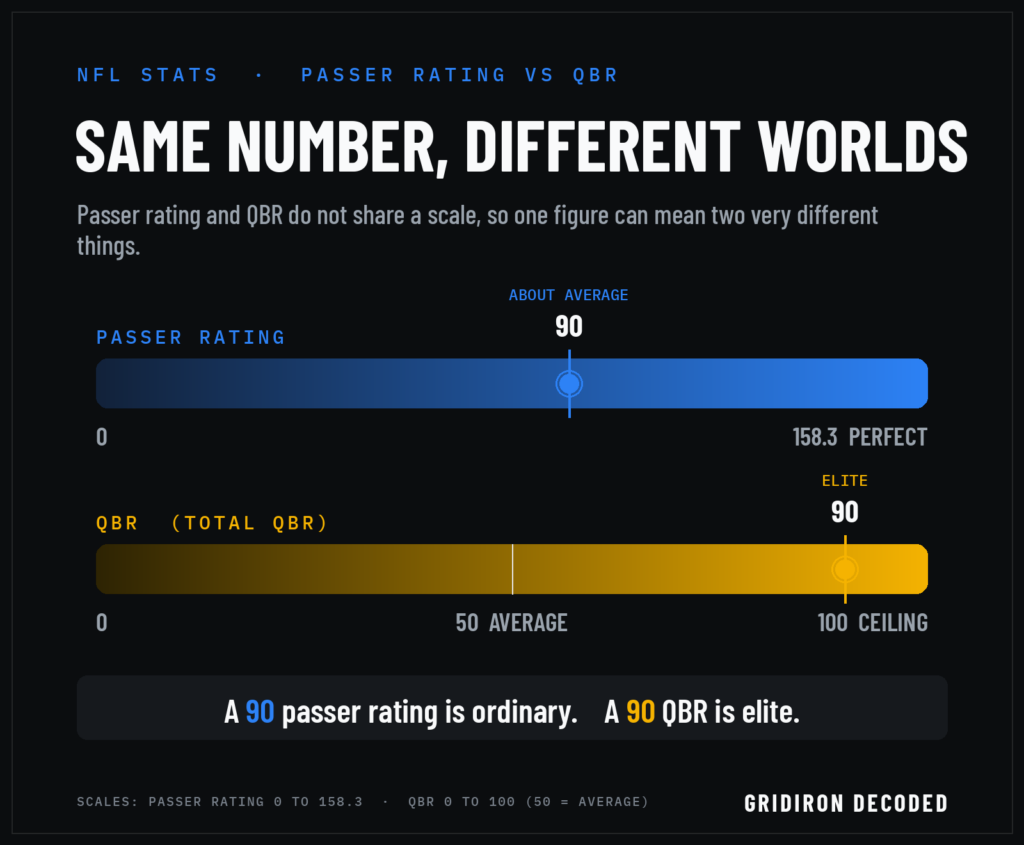
It runs on a 0 to 100 scale, which is much easier to understand, where 50 is roughly average and 100 is the ceiling.
Its headline strength is that it finally puts running quarterbacks on the same footing as pocket passers, because their legs actually count towards the score.
But QBR is trying to do something much bigger, and that is to answer a more complex question beyond his throws.
How much did this quarterback help his team win
Here is the same idea as a table, which is the fastest way to see the gap:
What it counts
Passer rating
QBR (Total QBR)
Passing (completions, yards, TDs, INTs)
Yes
Yes
The quarterback’s own rushing
No
Yes
Sacks taken
No
Yes
Game situation (down, distance, score)
No
Yes
Strength of opponent
No
Yes
Formula made public
Yes
No
Scale
0 to 158.3
0 to 100
Why do Passer rating and QBR disagree
These numbers are not even on the same scale, so a “90” means completely different things depending on which stat you are reading.
Because they are not measuring the same thing, they will often rate the same game very differently. That is not a glitch. That is the whole point.
Take a simple check-down pass, a short throw to a running back who then breaks three tackles and runs 75 yards for a touchdown. Passer rating credits the quarterback with a 75-yard touchdown pass. QBR tries to give him credit only for the safe short throw, and hands the rest to the runner.
Now flip it. QBR does not hand out bonus points for “clutch” moments. What it does instead is discount blowout garbage time, counting those plays as little as a quarter. So a quarterback who piles up numbers after the game is already decided gets less credit for them than his box score suggests, which can pull his QBR below a passer rating that counted every one of those yards the same.
Neither result is wrong. One number rewards the box score, the other rewards the impact on winning.
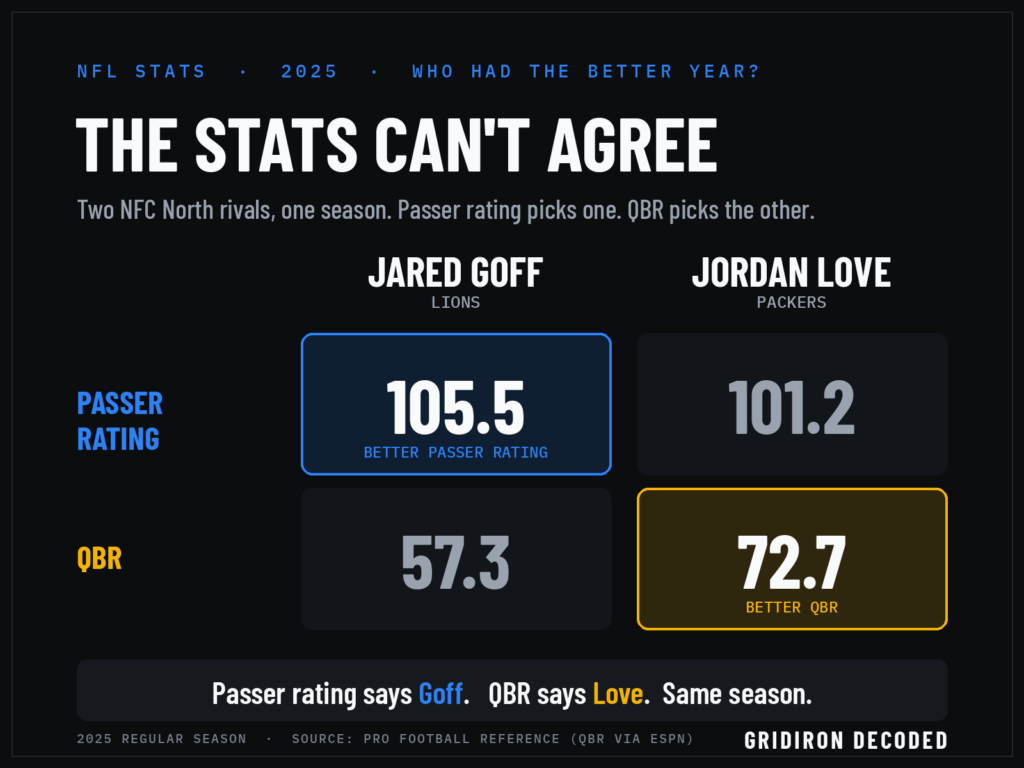
In 2025, passer rating and QBR could not agree on which NFC North rival had the better year. Passer rating rated Jared Goff above Jordan Love; QBR flipped it. Goff’s spotless efficiency won the passing score, while Love’s edge in sacks avoided, running and game situation won the QBR.
The takeaway: when passer rating and QBR clash, they are answering two different questions about the same afternoon.
Can QBR be trusted
This is where QBR gets genuinely controversial, and the criticism is fair to air.
It has produced some odd outliers over the years, the kind of single-game results that make people roll their eyes and reach for the “ESPN made this up” line.
One thing worth correcting, though, because it comes up a lot. The old theory that QBR was secretly built to flatter Tim Tebow does not hold. In 2011, his one full season as a starter, he finished with a QBR of 27.2, third-worst among the 34 qualifying quarterbacks. A stat designed to make him look good did a poor job of it.
Passer rating is transparent but crude. QBR is sophisticated but a closed box. Both have real flaws.
When should you use passer rating vs QBR
You do not have to pick a side. You just have to use the right tool for the question.
Reach for passer rating when you want a fast, like-for-like read, especially comparing quarterbacks across seasons or whole careers, where a public, unchanging formula is a genuine strength.
Reach for QBR when you want the whole game in one number, running included, and you care more about impact on winning than about the raw passing line.
And trust neither on its own. The people who read the game best look at several numbers at once, including ones like adjusted net yards per attempt, which folds in sacks and interceptions that passer rating ignores.
These two stats are not rivals to be ranked, they are different lenses, and knowing which to look through is the actual skill.
So the next time you see the two numbers clash on the same quarterback, you will know neither one broke. They are simply answering different questions, and the gap between them is the information.
That is the habit I want to carry through any of the content I publish. First and foremost, understand what a number is actually saying before letting it decide anything.
Which matters even more with a rookie, where the early stats can mislead you completely.
Next time, I will put one of these numbers to work on Mendoza himself.