
Ken Stabler dropped the ball on purpose. Two Raiders team-mates, Pete Banaszak and Dave Casper, knocked it forward toward the goal line, and Casper fell on it in the end zone. Errol Mann’s extra point won the game 21-20.
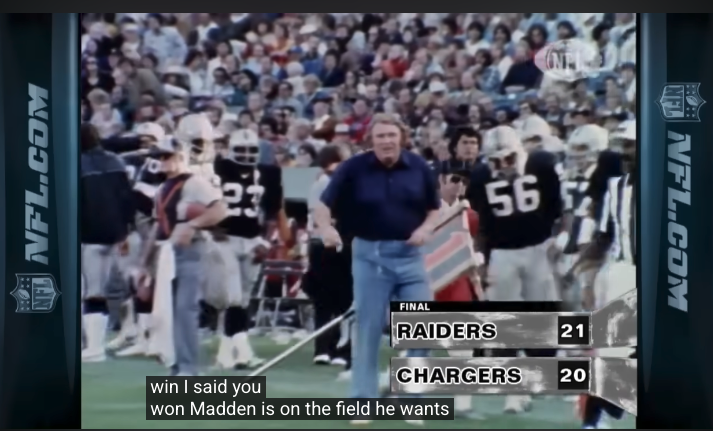
Image still is from the NFLs YouTube Channels, Top Controversial Plays: ‘The Holy Roller’
Then the NFL was so unimpressed it rewrote the rulebook that spring so nobody could ever do it again. That is the Holy Roller, a 1978 Raiders win the Chargers still call the Immaculate Deception, a bitter pun on the Immaculate Reception, the play that had knocked the Raiders out six years earlier. Same league, same era, opposite luck.
I’m telling you about it now because this Sunday the Las Vegas Raiders (my team, so I’ll keep myself honest about how they won this one) travel to the Los Angeles Chargers in Week 2, their first divisional game of the season. It is the same fixture as the Holy Roller, both clubs relocated since: in 1978 it was the Oakland Raiders at the San Diego Chargers. The Raiders go in 1-0 after a Week 1 win over Miami. Every tight finish this rivalry throws up now runs on the rule this one play created.
What happened in the final ten seconds
Ten seconds were left, the Raiders trailed 20-14, and they had the ball on the Chargers’ 14-yard line. Quarterback Ken Stabler, a left-hander known as “The Snake,” rolled to his right as the Chargers’ rush broke through, an awkward way for a left-handed passer to move, and with nothing on he threw the ball forward onto the turf. A fumble: a ball dropped rather than passed, which either team can grab.
What followed was not luck. Running back Pete Banaszak reached the ball, could not keep his feet, and shoved it forward again. Tight end (an attacking player who blocks and catches passes) Dave Casper got there next, batted and kicked it into the end zone, and fell on it for the touchdown as time expired. Errol Mann kicked the extra point, and the Raiders won 21-20.
Three Raiders touched the ball on its way to the goal line, and every touch moved it closer. That is the whole controversy in one sentence.
Watch it happen: the full enhanced video of the play is on YouTube, as is the radio call by the Raiders’ Bill King, which became one of the most famous in the sport.
The rule that was already in the book
Here is the part almost nobody mentions. The rules already had a line for this. A fumble sent forward on purpose was not meant to count as a fumble at all: ruled deliberate, it becomes a forward pass, not a loose ball.
That one distinction decides the game. A forward pass that hits the ground untouched is simply incomplete: the ball comes back, the down ends, and at zero on the clock the Chargers win 20-14. Ruled a fumble, the ball stays live and Casper’s recovery counts. So the officials were not staring at a hole in the rules. They were staring at a rule that turned on a single word: intent.
The rulebook had already imagined this exact trick. It just could not prove it in real time.
Why the referee let it stand
Referee Jerry Markbreit ruled it a legal play, and the league backed him. The reasoning was that the crew could not be sure the forward taps were deliberate, and without that certainty they could not upgrade the fumbles to illegal forward passes. In a live scramble, that is a defensible call.
The trouble is what the players said afterwards. Stabler was blunt about his own fumble: “I fumbled it on purpose.” His team-mates insisted their touches were real attempts to recover, and the doubt never lifted.
The call held not because the play was clean, but because intent is almost impossible to judge in the half-second you get to judge it.
The rule the Holy Roller created
The NFL does not usually rewrite its book over one game. It did over this one. After the 1978 season the league added a rule, now Rule 8, Section 7 of the rulebook, restricting who can advance a fumble.
As it stands today:
On fourth down, or after the two-minute warning in either half, only the player who fumbled may recover and advance the ball for his team.
If a team-mate recovers it in those situations, the ball is dead. It goes back to the spot of the fumble if it travelled forward. The two-minute warning, for anyone new to it, is the automatic clock stoppage two minutes before the end of each half.
Run the Holy Roller under that rule and it dies on contact. Banaszak touches the ball, and because he is not the man who fumbled, the play is dead and the ball goes back to where Stabler lost it. No forward crawl, no Casper touchdown, no win. The loophole was not clarified. It was shut.
Why it matters when the Raiders visit the Chargers on Sunday
The reason this is the play to start with is that the fixture is live again, and the rivalry has a long memory. These two have met well over a hundred times, and rivalries like this one don’t fade.
Watch the late-game fumbles this Sunday. Any loose ball in the final two minutes now gets whistled dead the instant a team-mate of the fumbler touches it, and the ball trots back upfield while newcomers wonder why the recovery did not count. That is not officials being fussy. That is a 1978 Raiders trick, written into law and still enforced 48 years later.
You now know something most people watching the game do not: the fumble rule they are half-ignoring exists to stop the Raiders doing this to the Chargers a second time.
This is the first of three plays so notorious the NFL changed its book because of them. The Raiders turn up in all three, which tells you something about the Raiders.
Leave a Reply