
This is the first of five posts in the run-up to Super Bowl LXI, each one taking a single famous play apart to see what actually made it work.
The story everyone tells about the greatest drive in Super Bowl history starts before the drive did. With just over three minutes left in Super Bowl XXIII, trailing by three and pinned 92 yards from the end zone, Joe Montana looked into the crowd and pointed out a film star to a nervous teammate. Then he went and won the game.
This is the drive that showed us what a quarterback is supposed to do in the last four minutes, so it’s the right place to start a series on the plays that decided Super Bowls.
What happened at Super Bowl XXIII?
On 22 January 1989 at Joe Robbie Stadium in Miami, the San Francisco 49ers drove 92 yards in 11 plays and scored the winning touchdown with 34 seconds left. They won it with a 10-yard pass from Joe Montana to John Taylor. The 49ers beat the Cincinnati Bengals 20-16.
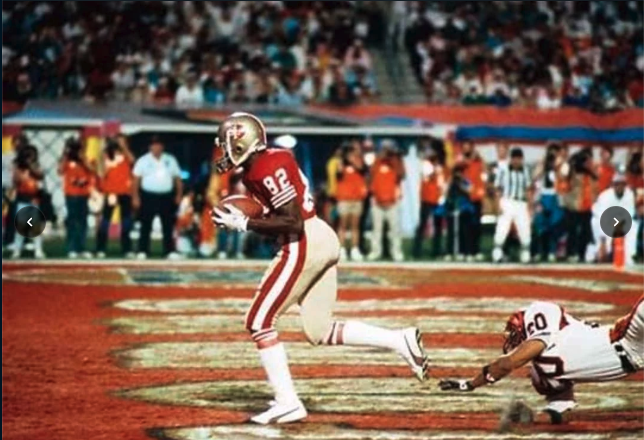
Image: John Taylor catches the game-winning 10-yard touchdown pass from Joe Montana with 34 seconds remaining in Super Bowl XXIII on January 22, 1989. Source: Cursed Images: Bengals Edition.
Decoded Takeaway: one drive, 92 yards, and the Super Bowl changed hands with half a minute on the clock.
How the scoring went
| Qtr | Team | Scoring play | CIN | SFO |
|---|---|---|---|---|
| Q1 | 49ers | Mike Cofer 41 yard field goal | 0 | 3 |
| Q2 | Bengals | Jim Breech 34 yard field goal | 3 | 3 |
| Q3 | Bengals | Jim Breech 43 yard field goal | 6 | 3 |
| Q3 | 49ers | Mike Cofer 32 yard field goal | 6 | 6 |
| Q3 | Bengals | Stanford Jennings 93 yard kickoff return (Jim Breech kick) | 13 | 6 |
| Q4 | 49ers | Jerry Rice 14 yard pass from Joe Montana (Mike Cofer kick) | 13 | 13 |
| Q4 | Bengals | Jim Breech 40 yard field goal | 16 | 13 |
| Q4 | 49ers | John Taylor 10 yard pass from Joe Montana (Mike Cofer kick) | 16 | 20 |
The situation: three points down, almost the length of the field to go
Cincinnati had just kicked a 40-yard field goal to lead 16-13 with 3:20 left. A penalty on the kickoff return backed San Francisco up, so they started the drive on their own 8-yard line with 3:10 on the clock.
To win, they had to cross almost the entire 100-yard field, score a touchdown (worth six points, plus the near-automatic extra kick, so seven in total, which you can read about on our scoring page), and do it before the clock ran out.
A field goal, worth three, would only have tied it. They needed the touchdown.
What makes the spot so hard is not just the distance. It’s that the defence knows you have to pass to cover ground quickly, and the clock is working against you as much as they are. Every throw that lands in the field of play keeps the clock running.
Decoded Takeaway: 92 yards, three points down, and only a touchdown would do, which is close to the worst spot a team can be in and still win.
The John Candy moment
Before the drive, Montana did something that has become part of NFL folklore. He looked up into the stands and said to his tackle, Harris Barton, “Isn’t that John Candy?”, nodding at the actor in the crowd.
Barton was the team’s self-confessed celebrity-spotter, and he had wound himself tight with nerves as the game slipped away. Montana knew exactly which button to press, pointed out Candy, and watched Barton relax. It worked. The huddle loosened, and then they went to work.
It’s a small thing, but it’s the reason the drive carries the weight it does. The quarterback who is about to march 92 yards for the title is calm enough to people-watch. That composure is the whole story.
Decoded Takeaway: the defining image of the drive happened before a single ball was snapped.
The drive, decoded: eight completions out of nine
Once it started, Montana was almost perfect. He completed eight of nine passes on the drive, moving the ball in chunks rather than gambling on one big throw.
The method matters, because it’s the opposite of panic. A team 92 yards out with the clock running feels like it should heave the ball deep. Montana did the reverse: short and intermediate passes, most of them to Jerry Rice and running back Roger Craig, taking the yards the Bengals gave him and getting out of bounds or back to the line fast to save the clock.
Rice was the engine. He finished the game with 11 catches for 215 yards, a Super Bowl receiving record at the time, and his 27-yard catch on the drive was the single biggest gain, pushing San Francisco into scoring range. He was named the game’s Most Valuable Player, the award we unpack on our Super Bowl MVP post.
Team stats: Bengals and 49ers
| Stat | Bengals | 49ers |
|---|---|---|
| First downs | 13 | 23 |
| Rushing | 28-106-0 | 28-111-0 |
| Passing | 11-25-144-0-1 | 23-36-357-2-0 |
| Sacked | 5-21 | 3-16 |
| Net pass yds | 123 | 341 |
| Total yds | 229 | 452 |
| Fumbles | 1-0 | 4-2 |
| Turnovers | 1 | 2 |
| Penalties | 7-65 | 4-32 |
| Time of poss. | 32:43 | 27:17 |
The one incompletion was deliberate. With the crowd so loud his teammates couldn’t hear the signals, Montana threw a ball away out of bounds to reset and calm the huddle. Even the mistake was on purpose.
Decoded Takeaway: the drive was built on control, not heroics, which is exactly why coaches still teach it.
The winning play: why it went to Taylor, not Rice
Here’s the part that rewards a closer look. The winning touchdown did not go to Jerry Rice, the best receiver on the field and the man Cincinnati was most afraid of. It went to John Taylor, who hadn’t caught a single pass all game.
That was the design, not an accident. The call was a play named “X up,” which head coach Bill Walsh had installed three days before the game. The idea was simple and ruthless: flood the left side of the field to pull the defence that way, then send one receiver back across to the open middle.
Taylor, lined up on the left in a tight formation, was that one receiver. As Rice went in motion to the left, a Bengals safety followed him across, and Taylor released clean and cut back on a skinny post into the space everyone else had vacated. Montana hit him for the 10-yard score with 34 seconds left.
On the drive, Montana’s throws had gone almost entirely to Rice and Craig, three completions each, so the Bengals were braced for both. The winning play used that fear against them. The star receiver does not have to touch the ball to win you the game.
He just has to occupy the people who would otherwise stop the player who does. If you want the fuller picture of how an offence is built to do this, our offence explainer is the place to go, and the thinking behind calls like this one sits on our coaches and play-calling page.
Takeaway: the decisive play worked because the man who scored was the man the defence had forgotten about.
Was it really the switch?
Mostly, yes, but the drive needed one break to survive. The 27-yard catch to Jerry Rice that set up the winning score came after the Bengals cornerback covering him, Lewis Billups, missed the tackle. Make that tackle short of the marker, and San Francisco is further out with less time, and the whole shape of the finish changes.
That’s the fair version of events. The drive was extraordinary and it still needed a Bengals defender to come up a yard short at the wrong moment. Both things are true, and the second doesn’t shrink the first.
Takeaway: it was the drive that won it, helped by a missed tackle that kept it alive.
Why the fans still talk about it
The debate around this one isn’t about a controversial call, which sets it apart from some other famous moments. The three live arguments are these.
- Was this the single greatest clutch quarterbacking performance in Super Bowl history?
- Did it, more than any one throw, cement Montana as the best there has been?
- And how much credit belongs to head coach Bill Walsh, whose system made a drive like this repeatable rather than a one-off?
There’s no settled answer, and that’s the point of starting here. Before the plays built on luck, improvisation or a coach’s nerve, this is the one built on sheer control.
If you want the games this series doesn’t cover, the plays so contentious the NFL rewrote its rulebook, I’ve written a separate trilogy on those: the Immaculate Reception, the Holy Roller and the Tuck Rule Game.
Next in the series: The play that rewrote a legacy. John Elway, 37 years old, leaving his feet on a third-down scramble and getting spun like a helicopter.