
Tom Brady lost the ball, the Raiders recovered it, and the Patriots’ season should have ended there. Referee Walt Coleman went to the replay screen and came back with an incomplete pass, because of a rule so obscure most people watching had never heard of it. The Patriots won in overtime, went on to their first Super Bowl, and eleven years later the NFL scrapped the rule entirely by a vote of 29-1.
This is the third of three plays so contentious the league rewrote its book. The Raiders are in all of them: beaten by the Immaculate Reception in 1972, winners by the Holy Roller in 1978, and on the wrong end here.
What happened in the snow at Foxboro
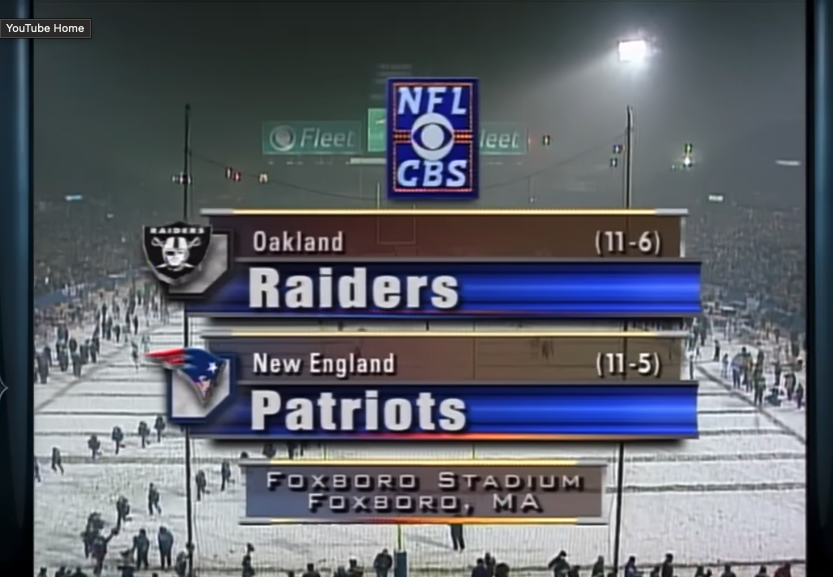
Image still is from the NFLs YouTube Channels, Raiders vs. Patriots: ‘Tuck Rule’ Game | NFL 2001 Divisional Round Highlight
It was 19 January 2002, an AFC divisional playoff game at Foxboro Stadium, played through heavy snow. The Raiders led the New England Patriots 13-10 in the fourth quarter.
With under two minutes left, Raiders cornerback Charles Woodson blitzed from Brady’s right and hit him as he brought the ball down. The ball came loose. Raiders linebacker Greg Biekert recovered it, which, with the Raiders ahead and the clock running down, would have effectively ended the game.
Coleman reviewed the play and overturned the call. Not a fumble, an incomplete pass. New England kept the ball.
Adam Vinatieri kicked a 45-yard field goal through the snow with 27 seconds left to tie it, then a 23-yarder in overtime to win it 16-13. Two games later the Patriots won Super Bowl XXXVI.
What the tuck rule actually said
The rule was Rule 3, Section 22, Article 2, Note 2, and it had been in the book since 1999. In plain terms: once a quarterback starts moving his arm forward to throw, it counts as a forward pass even if he loses the ball while pulling it back into his body. Only once the ball is fully tucked against him does dropping it become a fumble.
That is the whole thing. It sounds like a technicality because it is one. A quarterback who has visibly given up on throwing, and is bringing the ball back to his chest, is still legally “passing” until the tuck is complete.
So Brady dropping the ball mid-tuck was, by the letter of the rule, an incomplete pass rather than a fumble.
Why the call was defensible and infuriating at once
Coleman applied the rule as written. That is the uncomfortable part for anyone wanting a villain: the ruling followed the text.
The Raiders never accepted it. Woodson has maintained for years that it was a fumble and the call was wrong. Bruce Allen, then running the Raiders’ front office, put the objection more precisely: he said the rule itself did not bother him, but that as the rule was written, it was a fumble.
Coleman later said the reversal was right and it was his on-field explanation that had been muddled. The NFL backed the call, and its competition committee reviewed the rule after that season and left it alone.
What made it burn was not a rogue referee. It was a rule almost nobody agreed with, enforced correctly at the worst possible moment.
The eleven-year wait
The rule survived far longer than the outrage suggests. It kept surfacing, roughly a dozen times a season by the league’s own account, including a Chiefs-Ravens playoff game in January 2011 where a Matt Cassel fumble was reversed to an incomplete pass on review. Mike Pereira, the NFL’s former head of officiating, publicly withdrew his support after that one.
Then on 20 March 2013, at the annual meeting in Phoenix, the owners voted 29-1 to strike it out. Pittsburgh cast the only vote to keep it. New England abstained, as did Washington, whose general manager was that same Bruce Allen, by then citing a tribute to the late Raiders owner Al Davis.
Patriots owner Robert Kraft, asked about it afterwards, said he loved the tuck rule and always would, and that Al Davis was probably smiling. Today, a quarterback who loses the ball while tucking it has fumbled, full stop.
What the three plays add up to
Put the series side by side and a pattern shows. In 1972 the rule was too strict, and the NFL repealed the double-touch restriction six years later. In 1978 the rule was too loose, and the league closed the fumble loophole within months. In 2002 the rule was simply bad, and it took until 2013 to go.
The rulebook is not handed down finished. It gets rewritten by the plays that break it, usually years after everyone has agreed it should be.
Watch a quarterback lose the ball mid-motion this season. It is a fumble, no debate, no replay booth searching for an arm angle. That clean answer cost the Raiders a playoff game and took the league eleven years to arrive at.
Leave a Reply